


The Zhitong Finance App learned that TS Lombard recently issued a warning in a report, saying that the artificial intelligence (AI) investment boom still faces multiple hidden dangers: continued weakening of capital expenditure support, falling short of expectations, and a tightening credit environment. These factors can easily impact the market.
The research institute said that it is currently unclear when the reversal occurred and what factors triggered it, and pointed out that recent market turmoil may either mark the beginning of a reversal or calm down after a short period of fermentation.
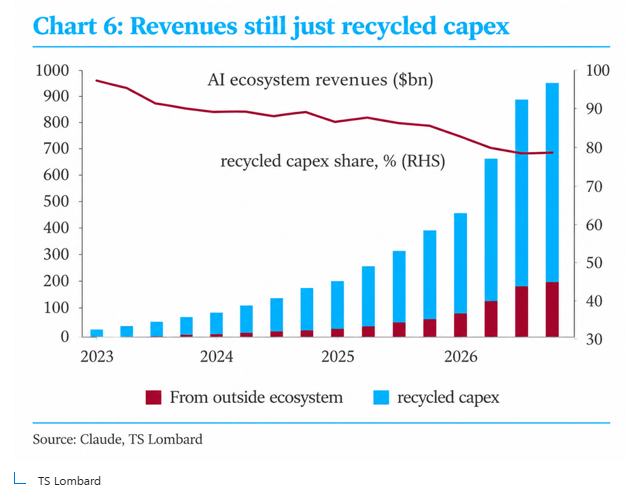
According to the report, US technology companies invest about 1 trillion US dollars in AI infrastructure every year, but most of the AI-related revenue growth still comes from internal recycling expenses in the industry, rather than payments from consumers and companies outside the ecosystem.
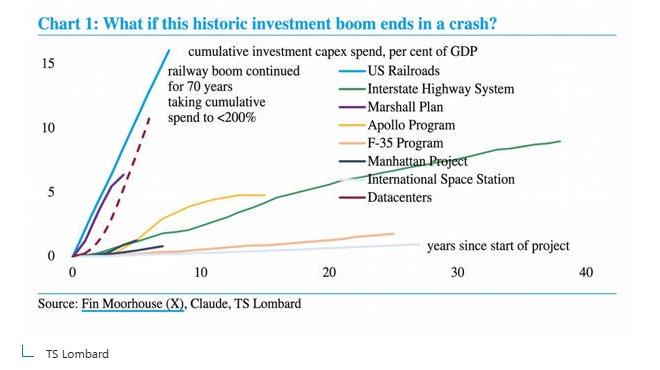
AI revenue needs to cross the $3 trillion mark
TS Lombard quoted estimates that by 2030, AI companies will need to achieve annual revenue of 2.5 trillion to 3 trillion US dollars to provide reasonable support for their investments, which is about 14 times the current revenue. The report questions whether companies can achieve this scale of growth within a set time frame, especially given that consumers have always been unwilling to pay for AI services, while China's big open source model is seizing market share.
The report also points out that about 80% of OpenAI and Anthropic's revenue comes from only 1% of customers, and most of these customers are AI startups that are not yet profitable and are highly dependent on continuous venture capital transfusions.
The report said that although related revenue continues to grow, the share of revenue from outside the AI ecosystem has hardly changed since June. As a result, a slowdown in capital expenditure may weaken the revenue of companies whose businesses depend on such investments.
The share of debt in AI construction is increasing
The financing structure has also changed, and debt is becoming a more important source of funding as technology companies scale up their infrastructure. According to estimates quoted in the report, AI companies are expected to issue about $700 billion in new bonds in 2027, of which $400 billion will come from large cloud companies and the rest from the broader AI ecosystem.
The report cites estimates that the hidden debt of the entire ecosystem has reached 1.5 trillion to 2 trillion US dollars, partly formed through arrangements such as private equity credit and investment instruments. The report also points out the risk of rising financing costs and mentions that some new cloud vendors, including CoreWeave (CRWV.US), are already paying interest rates of about 15%.
TS Lombard warned that once the financing environment is tightened, weak companies and projects will be the first to be exposed to risks, especially those that rely on continuous financing to meet contract payment obligations. The report also suggests two major concerns: financial reporting pressure brought about by depreciation of newly built data centers, and a wave of AI companies' listing may create a window for internal shareholders to reduce their holdings and exit.
Chip demand may shift from scarcity to excess
TS Lombard also believes that Nvidia (NVDA.US) has become a weather vane for the AI boom, and if this chip maker's performance falls short of expectations, the entire ecosystem will become vulnerable. The report also raised concerns about the supplier financing model, that is, companies provide loans to customers, and customers then use this money to purchase their products.
Such operations may exaggerate book demand, and the inherent cyclicality of the semiconductor industry makes it vulnerable to abrupt changes in procurement models. According to the report, many AI companies have repeatedly placed orders to lock in scarce hardware. As long as demand slows down slightly, the chip shortage pattern will quickly change to oversupply.
Regulatory and security risks, too, cannot be ignored. The report cites a survey. About 55% of Americans want to slow down the pace of AI development, and only 13% oppose slowing down. Once a major AI security incident occurs, or policies shift to tightening the technology industry, the pressure on the entire sector will increase further.