


The Zhitong Finance App learned that emerging biotech companies (i.e. Biotech), which have the potential to prolong human life expectancy and even cure cancer, are under the double pressure of “slow R&D implementation and surging financing costs,” and global investors are beginning to be cautious about biotech stocks. The rapid rise in US Treasury yields has weakened the appeal of such stocks; these companies are often viewed as extremely risky investments that bet on breakthrough treatments where the ultimate outcome of an innovative treatment may not win or lose (that is, All-or-Nothing).
Statistics show that the Nasdaq Biotech Index has fallen 3.8% since its high on August 19. The yield on US 10-year Treasury bonds jumped nearly 0.5 percentage points during the same period, and once hit 5.34%, the highest level since 2002. The index tracks nearly 250 biotech companies, and the cumulative increase is still about 25% this year, but recent pullbacks suggest that soaring yields are making stock investors uneasy.
US bond yields surged and raised the return threshold, and the medical breakthrough process faced a major financial test
Biotech stocks are particularly sensitive to rising interest rates, and more so in terms of risk appetite. These stocks are often viewed as lottery-like investments: they can bring huge returns or end up being almost worthless. Today, even the safest bonds can yield better returns, and investors' demand for high-risk segments of the stock market is beginning to wane.
William Soliman, founder and chief investment officer of White Manna Capital, said: “The investment appeal of early-stage biotech companies is more challenging because investors now have risk-free alternatives with significantly higher returns.”
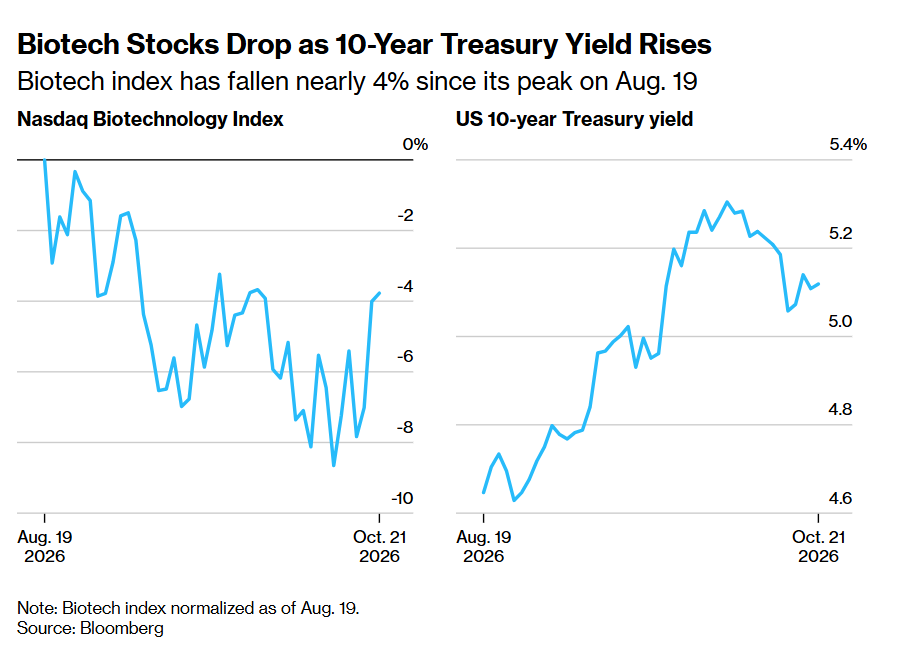
As shown in the chart above, biotech stocks generally fell sharply as 10-year US Treasury yields rose across the board — the biotech index fell nearly 4% since its high on August 19. Note: The biotechnology index is standardized based on August 19.
Driven by soaring energy prices and massive corporate borrowing for the AI business, US Treasury yields have risen rapidly this year. The 10-year Treasury yield rose rapidly above 5%, highlighting investors' stubborn concerns about continued inflation, even as the Federal Reserve promised to suppress price pressure.
This makes already cash-strapped biotech companies face a more complex environment. According to data compiled by Bloomberg, less than a quarter of the companies in the NASDAQ Biotech Index have achieved profits in the past year, and about half of the companies have insufficient cash to cover six months of daily expenses.
Soliman added that in an environment with higher interest rates, biotech investors will demand higher returns to cover the clinical, regulatory and financing risks involved in a company that may take years to generate revenue.
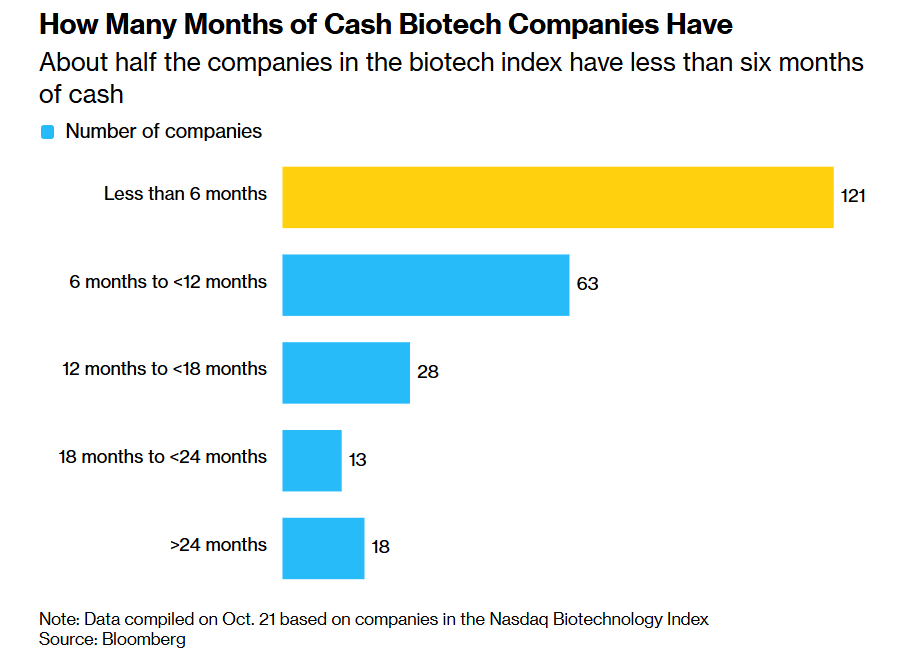
The picture above shows “How many more months can biotech companies' cash support” compiled by the agency — the cash of about half of the companies in the biotech index is not even enough to support about six months. Note: The data was compiled on October 21 and is based on the NASDAQ Biotech Index component companies.
Despite this, Gabelli's portfolio manager Elena Meng and other institutional investors who have long been optimistic about the biotech sector are still strongly optimistic about the biotech sector for a long time.
“We have always placed great emphasis on valuation when investing in biotech, so changes in interest rates will not fundamentally change the way we invest,” she said.
There was no shortage of highlights in this year's section. Positive trial data released by Modena and MSD raised market expectations for treating the most deadly skin cancer, driving Modena's stock price to rise by more than 700% so far in 2026 after four consecutive years of decline. Revolution Medicines, an oral medicine that can prolong the lives of advanced pancreatic cancer patients, was approved in the US, driving its stock price to rise more than 140% this year.
Meng said that although rising interest rates will affect biotech companies' capital costs, cash support periods, and financing risks, Gabelli's investment evaluation process has taken these factors into account.
From breakthroughs in the fight against cancer to cessation of research and sales: it's not just scientific progress bars that determine fate
Analysts in the Royal Bank of Canada capital market are also optimistic about biotech stocks. It is expected that if the AI computing power trading theme cools down completely, the sector will benefit from an accelerated rotation of capital from technology stocks.
However, Baird healthcare industry expert Mike Perrone said that since sector performance is closely related to clinical trial results, once negative news comes out of several large companies, it will weaken investors' enthusiasm for these stocks.
Signs of stress are already showing. Caribou Biosciences, which focuses on genome editing, said earlier this month that it plans to stop two treatment projects and explore strategic options, including potential mergers or acquisitions. The company also plans to lay off workers and cut costs, and its stock price has dropped by more than 60% this year.
Caribou CEO Rachel Horwitz said that many investors “are no longer prioritizing new investments in this area at all as numerous trading opportunities are emerging in other exciting areas.”
Perrone said that the current interest rate environment will make it difficult for biotech stocks to attract investors who do not focus on this field but allocate capital across industries. Concerns about rising interest rates have prompted Wall Street investors to withdraw from equity funds and switch to safe-haven assets. Although major US stock indexes hit new highs earlier this month, some believe this resilience is concentrated in just a few dozen stocks.
Perrone said, “This will hinder the return of integrated investors because they place more importance on macro factors when deciding when to rotate into the biotech sector. A clear negative factor such as rising interest rates will make them more hesitant.”
The term “all-or-nothing” usually describes valuations that are highly dependent on the success or failure of a few key projects, and are not a common characteristic of all biotech companies.
“All-or-nothing” biotechnology leaders usually focus on innovative cancer treatment fields: for example, Modena and MSD have developed individualized Neoantigen Therapy (Individualized Neoantigen Therapy), which uses messenger RNA (mRNA) to help the immune system recognize tumors, and the combination therapy has achieved positive phase III results; Revolution Medicines' RAS inhibitors are small-molecule targeted therapy (Targeted Therapy). Pancreatic cancer drugs have been approved in the US. The two reflect the revaluation of value brought about by clinical validation and commercialization access, respectively.
Needless to say, for these companies, continued high interest rates will increase the risk of financing failure, research stoppage, and asset sale. The Cash Runway (Cash Runway) is less than six months, which means that financing is urgent, but this does not mean that it will inevitably go out of business within six months. Businesses can continue to operate through budget cuts, licensing, additional issuance, or mergers and acquisitions, but existing shareholders may bear significant dilutions. On October 6, Caribou announced the cessation of the development of two allogeneic CAR-T cell therapies, layoffs, and sought strategic deals. It clearly mentioned financing difficulties, and has yet to declare bankruptcy. Between significant scientific potential and shareholder returns, it can be said that there is still a gap between whether enterprises can raise funds to complete R&D.