


- Ingram Micro Holding recently received a U.S. patent for its Vendor and Customer Agnostic Framework that underpins the Xvantage AI platform, aiming to standardize connections across catalogs, quotes, orders and financial processes without costly custom integrations.
- The patented framework automates how partner data and business rules are configured, which could cut onboarding time and operating complexity across Ingram Micro Holding’s global technology ecosystem.
- We will now look at how Ingram Micro Holding’s investment narrative could shift as this patented Xvantage framework scales partner connectivity.
Ingram Micro Holding Investment Narrative Recap
To own Ingram Micro Holding, you need to believe the business can turn its AI centric platforms into higher quality earnings while managing working capital and debt tightly. The new Xvantage patent fits that belief because it targets automation and lower cost to serve, which ties directly into the margin and efficiency story investors already watch.
The near term catalyst still sits in how effectively Ingram Micro Holding converts AI infrastructure demand and Xvantage adoption into mix that is not dominated by low margin GPU, server and storage deals. The biggest risk remains operational. Elevated working capital needs and debt coverage by operating cash flow leave less room for a stumble if sell through slows.
The freshly issued U.S. patent for the Vendor and Customer Agnostic Framework is the announcement that matters most for this story. It speaks directly to one of the key bullish arguments, that global Xvantage penetration and automation can structurally lower cost to serve and support operating margin improvement as volumes build.
VCAF touches many of the pressure points analysts already flag. By standardizing connections for catalogs, quotes, orders, billing and payments on both vendor and solution provider sides, it aims to simplify complex, low margin hardware flows and support scaled services. That could influence whether AI related demand, SMB momentum and cloud workloads show up as better mix or stay constrained by integration friction and elevated operating overhead.
What The Xvantage Patent Means For The Current Analyst Story
The patent around Ingram Micro Holding's Xvantage framework plugs directly into the analyst models that already assume only modest revenue expansion and measured earnings progress. With vendors and partners wired into a single rules based architecture for orders, billing and payments, each new connection can lean more on software configuration and less on custom integration projects. That is exactly the kind of repeatable plumbing analysts often assume when they underwrite small, compounding efficiency gains rather than big, binary product bets.
Investors tracking Ingram Micro Holding tend to focus on how much of the AI infrastructure wave turns into recurring, higher margin activity rather than just more throughput of low margin hardware. The VCAF patent sits in the background of that question, because more standardized data flows across catalogs and quotes give the distributor clearer visibility into attach opportunities for services, software and financing. It also gives vendors a more consistent way to expose offers to thousands of partners without bespoke work every time, which can matter when they decide where to route volume and which platforms to prioritize.
There is a risk that readers treat any AI related patent as a silver bullet. This one is more mundane and that is part of its appeal. It formalizes how Xvantage handles multi party rules, which helps explain why analysts are comfortable underwriting gradual margin improvement rather than sharp step changes. The bigger story is not breakthrough algorithms. It is the potential to trim onboarding steps, reduce order errors and keep headcount growth below transaction growth as AI servers, storage and networking volumes move through the system.
That links back to the operational risk already highlighted around working capital and leverage. If VCAF and Xvantage together can process more quotes, orders and billing events per employee, the group has more room to support AI infrastructure demand without stretching the balance sheet as much. If execution disappoints and process automation falls short, elevated inventories and receivables could weigh heavier on free cash flow than current analyst scenarios imply.
Ingram Micro Holding's narrative projects US$61.4b revenue and US$678.6m earnings by 2029. This is built on analysts' assumption of 3.1% yearly revenue growth and an earnings increase of about US$248m from US$430.6m today.
Discover how Ingram Micro Holding's fair value indicates a 20% potential upside to its current price that could be realized sooner than many investors expect.
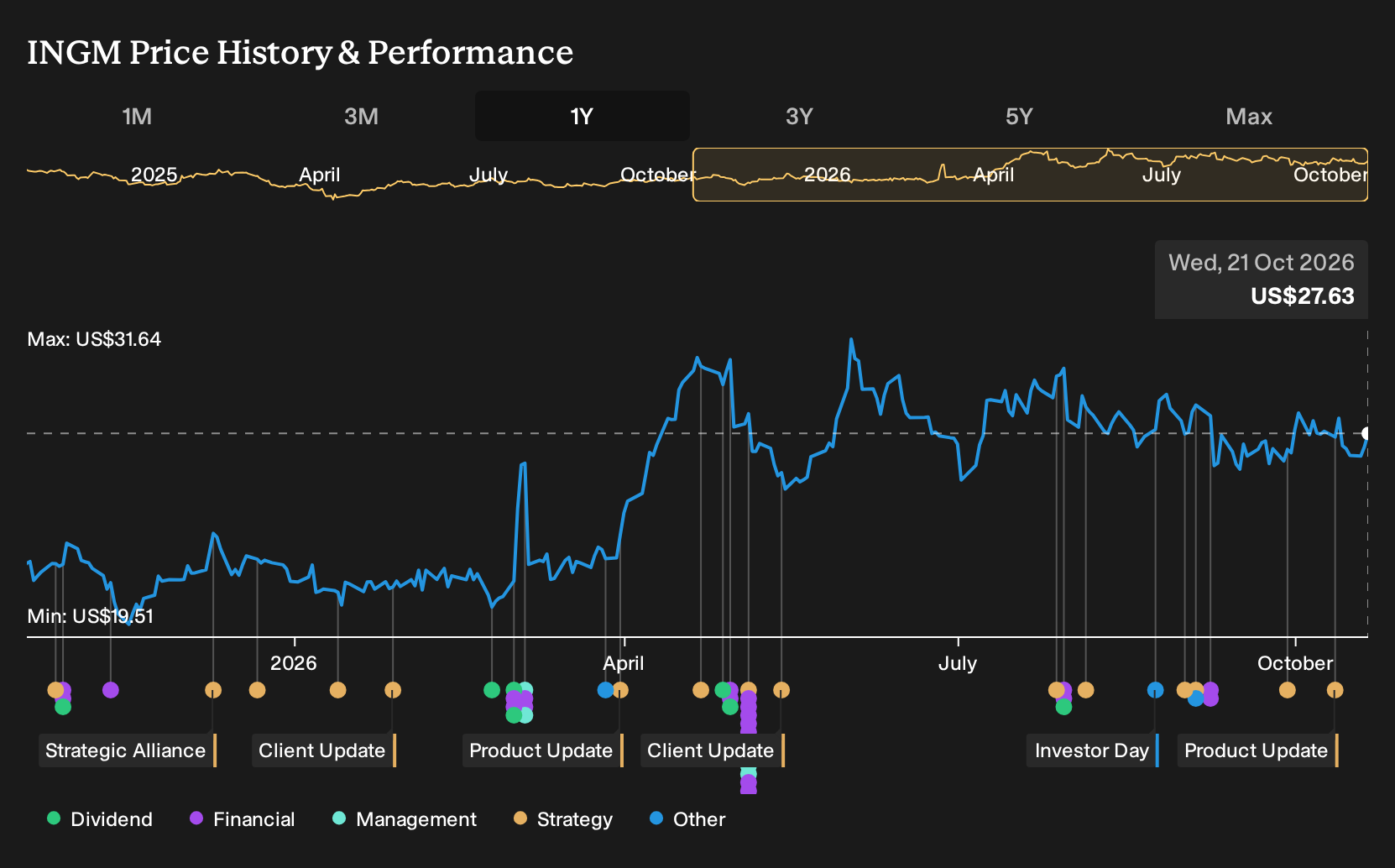
Exploring Other Perspectives
You can interpret this Xvantage patent in two ways. Bullish analysts view it as a potential accelerator for AI driven bundles, which aligns with their pre news forecast of 6.6% yearly revenue growth and US$849.9m earnings by 2029. Consensus estimates were closer to 3.1% and US$678.6m. You can use that gap to test your own view, as these narratives may shift when new information emerges.
Explore another Ingram Micro Holding fair value estimate, including one that suggests there may be as much as 20% upside from the current price.
Form Your Own Verdict
Don't just follow the ticker. Dig into the data and build a conviction that's truly your own.
- A great starting point for your Ingram Micro Holding research is our analysis highlighting 4 key rewards and 1 important warning sign that could impact your investment decision.
- See our latest analysis for Ingram Micro Holding. The report includes a comprehensive fundamental analysis summarized in a single visual, the Snowflake, making it easy to evaluate Ingram Micro Holding's overall financial health at a glance.
Looking for more investment ideas beyond Ingram Micro Holding?
If the Xvantage story has sharpened your view on how infrastructure and balance sheet discipline shape returns, you can use that framework to assess other opportunities through the Simply Wall St Screener.
- For investors who want potential mispricings with solid fundamentals, scan a curated 21 high quality undiscovered gems that might not be on every watchlist yet.
- If capital preservation and steadier profiles matter most to you, filter for 31 resilient stocks with low risk scores that score well on resilience and financial strength.
- Income focused readers can zero in on companies offering meaningful payouts by reviewing a focused 7 dividend fortresses that balance yield with underlying business quality.
Have feedback on this article? Concerned about the content? Get in touch with us directly. Alternatively, email editorial-team@simplywallst.com