


The Zhitong Finance App learned that due to huge capital expenditure and financing pressure in the artificial intelligence (AI) sector once again raised investors' concerns, compounded by rising geopolitical tension in the Middle East driving a sharp rise in international oil prices, global stock markets generally experienced a sell-off on Thursday, and safe-haven funds poured into US Treasury bonds, driving a significant decline in US bond yields — the yield on partial term US Treasury bonds fell sharply by up to 20 basis points, the biggest decline since August 2025.
But at the same time, gold, which is also a safe-haven asset, is not favored by capital. The price of gold stabilized near its lowest closing level in more than three months. Gold fell nearly 3% on the previous trading day, falling to its lowest level since July 20, and is currently hovering around $4,020 per ounce.
Gold and the stock market fell simultaneously during the same period, which deviated from the trend of US bonds. This combination of “risky assets and safe-haven assets falling sharply, and only cash assets and US bonds benefit in the long run” is a standard “fingerprint” for liquidity shocks. Safe haven assets are sold off during safe-haven times, and this divergence itself is the answer — this is a typical liquidity-driven selloff (liquidity-driven selloff) — the reason the market sells is not “gold is worthless,” but “I need cash.”
Global X ETFS analyst Justin Lin said that gold may have experienced a “liquidity-driven sell-off.” “This often happens when the market falls sharply, because gold is an important source for raising liquidity and meeting additional margin requirements and capital requirements,” he said. He also said that the price of gold is close to testing the critical level of 3,900 US dollars per ounce.
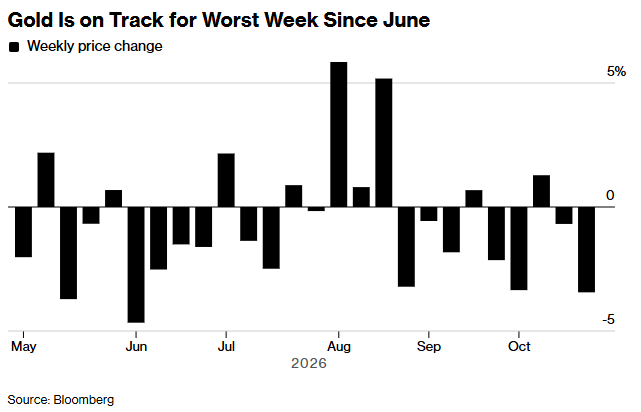
Gold may record its worst weekly performance since June
Despite this, the market's expectations for further interest rate hikes from the Federal Reserve have cooled down, which should provide some support for gold prices in the short term. Investors are increasingly concerned about the sustainability of AI investments, which are one of the main drivers of US economic growth. This prompted traders to lower their bets on another rate hike by the Federal Reserve. Currently, the market anticipates that the probability that the Federal Reserve will raise interest rates by 25 basis points at next week's meeting has dropped below 10%.
Justin Lin said that despite facing downward pressure in the short term, “gold is likely to experience a V-shaped recovery.” He added that falling interest rates, weakening AI trading momentum, and capital outflows from the US and driving the dollar lower will all benefit precious metals.
In the short term, three things determine the gains and losses of gold at the $4,000 mark: the US Federal Reserve's October interest rate meeting next week (focusing on the statement's guidance for December), upcoming PCE inflation data, and whether the situation in the Middle East will further boost oil prices. If inflation continues to stick and the December interest rate hike is implemented, the adjustment of gold prices may not be over; if the fall in oil prices causes expectations of interest rate hikes to cool down marginally, the price of gold is expected to stabilize first.
In the medium term, the nature of the current round of gold correction is closer to March 2020 than April 2013 — the former was the starting point of the gold bullish market after the liquidity shock, and the latter was the long-term inflection point caused by the reversal of monetary policy expectations. The criteria for distinguishing the two have always been clear: as long as the three structural trend lines of central bank purchases, diversification of reserves, and revaluation of sovereign debt continue, a liquidity-driven sell-off means more of a “forced change of hands” than an “end of logic.”
Wall Street banks are also cautious about gold in the short term, but they are still bullish in the medium to long term. For example, Goldman Sachs kept its target price of 5,400 US dollars unchanged at the end of 2027 for gold. The judgment is straightforward — austerity policies may slow the rise in gold prices, but they will not derail it. However, Goldman Sachs also warned of structural trading risks, saying that the price of gold is approaching the key execution price of some bullish options, and that the hedging behavior of traders may amplify fluctuations in both directions, and “the price of gold may experience a more drastic correction than usual.”
On October 12, UBS Wealth Management clearly presented a path map: the price of gold may test support around $4,000 again in the short term, and structural demand to buy on dips is expected to bottom here; as the market revises expectations of the Fed's interest rate hike, the price of gold is expected to regain momentum towards the end of the year and continue until 2027. The specific targets are $4,600 in December 2026, $5,000 in March 2027, $5200 in June, and $5400 in September. The supporting logic includes the central bank's structural demand of 750 to 1,000 tons of annual purchase capital, public debt concerns, expectations of a long-term weakening of the US dollar, and Chinese gold purchases. UBS specifically pointed out that the sensitivity of gold prices to real interest rates has declined, indicating that structural demand buffers are stronger than in previous cycles.
J.P. Morgan gave a bold estimate of 2029 or $6,000. The bank estimates that if only 0.5% of the US assets held by foreign investors were reallocated to gold, equivalent to an incremental demand of about 273.6 billion US dollars or 2,500 tons in four years (accounting for only 3% of total gold holdings), the price of gold may reach 6,000 US dollars by 2029 — its core argument is that the supply of gold is not elastic, and small changes in marginal demand are enough to drive large price fluctuations.