


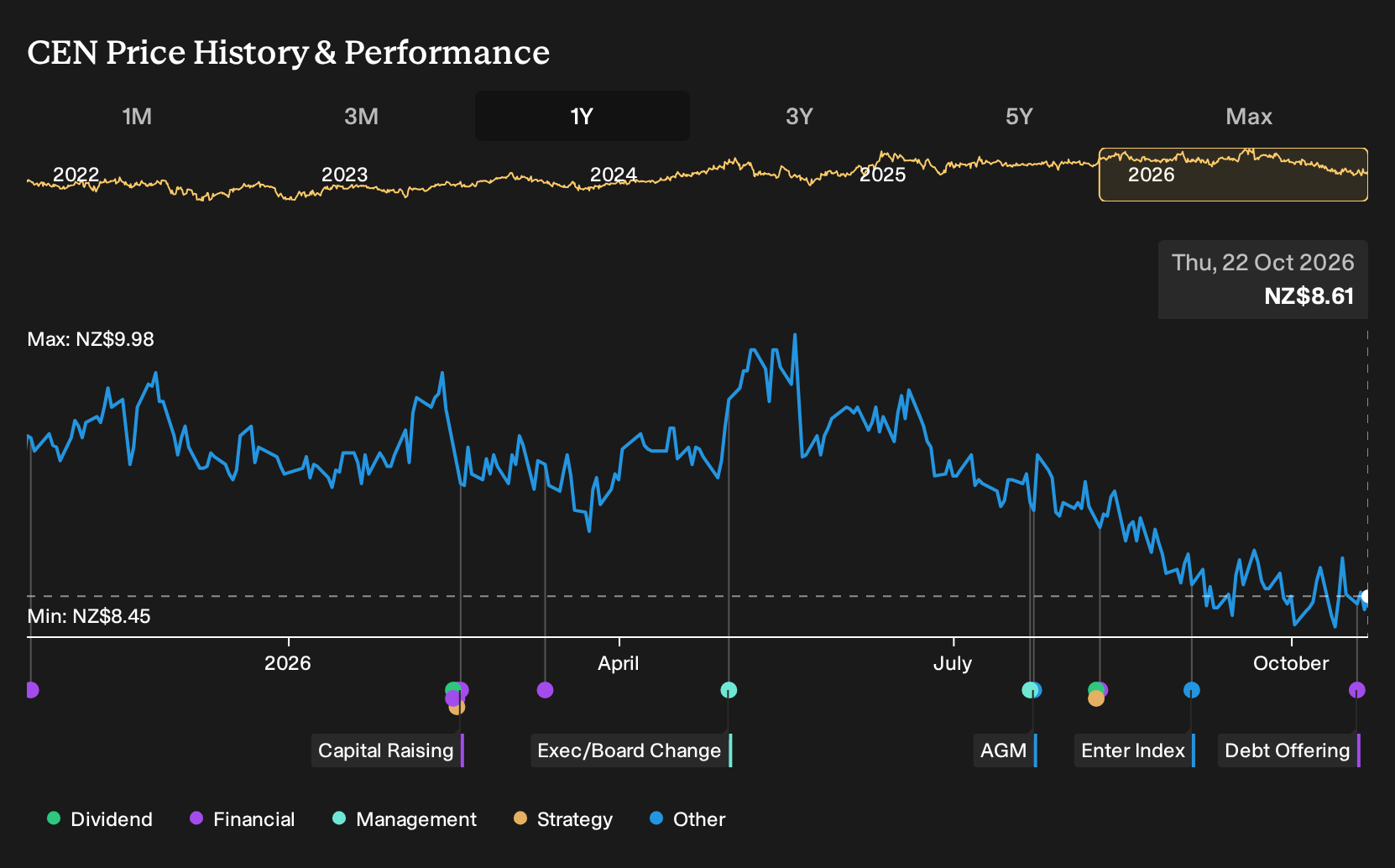
- Contact Energy has issued NZ$225 million of subordinated, unsecured green notes, a callable fixed income instrument labelled under climate bond criteria.
- The subordinated green structure signals Contact Energy’s intent to fund renewable projects while keeping bank lines and senior debt capacity available for other needs.
- We will now see how Contact Energy's subordinated green bond funding choice could reshape its investment narrative around future project delivery.
Scan beyond Contact Energy and explore how other utilities are funding their next phase of low carbon projects through our curated list of solid balance sheet and fundamentals (203 results).
Contact Energy Investment Narrative Recap
To own Contact Energy, you need to believe the business can keep turning its 98% renewable platform, large project pipeline and industrial contracts into steady earnings even when wholesale prices soften. The green subordinated notes do not change the core near term catalyst. That remains execution on Tauhara 2, batteries and solar so new assets arrive broadly on time and on budget.
The biggest current risk still sits with operational and funding discipline. A repeat of grid events or slower cash generation in a lower price market could bite, especially with high debt levels and a dividend that is not fully covered by earnings or free cash flow. The new notes modestly extend funding, but do not remove those pressures.
The NZ$225m subordinated, unsecured green notes are most relevant for how Contact Energy funds more than NZ$2.4b of committed renewable projects and its 11 TWh development pipeline. This instrument sits below senior lenders, so it can help preserve bank capacity for future build out, grid storage and potential acquisitions tied to industrial demand growth.
For you, the key link is between this capital structure choice and execution on the project list that underpins earnings expectations. Progress on Tauhara 2, Te Mihi 2, Glenbrook batteries and Glorit solar, combined with contracts with NZ Steel, Fonterra and others, still drives the medium term story. The green notes simply adjust how that plan is funded and where risk sits in the capital stack.
Contact Energy's current analyst storyline assumes revenue grows at 4.0% a year, reaching about NZ$3.6b of sales and NZ$442.2m of earnings by 2029, compared with earnings of NZ$420.0m today. This implies an earnings uplift of roughly NZ$22m over that period.
Uncover why Contact Energy's fair value indicates a 20% potential upside to its current price, which could narrow quickly if Contact Energy keeps executing on its project pipeline.
Exploring Other Perspectives
Three fair value estimates from the Simply Wall St Community span roughly NZ$10.35 to NZ$20.53 a share, so retail opinions on Contact Energy already cover more than a 2x range before factoring in the new subordinated green notes. When you also consider grid incident risk, wholesale price softness and project delivery milestones, there are plenty of reasons to compare multiple viewpoints before acting.
Explore 2 other Contact Energy fair value estimates, including one that suggests it could be worth just NZ$10.35!
Reach Your Own Conclusion
Disagree with existing narratives? Extraordinary investment returns rarely come from following the herd, so go with your instincts.
- A great starting point for your Contact Energy research is our analysis highlighting 3 key rewards and 2 important warning signs that could impact your investment decision.
- See our latest analysis for Contact Energy. The report includes a comprehensive fundamental analysis summarized in a single visual, the Snowflake, making it easy to evaluate Contact Energy's overall financial health at a glance.
Looking for more investment ideas beyond Contact Energy?
Once you have a view on Contact Energy, it often helps to benchmark that thesis against other companies with different balance sheets, dividends and risk profiles. The Simply Wall St Screener can give you a wider field of options in just a few minutes.
- If capital preservation is your priority, start with a basket of companies that pair resilient finances with lower measured risk through the 223 resilient stocks with low risk scores.
- If value is your focus, scan for established businesses that combine stronger fundamentals with prices that look appealing using the 191 high quality undervalued stocks.
- If income is front of mind, filter for resilient payers that currently offer higher yields through the 225 dividend fortresses.
Have feedback on this article? Concerned about the content? Get in touch with us directly. Alternatively, email editorial-team@simplywallst.com