


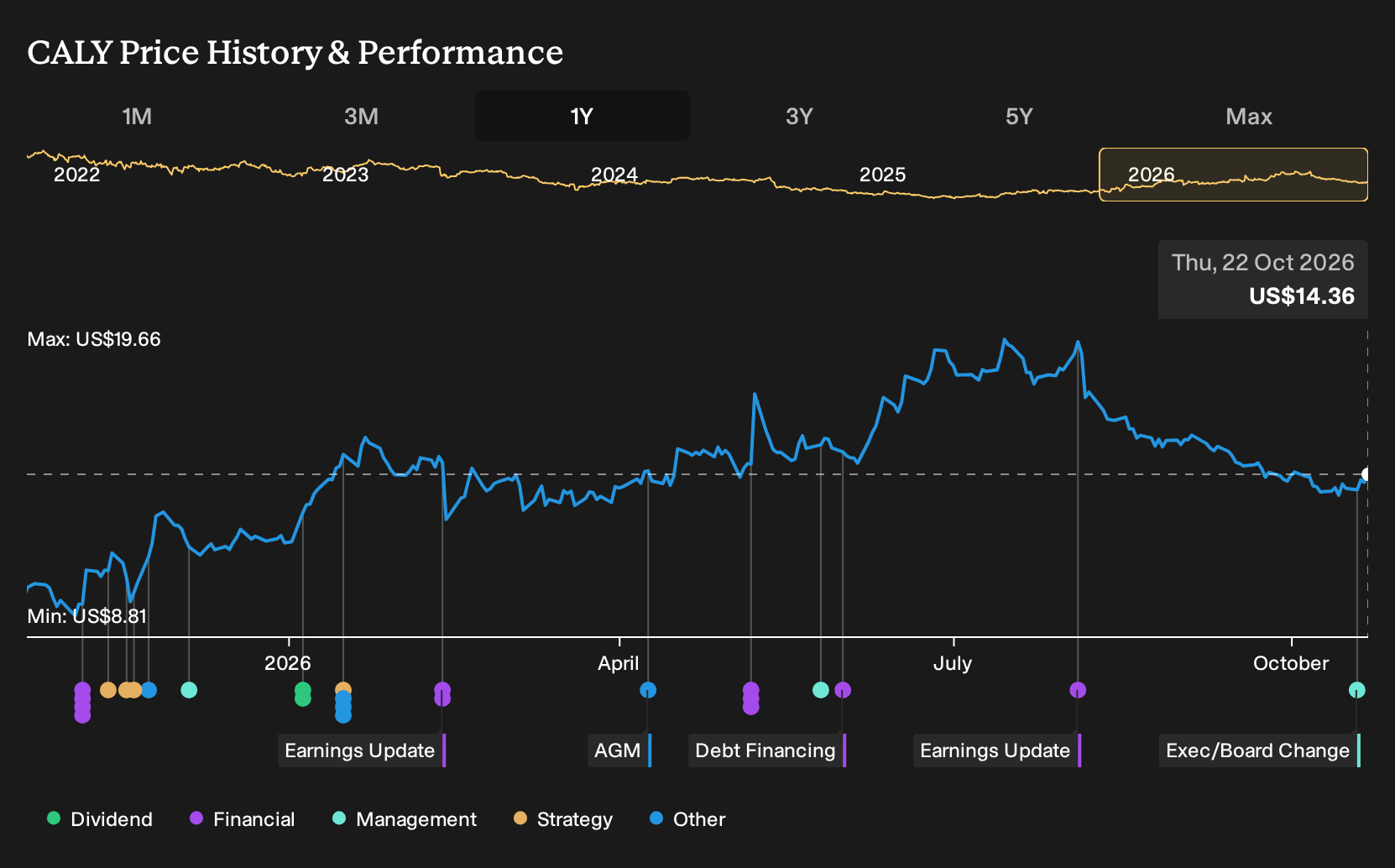
- Callaway Golf announced that Harry Arnett, who led its global brand and marketing from 2012 to 2019, has rejoined as Senior Vice President and Chief Brand Officer to oversee worldwide brand strategy, creative communications, and consumer facing activity.
- Arnett’s remit to unify demand creation and brand building across equipment, balls, and apparel matters directly to how Callaway Golf converts golf participation and product interest into sustained revenue and margin progress.
- We will now look at how Callaway Golf's investment narrative could shift as Harry Arnett reshapes its global brand playbook.
Callaway Golf Investment Narrative Recap
To own Callaway Golf, you need to believe the cleaner pure play golf structure, net cash position and ongoing margin work can turn relatively modest historical growth into stronger earnings and free cash flow. The short term swing factor is whether cost actions and pricing can lift margins while golf equipment and apparel demand hold up.
The biggest risk is exactly the flip side. Softer discretionary spending on clubs, balls or apparel, paired with higher input costs for materials and energy, could keep profit margins under pressure after falling to 3.8% from 13.3%. Harry Arnett’s return looks directionally helpful for brand strength but does not by itself change this risk reward setup.
The most relevant context for this leadership move is Callaway Golf’s recent decision to sell Jack Wolfskin and a majority stake in Topgolf, which left the balance sheet in a net cash position. A simpler structure gives Arnett a narrower target. The focus is now squarely on golf equipment and related soft goods rather than a mix of golf entertainment and broader outdoor apparel.
That matters for catalysts. Management is already rationalizing SKUs, closing underperforming TravisMathew stores and stretching product cycles to support margin expansion and free cash flow. Brand work under Arnett will sit on top of these efforts. Execution risk remains around discretionary golf spending and cost inflation, but a tighter portfolio gives investors a clearer line of sight on whether the brand and margin programs are working.
What The Consensus Assumptions Say About Callaway Golf
Analysts are effectively betting that Callaway Golf squeezes more profit out of roughly the same top line. Their models point to revenue that stays fairly flat over the next three years while net margin steps up from 3.8% today to 9.8% around 2029. That is a big ask on the execution front, because it leans heavily on cleaner product ranges, tighter store footprints and more disciplined pricing, rather than an easy volume lift.
Earnings expectations spell this out in dollar terms. Forecasts call for Callaway Golf to move from US$80.6 million of earnings today to US$213.5 million by 2029, with earnings per share reaching US$0.90. That implies the profit pool would need to increase by roughly US$133 million, driven by higher margins and some help from a shrinking share count if buybacks track the projected 2.92% annual share reduction over the next three years. Revenue does not have to do much heavy lifting in this setup, so the spotlight falls squarely on product mix, cost of goods and overhead discipline.
The valuation bridge uses those same 2029 figures as its anchor. To line up with the current analyst targets, an investor would need to accept a scenario where Callaway Golf reaches about US$2.2b of revenue and US$213.5 million of earnings in 2029, with the stock trading around 19.3x those earnings. That would mark a step down from the current 30.0x P/E multiple and sit slightly below the 19.7x P/E for the broader US Leisure group. The story is therefore less about paying a premium and more about whether the margin rebuild and brand reset can get anywhere close to those profit numbers.
Callaway Golf's narrative projects revenue of about US$2.2b and earnings of US$213.5 million by 2029. This rests on fairly flat yearly revenue trends and an earnings increase of roughly US$133 million from US$80.6 million today.
Uncover how Callaway Golf's fair value indicates a 42% potential upside to its current price that could narrow quickly.
Exploring Other Perspectives
You can read Harry Arnett’s return at Callaway Golf as a potential branding catalyst, yet the lowest analysts were still wary even before this news. They were penciling in about US$2.1b of revenue and US$206.6 million of earnings by 2029. That is a more cautious script. Use it as a reminder that opinion ranges are wide and worth comparing.
Explore 2 other Callaway Golf fair value estimates, including one that suggests it could be worth just $20.40!
Decide For Yourself
Disagree with existing narratives? Extraordinary investment returns rarely come from following the herd, so consider conducting your own research.
- A great starting point for your Callaway Golf research is our analysis highlighting 3 key rewards and 2 important warning signs that could impact your investment decision.
- See our latest analysis for Callaway Golf. The report includes a comprehensive fundamental analysis summarized in a single visual, the Snowflake, making it easy to evaluate Callaway Golf's overall financial health at a glance.
Looking For More Investment Ideas Beyond Callaway Golf?
Callaway Golf may sit at the center of your watchlist today, but your portfolio will likely benefit from a wider field of candidates that line up with your own tolerance for risk, income needs and valuation discipline. Use the Simply Wall St Screener to compare stocks with those preferences, then pressure test which ones genuinely earn a place alongside Callaway Golf.
- If you want potential upside without abandoning risk management, start by scanning 30 resilient stocks with low risk scores that still leave room for returns to compound.
- Income focused investors who care about both yield and resilience can review 6 dividend fortresses that aim to balance payout strength with staying power.
- For those hunting for under the radar potential, widen your search with 20 high quality undiscovered gems that combine solid fundamentals with less crowded investor attention.
Have feedback on this article? Concerned about the content? Get in touch with us directly. Alternatively, email editorial-team@simplywallst.com