


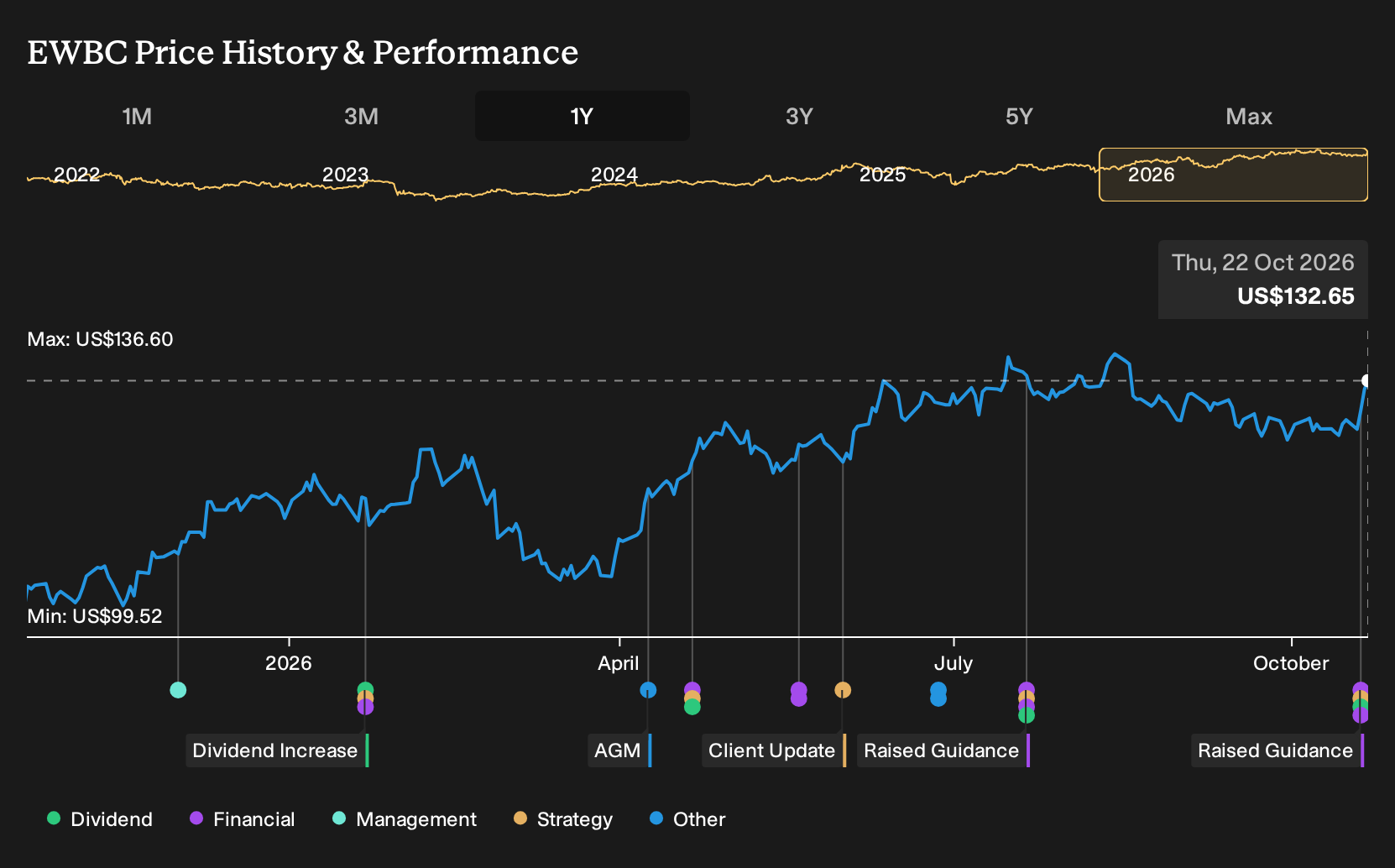
- East West Bancorp reported Q3 2026 net interest income of US$718.9 million and net income of US$382.2 million. The bank then raised full year 2026 net interest income growth guidance to a range of 9% to 10% following September’s rate hike and strong operating performance.
- The bank paired higher guidance with a US$0.80 per share Q4 2026 dividend and modest net charge offs of US$22 million, highlighting a mix of earnings strength, capital return, and credit discipline that matters for long term investors.
- We will now look at how East West Bancorp’s raised net interest income guidance could reshape its longer term investment narrative.
Scan other regional lenders that show similar earnings power, balance sheet resilience, and dividend support in our hand picked list of list of solid balance sheet and fundamentals (26 results)
East West Bancorp Investment Narrative Recap
To own East West Bancorp, you need to believe its cross border franchise, deposit relationships, and expense discipline can keep supporting solid net interest income while credit stays contained. The raised 2026 NII growth outlook to 9% to 10% reinforces that story but also raises the bar for execution if funding costs climb.
The most important short term catalyst remains how net interest margin holds up as a higher rate backdrop meets intense deposit competition. The biggest risk is pressure on funding costs or a turn in asset quality that erodes the benefit of higher NII. Recent guidance tweaks that balance but does not radically change it.
The raised full year NII growth guidance to 9% to 10% is the announcement that ties most closely to the current story. It leans on Q3 2026 net interest income of US$718.9 million and net income of US$382.2 million, and on earlier commentary around record revenue and strong deposit and loan growth.
For investors, that more specific guidance puts additional focus on execution around deposit pricing, loan mix, and credit discipline. The updated outlook also interacts with existing catalysts such as digital investments and fee initiatives, while keeping the known risks intact, including fee income volatility and any future rise in credit provisions from today’s modest net charge offs.
What The Long Range Targets Assume For East West Bancorp
East West Bancorp's narrative projects US$3.9 billion revenue and US$1.7 billion earnings by 2029. This rests on 10.3% yearly revenue growth and a roughly US$300 million earnings increase from US$1.4 billion today.
Analysts are effectively sketching out a future where the bank grows its top line at double digit rates while accepting slimmer profit margins. Revenue is modeled to rise about 10.3% a year over the next three years, yet projected profitability steps down from a 50.1% margin today to 42.6% by 2029. That mix points to stronger activity levels but a richer cost base or more competitive pricing on loans and deposits.
The earnings bridge matters just as much. Consensus figures call for profit to move from US$1.4 billion today to about US$1.7 billion by 2029, alongside earnings per share of US$11.98. The implied increase of roughly US$300 million in annual profit assumes credit stays manageable and operating discipline holds even as funding costs and technology spending remain in focus.
Those profit expectations are also tied to how investors might value East West Bancorp in a few years. To line up with the analyst price target, the stock would need to trade on a P/E of 15.1x applied to the US$1.7 billion earnings estimate in 2029. That multiple is higher than both the current 11.9x on East West Bancorp and the 11.7x level cited for the broader US banks industry, so the scenario implies a continued premium relative to many regional peers.
Revenue assumptions lead to a similar picture. The consensus framework points to US$3.9 billion of sales in 2029, consistent with the forecast profit margin reset and earnings path. Forecast growth over the next few years is paired with a modest 0.42% annual reduction in share count, which would support earnings per share even if net income growth tracks close to the top line.
Discount rates and risk inputs round out that model. Analysts mention a 7.24% discount rate in the detailed company work and a 7.2% rate in the price target summary. Those figures reflect one way of translating future cash flows into today's value and may differ from the return hurdle you use when you benchmark East West Bancorp against other banks or income opportunities.
Uncover why East West Bancorp's fair value indicates a 13% potential upside to its current price, which could narrow quickly.
Exploring Other Perspectives
Three fair value views from the Simply Wall St Community span roughly US$150 to about US$269 per share, so some retail investors see East West Bancorp as deeply discounted, while others lean toward a rich outcome. Consider this alongside risks around deposit competition and fee swings, then explore these contrasting viewpoints before framing your own stance.
Explore 2 other East West Bancorp fair value estimates, including one that suggests it could be worth just $150.00.
The Verdict Is Yours
Don't just follow the ticker, dig into the data and build a conviction that's truly your own.
- A great starting point for your East West Bancorp research is our analysis highlighting 4 key rewards and 1 important warning sign that could impact your investment decision.
- See our latest analysis for East West Bancorp. The report includes a comprehensive fundamental analysis summarized in a single visual, the Snowflake, making it easy to evaluate East West Bancorp's overall financial health at a glance.
Looking For More Investment Ideas Beyond East West Bancorp?
If the East West Bancorp story has sharpened your thinking about banks, you can broaden that momentum by scanning a wider field of opportunities using the Simply Wall St Screener. You can line up companies by quality, balance sheet strength, income potential, or risk profile, then decide which ones deserve a deeper look.
- For investors who want potential upside with an eye on balance sheet resilience, filter for stocks that pair solid finances with room to grow through the 30 high quality undervalued stocks.
- If reliable income matters most to you, focus on businesses that combine higher yields with consistent payout support using the 6 dividend fortresses.
- When capital preservation and stability are near the top of your checklist, narrow your watchlist to companies with stronger financial footing and lower risk scores via the 30 resilient stocks with low risk scores.
Have feedback on this article? Concerned about the content? Get in touch with us directly. Alternatively, email editorial-team@simplywallst.com