


- Lear Corporation has confirmed a planned finance leadership transition, with long-time executive Jared Fedele set to become Chief Financial Officer and Senior Vice President on March 1, 2027. He will succeed retiring CFO Jason Cardew, who will stay on as Executive Advisor through the end of 2027.
- The choice of an internal candidate who already oversees finance for both Seating and E-Systems signals that Lear is prioritizing continuity in its capital decisions and day to day financial execution across its core businesses.
- We will look at how Lear's investment narrative could be shaped by this CFO handover, especially Fedele's Asia and E-Systems experience.
Scan how Lear's leadership reshuffle compares with peers handling similar transitions by reviewing the hand picked list of solid balance sheet and fundamentals (26 results) for context on financially robust alternatives in the sector.
Lear Investment Narrative Recap
To own Lear, you need to believe its seating and E-Systems businesses can turn operational execution into steadier earnings and cash, even while auto demand and China stay uneven. The near-term story still leans on cost efficiencies such as IDEA automation and disciplined capital allocation, and this CFO news does not materially change those levers.
The bigger swing factor is still how cleanly Lear manages the E-Systems portfolio shift and 2027 roll-off, and whether the conquest backlog converts into post-2027 volume. The main risk remains weaker China demand or slower program ramps that make it harder to hit the margin and free cash flow ambitions already outlined.
The most relevant announcement here is Lear confirming Jared Fedele as future CFO and Senior Vice President from March 2027, after a long internal career spanning FP&A, Asia Pacific and both Seating and E-Systems. That kind of tenure matters if you care about consistency in how restructuring of E-Systems and automation investments are measured and tracked.
With Jason Cardew staying on as Executive Advisor through December 2027, investors get a long overlap period covering the key 2027 transition year when non-core E-Systems revenue is set to roll off. That extended handoff can help reduce execution risk around cost programs, China exposure and capital deployment, but the fundamental catalysts and risks around demand, backlog conversion and margins stay the same.
What The New CFO Means For Lear’s Long Game
Lear's narrative projects US$25.0b revenue and US$978.0m earnings by 2029, built on a 1.8% yearly revenue growth rate and an increase of about US$422.0m from current earnings of US$556.0m.
Those analyst numbers effectively sketch the financial backdrop that Jared Fedele will inherit when he steps into the CFO role. The forecast assumes the business can lift profit margins from 2.3% today to 3.9% by around 2029, while earnings move from US$556.0m to US$978.0m and potentially as high as US$1.1b if the most optimistic projections prove correct. For any investor watching this transition, the key question is how a finance chief who grew up inside Lear’s seating, E Systems and Asia operations will choose to track progress against those targets quarter by quarter.
Revenue growth expectations are relatively modest at 1.8% a year over the next three years, which means the burden shifts to mix and efficiency rather than raw top line expansion. That fits an automaker supplier like Lear, where capital discipline, contract selection and cost programs such as IDEA automation often drive value just as much as unit volumes. It also sets a clear test for incoming finance leadership. Execution on planned roll offs in E Systems and share count reductions of about 4.91% per year need to line up cleanly with that earnings bridge to around US$978.0m.
The valuation framework baked into the current analyst view puts even more focus on steady hands in the finance seat. To land at a consensus price target of US$150.86 on a stock trading at US$120.85 as of late October 2026, the models assume Lear trades on a P/E of 8.7x 2029 earnings, down from 10.7x today and well below the US auto components sector at 16.3x. A lower future multiple implies the market expects cleaner, more predictable earnings streams, not a rerating story. That aligns squarely with what a methodical CFO transition is trying to signal.
Risk sits in the gap between those assumptions and the on the ground realities that Fedele will have to manage. China demand has been weak, non core E Systems revenue is scheduled to wind down through 2027 and the conquest driven backlog only really kicks in after that muted year. If program ramps or China volumes fall short, the US$25.0b revenue path and margin lift to 3.9% become harder to defend. A disciplined finance function can adjust capital spending and buybacks in response, but it cannot fully offset softer operating trends.
For readers, the practical takeaway is straightforward. Treat the announced CFO change at Lear as one more input into how confident you feel about the published 2029 revenue and earnings markers, the implied 1.8% annual growth rate and the step up from US$556.0m to US$978.0m in profit. Then compare those assumptions with your own expectations for China auto demand, the E Systems reshaping and the pace of seating and wiring backlog conversion. The tighter that match, the more comfortable you are likely to be with this long runway for a new finance leader to prove the model out.
Uncover why Lear's fair value indicates a 27% potential upside to its current price that may not last much longer.
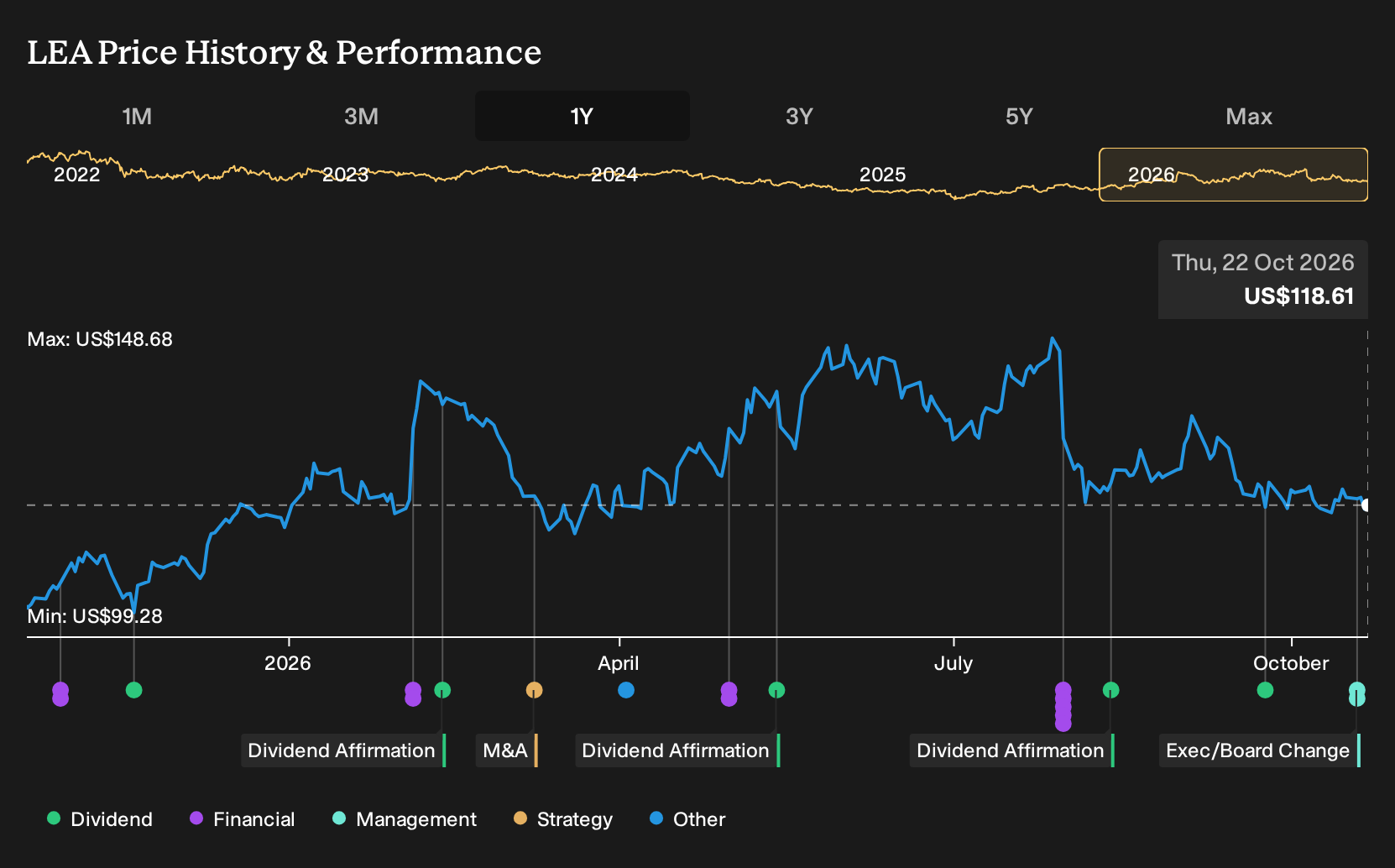
Exploring Other Perspectives
One alternate view puts Lear’s China exposure front and center. The most cautious analysts were working off roughly flat revenue and earnings of about US$760.6m by 2029 before this CFO news, far below the US$978.0m consensus path. That camp effectively asks you to consider whether a new finance leader can really shift that trajectory.
Explore 5 other Lear fair value estimates, including one that suggests as much as 7% downside from the current price.
Reach Your Own Conclusion
Disagree with existing narratives? Extraordinary investment returns rarely come from following the herd, so trust your own analysis and judgment.
- A great starting point for your Lear research is our analysis highlighting 5 key rewards and 2 important warning signs that could impact your investment decision.
- See our latest analysis for Lear. The report includes a comprehensive fundamental analysis summarized in a single visual, the Snowflake, which makes it easy to evaluate Lear's overall financial health at a glance.
Looking For More Investment Ideas Beyond Lear?
If this Lear story has sharpened your view on risk, reward and capital discipline, use that same lens to widen your opportunity set with the Simply Wall St Screener.
- For investors focusing on quality at a reasonable price, start with a curated pool of 30 high quality undervalued stocks that pair fundamentals with more grounded expectations.
- If resilience and balance sheet strength sit at the top of your checklist, narrow your search to a 30 resilient stocks with low risk scores that may better match a capital preservation mindset.
- Income seekers who want yield supported by fundamentals can scan a shortlist of 6 dividend fortresses that might complement a total return approach.
Have feedback on this article? Concerned about the content? Get in touch with us directly. Alternatively, email editorial-team@simplywallst.com