


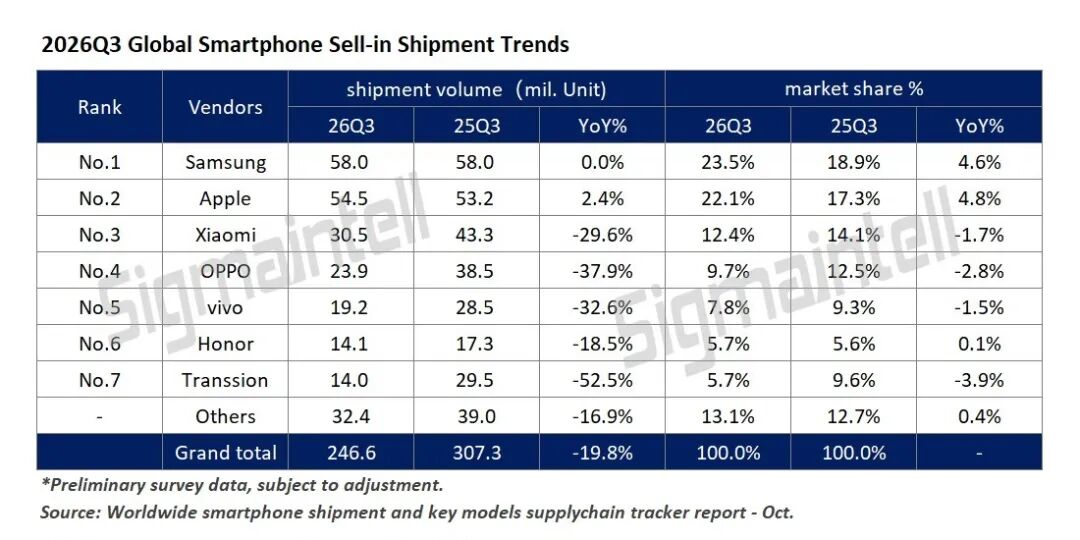
The Zhitong Finance App learned that on October 23, Qunzhi Consulting published an article stating that in the third quarter of 2026, global smartphone shipments were about 250 million units, a year-on-year decrease of 19.8%. Rising costs have spawned K-type market differentiation. The resilience of Apple and Samsung to decline is prominent. Shipments from most domestic brands are under heavy pressure, and industry share is being restructured. As market growth dividends subside, the game between cost cycles and product innovation will dominate the next shipment differentiation and market trends of mobile phone manufacturers.
1. Global market: Global smartphone shipments in the third quarter of 2026 were about 250 million units, a year-on-year decrease of 19.8%
Global mobile phone market trends diverged significantly in Q3 2026. Apple was the only mainstream manufacturer that achieved a year-on-year increase in shipments this quarter. The rest of the brands generally declined, with domestic brands falling particularly significantly, with some exceeding 30%. This phenomenon reflects the structural contradictions in the current industry: in the upward cost cycle, brand premium capacity determines the level of resilience of manufacturers to risk, and manufacturers with low- to mid-range models as the basic market are more likely to be impacted by shrinking consumer demand.
Samsung (Samsung): 58 million units shipped in Q3. Under the trend of mainstream brands in the industry reducing 4G models, Samsung launched new 4G products such as the A07S. The low-end business focus is on A-series 4G models, supporting shipments and hedging market fluctuations by relying on entry-level demand in emerging markets. However, the increase in memory prices continued to erode profits, and the MX division was clearly under subsequent pressure. As a result, production was drastically cut in 26Q4, with an overall reduction of 30%; based on the performance of each quarter, shipments of about 230 million units are expected for the whole year.
Apple (Apple): 54.5 million units were shipped in Q3, up 2.4% year over year. The product structure continues to lean towards the high-end. The iPhone 18 Pro Max is in strong demand, has the potential to be purchased, and the folding model market has received enthusiastic responses. The high-end product matrix has become Apple's core gripper to withstand downward pressure on the industry, supporting the annual shipment target of about 230 million units.
Xiaomi (Xiaomi): The Q3 shipment volume was 30.5 million units, and the performance was relatively impressive among domestic brands. Part of the increase in shipments this quarter came from pre-procurement through the channel, which had a significant short-term driving effect. Shipment momentum is expected to decline in the next two quarters, and the channel gradually enters the inventory digestion stage.
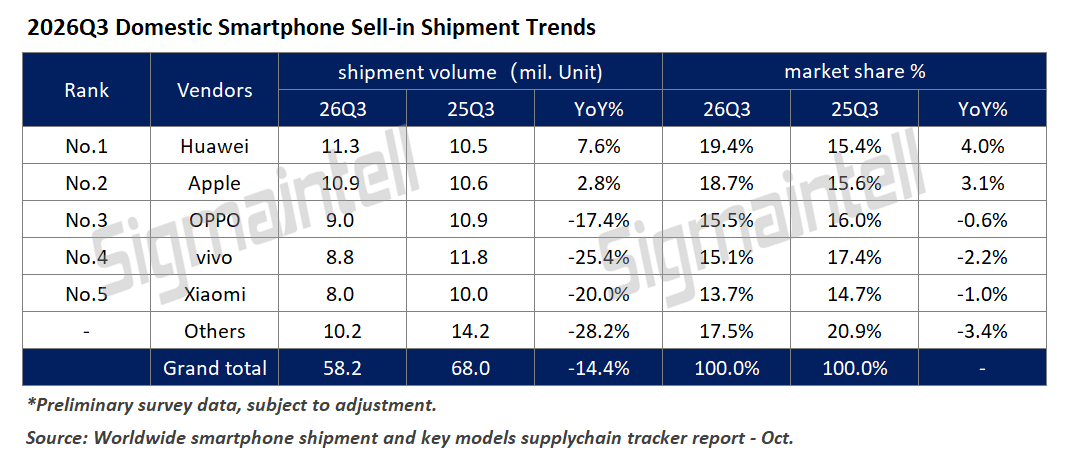
2. Chinese market: Shipments fell 14.4% year-on-year in the third quarter of 2026
In the domestic market, Q3 shipments fell 14.4% year on year. The decline was superior to the global market, and the market was more resilient. On the one hand, domestic consumers are highly accepting of folding screens and AI flagships, and high-end models continue to create demand for new ones; on the other hand, domestic channel promotion methods are flexible, which can activate existing users in stages and cushion the downward impact on the market.
Huawei (Huawei): According to Qunzhi Consulting data, Huawei shipped 11.3 million units in Q3, an increase of 7.6% over the previous year, and reached the top of the domestic market. The brand continues to increase the folding track, and the market feedback for wide folding models is outstanding. At the same time, new wide and straight board products have received positive feedback due to their differentiated forms, and various innovative forms are jointly driving demand for high-end switches.
Apple (Apple): Domestic Q3 shipped 10.9 million units, up 2.8% year on year. The first release of the iPhone 18 without a standard version drove some users to buy Pro models; the popularity of the iPhone 17 continued on the eve of the release of the new model, and new and old products achieved a relay of sales, compounding the strong performance of Pro Max and the influx of high-end users across brands, driving shipments bucked the trend.
OPPO: Domestic shipments of 9 million units in Q3, shipments are under pressure. Affected by the increase in component prices, the increase in flagship pricing has caused user diversion; brands are actively shrinking low-margin models, and resources are skewed towards high-end and folding products.
III. Future Market Outlook
According to analysis forecasts by Qunzhi Consulting, global smartphone shipments will be about 1.03 billion units in 2026. Looking ahead to 2027, although storage prices are expected to stabilize or decline slightly at the end of the year, due to significant delays in the transmission of cost improvements to the whole machine side, it is difficult to effectively drive terminal retail prices down in the short term, and high cost pressure will continue to curb consumer demand for switching. Global smartphone shipments are expected to continue to decline by about 9% year on year in 2027.
The core trend of the global smartphone market in 2027 depends on two key variables:
1. Cost pressure relief and terminal transmission rhythm: Even if the storage price falls, it is difficult to quickly transfer to the retail price of the terminal. The time and magnitude of the transmission of cost improvements to the price of the whole machine will directly affect the cost performance repair space of low- and mid-range models, which in turn will determine the degree of recovery in replacement demand in the stock market.
2. Demand driving effect of innovative products: As the smartphone switching cycle continues to extend, the appeal of conventional hardware specification upgrades to consumers gradually weakens, and differentiated product experiences will become an important driving force in stimulating switching demand. On the one hand, innovative products such as AI mobile phones and wide folding are expected to further activate high-end market demand through differentiated experiences; on the other hand, new forms of products such as wide and straight boards will penetrate into the middle and low end price segments, which is expected to expand the coverage of innovative experiences, stimulate the mass market's willingness to switch, and bring new structural growth opportunities to the market.