


The Zhitong Finance App learned that economists expect the ECB to raise interest rates for the last time in December after being on hold next week. This judgment is in stark contrast to the market's bet that interest rates will still be raised many times in the future.
The last rate hike in December? Economists and the market have their own opinions
According to the survey, the vast majority of respondents believe that the ECB will raise deposit interest rates by 25 basis points to 2.75% at the last meeting in 2026 and maintain this level until May 2028. In contrast, traders expect three more rate hikes in the next year.
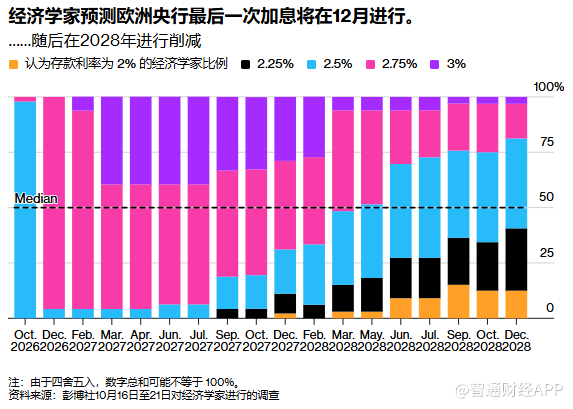
These findings highlight a long-standing divide: how much effort will be needed from policymakers to pull consumer price increases back to the target level of 2%. Although investors are closely watching the continued rise in oil prices, analysts pointed out that the ripple effect of inflation is still fully evident.
“There is still no sign that energy inflation is being transmitted to broader wage and price settings,” said Rabobank economist Bas van Geffen. “The ECB does not need to speed up the rate hike cycle; it can wait until December before acting.”
In response to the war with Iran, the ECB raised interest rates twice in June and September. Despite the acceleration of inflation, which reached 3.8% last month, output performance was more resilient than most expected.
ECB officials wanted to prevent energy shocks from being embedded in the economy, and this month they considered raising interest rates again. However, it is still more likely that the pace of quarterly rate hikes will be maintained, and new forecasts will be announced at the December meeting.
The ECB's September outlook is for GDP growth of 0.9% this year, 1.4% growth in 2027, and consumer prices rising by 3% and 2.5%, respectively. Under unfavorable circumstances, inflation is expected to reach 3.1% and 3.2%.
As oil prices surpass $110 per barrel, more than two-thirds of economists believe that the Eurozone's economic performance is worse than the September baseline scenario.
“The longer overall inflation remains high, the harder it is to ignore the second-round effects on wages, prices, and expectations,” said Dennis Shen, a lecturer at the Berlin School of International Management. “For the ECB, overinflation is now a much greater medium-term risk than underinflation.”
The yield on French bonds broke 5%. Can the ECB save it?
In addition to the situation in the Middle East, policymakers are evaluating the extent to which rising bond yields are tightening the financial environment. ECB President Lagarde and others believe that this will curb economic growth and limit the transmission of energy to inflation.
As France's benchmark bond yield hit 5% this week, for the first time since 2002, some investors have even seen the risk of a new euro debt crisis. Markets speculate that the extent to which the situation will worsen will prompt the ECB to use an unused emergency tool — the Transmission Protection Tool (TPI).
Economists think the threshold is very high: 70% of respondents ruled out any kind of intervention, and about 90% ruled out TPI. TPI is designed to respond to unwarranted and disorderly market dynamics, which threaten the transmission of Eurozone policy.
“The rise in bond yields can be explained very well by the strengthening of global capital demand and the deterioration of public finance in many countries,” said Karsten Junior, chief economist at Bank J Safra Sarasin. “Under these circumstances, it is difficult for the ECB to find a reason to use TPI.”
Some economists believe that the ECB may take less aggressive measures, such as verbal intervention, releasing dovish interest rate signals, or stopping quantitative austerity.
“As long as France is unwilling to save itself, the ECB is currently very limited in what it can do to help France,” said Carsten Brzeski, head of global macroeconomics at ING. “With the bond market taking over the ECB's responsibilities, the only thing the ECB can do is sound more dovish and try to lower expectations of interest rate hikes.”