


Analyst attention has intensified around Colgate-Palmolive (CL) as traders look ahead to its October 30, 2026 earnings release, following a pattern of prior estimate beats and what some view as a positive indicator for upcoming results.
Colgate-Palmolive’s recent 4.3% 1-day share price return and 11.9% 1-month share price return signal building momentum ahead of the October earnings update, while a 1-year total shareholder return of 27.1% reflects steady interest in the story over a longer horizon.
Scan how Colgate-Palmolive stacks up against other consumer staples by reviewing a curated 30 resilient stocks with low risk scores that have been holding up well through different market conditions.
Colgate-Palmolive appears to be a solid global franchise, and the recent share price jump reflects that reputation. After this run, the key consideration is whether the current valuation still leaves enough room for comfort.
Most Popular Narrative: 13% Overvalued
On the most followed narrative for Colgate-Palmolive, the fair value sits at $86.48 using a 7% discount rate, compared with a last close of $97.39. That gap is not huge, but it matters for anyone weighing whether the recent share price strength is already baking in the core investment case.
This creates a trap worth naming. If you normalise the margin but leave the future multiple at the GAAP-derived figure, you count the adjustment twice and overstate fair value by roughly 45%. The margin and the multiple have to sit on the same basis. That is why 15% pairs with 24x here rather than with 35x.
See why 9 investors see Colgate-Palmolive as 13% overvalued.
On this narrative, Colgate-Palmolive is framed as a robust consumer staples franchise where the underlying business performance and the accounting optics part ways. Reported net margin at 9.7% reflects a large one-off impairment in the skin health unit, while the narrative argues that a normalised profit margin closer to 15% better reflects ongoing operations and cash generation.
The writer, rcb9, leans heavily on cash flow and Base Business earnings, pointing out that operating cash flow reached $4.198b and that base EPS rose even as headline earnings fell. That view treats the $794m non-cash charge as a clean-up item rather than a recurring hit, which then feeds into the fair value estimate built around a 4% top line growth rate and a 7% discount rate.
For readers, the key tension is simple. Headline data screens Colgate-Palmolive on roughly 10% net margin with a P/E ratio flagged as expensive versus both peers and a calculated fair P/E of 24.1x. The narrative instead rebuilds the investment case on adjusted profitability and a forward P/E of 24x, then tests whether that multiple and a 15% margin align with what the current share price already implies.
Under that lens, the stock screens as about 13% above the narrative fair value, which is a relatively modest gap for a large-cap household products group with a long operating history. Colgate-Palmolive has revenue of $21,047.0m and net income of $2,038.0m, and it pays a 2.18% dividend yield, so the question becomes how much investors are willing to pay today for what the narrative calls "competent continuation" rather than a major shift in the earnings profile.
On the risk side, the narrative flags several concrete checkpoints over the next 12 to 18 months. These include North American organic sales returning to positive territory by the second quarter of 2027, gross margins holding roughly flat for full year 2026 after guidance was lifted, and emerging market growth remaining in the mid single-digit range. Any clear miss against that checklist would weaken the case for treating the 2025 impairment as a one-off reset.
Management quality and governance data from Simply Wall St paint a mixed but informative picture alongside this. The executive team has an average tenure of 3.9 years and the board shows 7.5 years of average service with 90% independent directors, suggesting a seasoned oversight structure. CEO Noel Wallace's total compensation of $16.48m is described as broadly in line with peers, and his pay is flagged as consistent with company performance over the past year.
Financially, Colgate-Palmolive is not portrayed as a high-growth story. Revenue is reported to have grown 3.1% annually, which is slower than the forecast 13.5% per year for the wider US market. Earnings are forecast to rise 11.5% annually, again behind the 17.2% figure for the broader market but still positive in absolute terms. Over the past five years, earnings growth has averaged 3.7% per year, which fits with a mature staples business rather than a rapid compounder.
The capital structure adds another layer. Return on equity is described as outstanding at about 382.16%, although that figure is explicitly flagged as being skewed by high leverage. Simply Wall St also notes that Colgate-Palmolive carries a high level of debt and that 100% of its liabilities come from higher-risk funding sources such as external borrowing, rather than customer deposits or similar low-risk obligations.
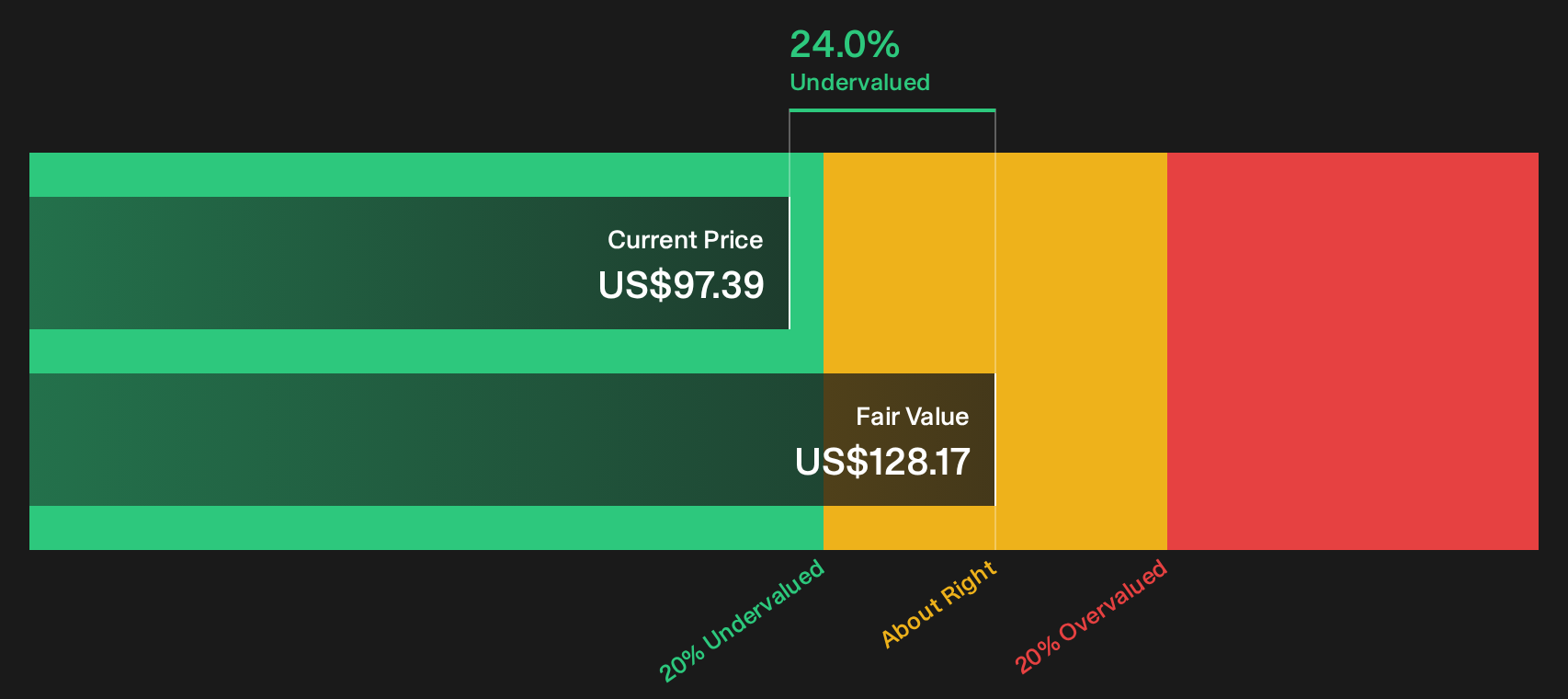
Valuation checks outside the narrative lean in different directions. The stock is marked as expensive relative to peers on a P/E of 38.1x compared with a global household products industry average of 17x and a peer average of 24.9x. The same P/E is higher than an estimated fair ratio of 24.1x. At the same time, Simply Wall St's DCF model suggests the share price of $97.39 is trading about 24% below an estimated future cash flow value of $128.17, which is why the platform categorises the stock as "Good value" when using that specific method.
Those conflicting signals highlight why process matters here. Screens that lean on reported P/E will likely flag Colgate-Palmolive as expensive against both its sector and its own fair ratio, especially while the one-off loss still sits in the trailing twelve-month earnings window. A cash flow driven model that adjusts for those items instead points to undervaluation, which links back to the narrative's focus on normalised margins and Base Business earnings rather than GAAP net income.
For income-focused readers, the 2.18% yield is backed by what Simply Wall St calls a reliable dividend, although the narrative notes that the payout looks stretched if you only look at GAAP EPS. On the normalised measure, the payout ratio appears more comfortable at around 57%, which again connects back to how investors choose to treat that 2025 impairment when they think about sustainable distributions.
Where does this leave you heading into the October 30, 2026 earnings release? The stock has beaten the broader US market and the US household products industry over the last year, with a 1-year total shareholder return of 27.1%. Management forecasts from analysts point to continued earnings growth, but not at levels that would usually justify a very high valuation premium on their own. Whether the current price feels acceptable depends on how much weight you place on normalised profitability and discounted cash flows versus simple headline multiples.
Result: Fair Value of $86.48 (OVERVALUED)
Still, this narrative could crack if North American organic sales stay weak or if another large skin health impairment raises questions about Colgate-Palmolive’s normalised margin assumptions.
Find out about the key risks to this Colgate-Palmolive narrative.
Another View: SWS DCF Model Flags Undervaluation
The narrative around Colgate-Palmolive focuses on earnings multiples and a fair value of $86.48, yet the Simply Wall St DCF model points in the opposite direction. On that cash flow view, the stock trades at $97.39, which is about 24% below an estimated future cash flow value of $128.17. This implies investors today are paying less than the model suggests those long term cash streams are worth.
For you as a shareholder, that contrast between a multiple-based fair value that implies roughly 13% overvaluation and a DCF output that frames the shares as 24% undervalued raises a simple question: which lens do you trust more when the same cash flows produce two very different comfort levels on price?
Look into how the SWS DCF model arrives at its fair value.
Simply Wall St performs a discounted cash flow (DCF) on every stock in the world every day (check out Colgate-Palmolive for example). We show the entire calculation in full. You can track the result in your watchlist or portfolio and be alerted when this changes, or use our stock screener to discover 29 high quality undervalued stocks. If you save a screener we even alert you when new companies match - so you never miss a potential opportunity.
Next Steps
Mixed signals across Colgate-Palmolive’s valuation, cash flows, and accounting adjustments make this a judgment call that will not wait forever. Act quickly, review the key positives and negatives, and weigh the 3 key rewards and 3 important warning signs
Looking for more Colgate-Palmolive sized opportunities?
If Colgate-Palmolive is already on your radar, do not stop there. Use the Simply Wall St screener to uncover fresh ideas that match your risk, income, and valuation preferences.
- Target resilience first and hunt for companies that score strongly on stability using our 30 resilient stocks with low risk scores before the crowd pays up for them.
- Prioritise quality at a reasonable price by scanning a focused 29 high quality undervalued stocks that filters for both solid fundamentals and attractive valuations.
- Strengthen your income stream and track a curated 6 dividend fortresses that highlights higher yielding payers with support from underlying cash flows.
Have feedback on this article? Concerned about the content? Get in touch with us directly. Alternatively, email editorial-team@simplywallst.com