


- Ally Financial reported Q3 2026 net income of US$433 million compared with US$398 million a year earlier and raised its common dividend to US$0.35 per share, a 17% increase, alongside continued share repurchases under its existing buyback program.
- The mix of stronger profitability, growth in higher yielding auto and corporate finance lending, a higher common dividend, and completed buyback tranches highlights how Ally Financial is using earnings power and capital actions together to support both business investment and shareholder returns.
- We will now examine how Ally Financial's stronger Q3 profitability and dividend increase could reshape its longer term investment narrative.
Scan how Ally Financial's latest dividend increase and buybacks compare with other capital return stories by reviewing our hand picked 6 dividend fortresses that are actively rewarding shareholders right now.
Ally Financial Investment Narrative Recap
To own Ally Financial, you need to believe the digital bank and auto focused lender can keep growing higher yielding assets while holding credit and funding costs in check. Q3 profitability, with net income at US$433 million and net margin at 17%, points to earnings power that supports that view, although it does not erase execution risk.
The near term swing factor still sits in credit and auto volume quality. Retail auto losses, Stellantis related lease residual pressure, and heavier competition in consumer finance remain the key threat to the story. The latest results and guidance on credit normalization do not materially change that risk profile.
The 17% lift in the common dividend to US$0.35 per share is the clearest new signal tied to this earnings print. It indicates that Ally Financial currently sees its capital and earnings base as strong enough to support a higher recurring cash return while it continues buybacks under the existing program.
For you as an investor, that higher payout links directly to the main catalysts already in play. The thesis still leans on digital deposit scale, remixing into higher yielding auto and Corporate Finance loans, and use of risk transfer structures to support capital. Execution on those levers will matter more than the dividend headline if credit costs or auto financing volumes move against the company.
What Ally Financial's Analyst Assumptions Really Imply
Analyst models around Ally Financial are not just abstract spreadsheets. They effectively spell out what needs to happen in the business for the current dividend, buybacks, and Q3 profitability to remain supported over time.
Consensus expectations call for revenue to increase by 7.7% per year over the next three years. That is a reasonably brisk pace for a lender that already has meaningful scale. It leans heavily on the idea that higher yielding auto and Corporate Finance assets can keep expanding without credit costs or funding pressures absorbing most of the benefit.
Profit margins are assumed to rise from 16.8% today to 17.8% in three years. That 1 percentage point shift may sound small. For a bank style platform with billions of dollars in revenue, even that type of change generally implies either steadier credit outcomes than the market fears, tighter cost discipline, or more mix shift into higher return lending and fee streams.
Earnings expectations fill in the rest of the picture. Analysts are penciling in earnings of US$1.8b by about 2029, up from US$1.3b today. That is an increase of about US$500m in absolute profit. For you as a shareholder, the important question is not just whether that step up looks achievable, but what has to happen in auto volumes, deposit pricing, and loss rates for that type of earnings path to hold.
There is real disagreement inside that consensus. The most optimistic forecasts point to US$2.2b of earnings while the most cautious sit closer to US$1.5b. That spread matters. It tells you the market does not have a single clear view on how Ally Financial will balance loan growth, risk normalization, and funding costs through the rest of the decade.
Underlying these profit estimates is an assumption that the share count will keep shrinking. Analysts are building in a 2.22% yearly decline in shares outstanding over the next three years. That depends on buybacks continuing in some form and can amplify earnings per share even if total earnings track closer to the lower end of the forecast range.
Valuation work in the consensus report links those operating assumptions back to the share price. To line up with the current analyst price target, Ally Financial would need to trade at a P/E of 11.0x on the 2029 earnings estimate, compared with 8.3x today. That would also sit above the quoted 9.0x P/E for the broader US consumer finance peer group in the report, which effectively bakes in a relative premium for the stock.
This potential rerating rests on the idea that the earnings and margin profile of Ally Financial becomes more resilient and more capital efficient than the average consumer finance company. If that does not materialize, the argument for a higher P/E multiple weakens and more of the return would need to come from the earnings and dividend stream alone.
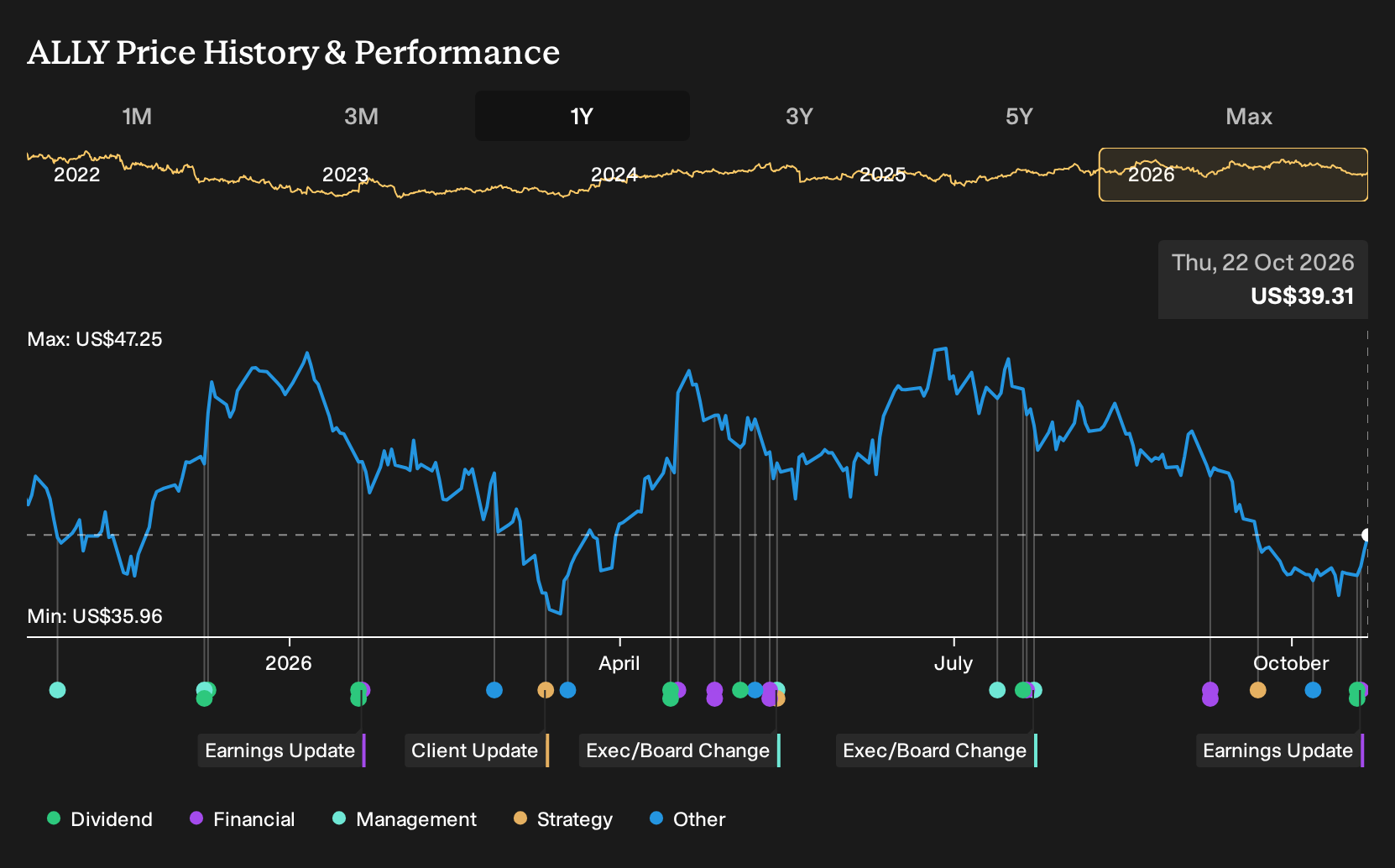
Price targets in the compilation carry a wide spread, from US$40 on the low end to US$58 at the top. With the consensus target at US$48.78 against a current share price of US$36.74, the numbers in the report imply meaningful upside. It is important to treat that gap as a reflection of the model inputs and required conditions, not as a prediction.
For you as an investor, the practical step is to stress test those inputs. Ask whether a 7.7% annual revenue increase, a margin lift from 16.8% to 17.8%, and a US$500m earnings rise to US$1.8b by 2029 feel reasonable given everything you know about auto credit cycles, digital banking competition, and Ally Financial's capital plans.
Ally Financial's narrative projects US$9.9b revenue and US$1.8b earnings by 2029. This would require 7.7% yearly revenue growth and an earnings increase of about US$500m from US$1.3b today.
Uncover why Ally Financial's fair value indicates a 24% potential upside to its current price, a discount that may not last much longer.
Exploring Other Perspectives
One bullish twist in the alternate Ally Financial storyline is how much weight those analysts put on Corporate Finance as a catalyst. They were sketching out roughly US$10.7b of revenue and US$2.2b of earnings by 2029, far above consensus. Your job now is to ask whether the latest dividend hike and buyback progress strengthen that more optimistic path or push the narrative closer to the middle. Use this Q3 print as a fresh data point and compare several viewpoints before deciding which version you find most convincing.
Explore 4 other Ally Financial fair value estimates, including one that suggests potential upside of up to 42% from the current price!
Form Your Own Verdict
Disagree with existing narratives? Extraordinary investment returns rarely come from following the herd, so trust your own analysis and judgment.
- A great starting point for your Ally Financial research is our analysis highlighting 5 key rewards that could impact your investment decision.
- See our latest analysis for Ally Financial. The report includes a comprehensive fundamental analysis summarized in a single visual, the Snowflake, making it easy to evaluate Ally Financial's overall financial health at a glance.
Looking For More Investment Ideas Beyond Ally Financial?
If Ally Financial has helped sharpen your thinking about income, valuation, and risk, it can be useful to test that same framework on a wider watchlist. Use the Simply Wall St Screener to line up comparable opportunities and see which businesses best match the return profile and balance sheet quality you are targeting.
- Focus on resilience first and scan our 30 resilient stocks with low risk scores to find businesses that may better match a capital preservation mindset.
- If balance sheet strength is your anchor, widen your search with a list of solid balance sheet and fundamentals (26 results) that pairs financial stability with underlying fundamentals.
- For investors hunting for lesser known opportunities, broaden the watchlist with a 20 high quality undiscovered gems that combine healthy fundamentals with lower market attention.
Have feedback on this article? Concerned about the content? Get in touch with us directly. Alternatively, email editorial-team@simplywallst.com