


US stocks closed on October 22. Under the common negative catalyst of a surge in AI financing cost pressure and a worsening geopolitical situation in the Middle East, AI transactions in US stocks were once again intensively sold off.
However, the other side of the market is being divided: on the one hand, the semiconductor sector of US stocks suffered a severe setback, and on the other side, there was a “deep V” market where Chinese and South Korean technology stocks plummeted during the session and closed in counterattack on October 23. Expectations of price increases for memory chips, continued expansion in demand for AI computing power, and progress in commercialization of some AI applications are still providing support for technology stock bulls.
It is worth noting that whether this rebound can continue will soon face a new test. Next week, Microsoft, Google's parent company Alphabet, Amazon, and Intel will release financial reports one after another from October 28 to 29. At a time when investment in AI infrastructure continues to rise and the semiconductor sector shocks sharply, the performance and guidance of these companies will provide the market with a new observation window: whether cloud giants can turn AI investment into revenue growth, whether demand for chips is still strong, and whether corporate capital expenditure can reap corresponding returns.
Chinese and South Korean technology stocks staged a “deep V” counterattack, and the semiconductor bull market narrative has not yet come to an end
On October 22, US technology stocks experienced a concentrated sell-off. The Nasdaq 100 Index fell 2.90%, and the Philadelphia Semiconductor Index fell 6.72%. Memory chips and related hardware stocks were generally under pressure. Micron Technology fell 6.26%, Seagate fell 7.86%, Western Digital fell 6.43%, and SanDisk fell 8.51%.
However, this round of sell-off does not mean that the entire US stock market has fallen into an indiscriminate decline. Among the constituent stocks of the S&P 500 index, about two-thirds closed higher, while value-oriented stocks such as Coca Cola and Berkshire showed relatively strong performance. This shows that market pressure is more concentrated on technology stocks and AI-related transactions, and investors are re-evaluating the financing costs, capital expenses, and return risks faced by overvalued technology assets.
On October 23, there was a clear reversal in Asian technology stocks. The Korea Composite Stock Price Index fell by more than 4% during the intraday period, then recovered and eventually rose 0.30%; SK Hynix rose 4.42%, and Samsung Electronics rose 0.47%. The news about Solidigm's suspension of listing in the US has also allayed some of the market's concerns about the possible impact of a dual listing.
The A-share GEM Index also experienced severe shocks. It fell 3.21% during the intraday period, then rebounded strongly and closed up 4.16%. The market turnover on the same day was about 1.96 trillion yuan, and more than 4,500 individual stocks rose. At the same time, the order status of optical communication industry chain companies such as Zhongji Xuchuang and Tianfu Communications has received attention, and related companies in the Yizhongtian industrial chain have also continued to be the focus of market transactions; the repurchase plans of optical module companies have further attracted investors' attention.
Judging from trading performance, the Chinese and South Korean technology stocks counterattack shows that the sharp decline in the US semiconductor sector on the previous trading day was not enough to directly falsify the growth logic of the AI industry chain. However, sharp intraday fluctuations also mean that market sentiment is still weak: on the one hand, capital continues to bet on demand for computing power infrastructure, and on the other hand, it is also wary of the risks posed by high investment, rising financing costs, and excessive valuations.
Memory chip price increases are expected to extend to 2027, and demand for AI infrastructure remains strong
Memory chips are one of the hottest links in the current AI infrastructure investment chain. As data center construction continues to advance, the demand for high-bandwidth memory (HBM), DRAM, and enterprise-grade solid-state drives for AI servers continues to increase, and the bargaining power of storage vendors also increases.
According to KeyBanc's recent Asian research data, AI data centers are still absorbing the supply of AI computing power resources such as storage on a large scale, driving the price increase to 2027. The agency predicts that HBM hybrid prices are expected to rise sharply by 80% to 100% in the first quarter of 2027. At the DRAM memory price level, KeyBanc predicts a 15% to 20% month-on-month increase in the fourth quarter of 2026, and 10% to 15% in the first quarter of 2027; in terms of future NAND pricing, it is predicted that the fourth quarter of 2026 will rise by about 20% month-on-month under the strong base in the third quarter, and 10% to 15% in the first quarter of 2027.
TrendForce's predictions for conventional storage are slightly moderate, but they also believe that demand for AI inference supports rising prices. This market research agency expects regular DRAM contract prices to rise 10% to 15% month-on-month and NAND contract prices to rise 15% to 20% in the fourth quarter. On the DRAM side, smart workloads drive the procurement of supporting general-purpose servers and memory, while there are restrictions on advanced manufacturing processes, package testing, and capacity allocation; on the NAND side, real-time retrieval, caching, and vector databases expand the demand for enterprise solid-state drives (Enterprise SSDs). TrendForce expects demand for enterprise-grade SSD bits to increase by more than 80% year-on-year in 2026, and most of the new supply has already been booked, so the price increase for this category in the fourth quarter may even expand compared to the third quarter.
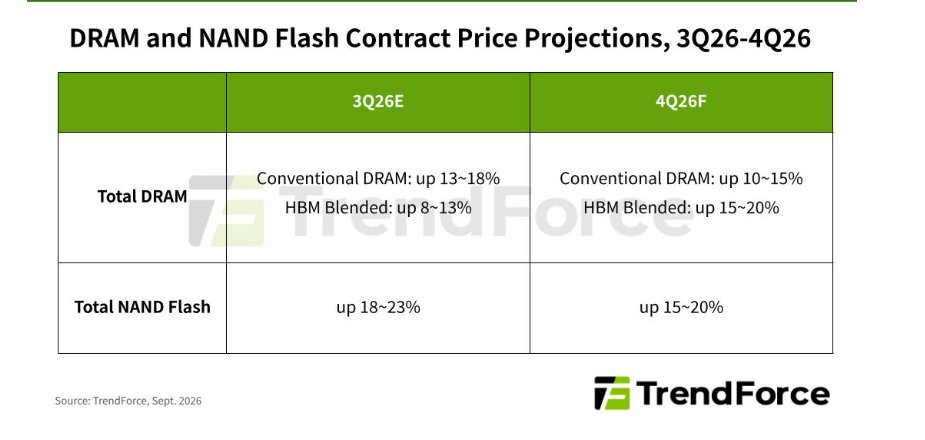
HBM's price increase also compounded product upgrades and supply bottlenecks. TrendForce recently raised the 2027 HBM mixed average sales price (blended ASP) forecast to a 121% year-on-year increase. Based on HBM and conventional DRAM competing for limited advanced processes and wafer production capacity, it will take time for the yield of next-generation products to climb. At the same time, the share of higher-priced HBM4 is increasing, and HBM4e is gradually being rolled out. As a result, this figure includes the combined contribution of price increases and product portfolio upgrades. The judgments of the two authorities have jointly strengthened the core arguments of semiconductor bulls — AI demand is extending the pricing advantage of suppliers, the duration of high sales prices, and its ability to turn them into profits, making more investment sense than just whether the percentage increase decelerates.
However, rising storage prices do not mean that all semiconductor companies will benefit at the same time. Supply capacity, product mix, customer bargaining power, and the pace of production expansion will all affect the increase in profits that an enterprise can ultimately obtain. For investors, what is really worth paying attention to is whether price increases can continue to translate into revenue growth and profit improvements.
Philadelphia Semiconductor fell back, and China and South Korea turned strong! Wall Street still sees Nvidia as a bullish pricing anchor for the AI super counterattack market
With the volume of broad-based ETF transactions, Ningde Era rose 7.80% and Zhongji Xuchuang rose 3.82%. The weight of new energy and computing power and hardware combined to drive index restoration, and the humanoid robot sector strengthened at the same time. Judging from the investment logic of the AI computing power industry chain, this reversal reflects the resonance of order confirmation, repurchase support, and risk appetite restoration. It also echoes the continued surge in revenue generation associated with Meta and SpaceX's AI application, and the industry background of KeyBanc and TrendForce optimistic about storage pricing — pressure on global semiconductor and broad technology stock valuations does not necessarily mean that AI demand declines simultaneously; those can transform overseas capital expenditure into actual delivery, profit, and cash flow Strong fundamentals of AI computing power industry chain leaders, such as Nvidia, the AI chip superleader, are getting an opportunity for the market to re-examine their value.
The dramatic “Deep V” reversal story in the technology sector of the Asian market on Friday, which was dominated by a major reversal rise in the Chinese and South Korean stock markets, was essentially not driven by news. The macro-level positive catalysts and favorable news information on the entire Asian trading terminal were very poor, and almost no important macro-level dynamic news popped up.
This round of rebound is more like being driven by the Korean stock market. A Wall Street analyst's latest quick market review shows -- on the one hand, after the concentrated sell-off of South Korean technology stocks over the past two weeks, some investors may have profiably closed their short positions, and capital to buy at a low point has begun to enter the market. When new sales weaken, short recovery and bottom-up funds appear at the same time, this may cause a sharp rebound in the Korean stock market on Friday. On the other hand, more and more capital sees the seriously undervalued side of Korea's KOSPI Index. The expected price-earnings ratio for the next 12 months has dropped to only 4.2 times, which is much lower than the NASDAQ and Philadelphia Semiconductor Index.
There was a sharp “deep V” reversal in Chinese and South Korean technology stocks on Friday. Some analysts understood this from the changes in trading strength after continuous sell-offs. After South Korea's technology stocks experienced a concentrated decline, a bears' recovery trajectory began to emerge, and funds began to be placed on dips. In particular, most bears may be able to redeem their previous strong shorting gains by buying back stocks; when marginal selling pressure weakens, active purchases are compounded with potential bearish compensation, and even if additional benefits are limited, they may amplify intraday gains. At the same time, the rise in the technological weight of Korean chip stocks and A-shares echoed each other. News of orders, repurchases, and listing arrangements at the company level further improved sentiment and pushed the market from centralized position reduction to recovery from overfall.
The core of this adjustment is that the market remains extremely optimistic about AI computing power resources and the demand for AI applications dominated by AI agents, yet it places higher requirements on investment scale, financing arrangements, and return delivery speed. Brent crude rose 4% to $113.17 on Thursday, strengthening concerns that capital costs associated with inflation and AI remain high; however, safe-haven purchases on the same day drove 10-year US Treasury yields down about 19 basis points to 4.95%. Therefore, the sharp decline in technology stocks in the US stock market cannot simply be attributed to expectations of the Federal Reserve interest rate hike against the backdrop of the sharp rise in oil prices and natural gas prices on the same day and the trend of high US bond yields — AI financing costs, which are near historical highs, are a continuous constraint, and the stock market sell-off itself also pushes capital to treasury bonds, indicating that investors are reducing their risk exposure.
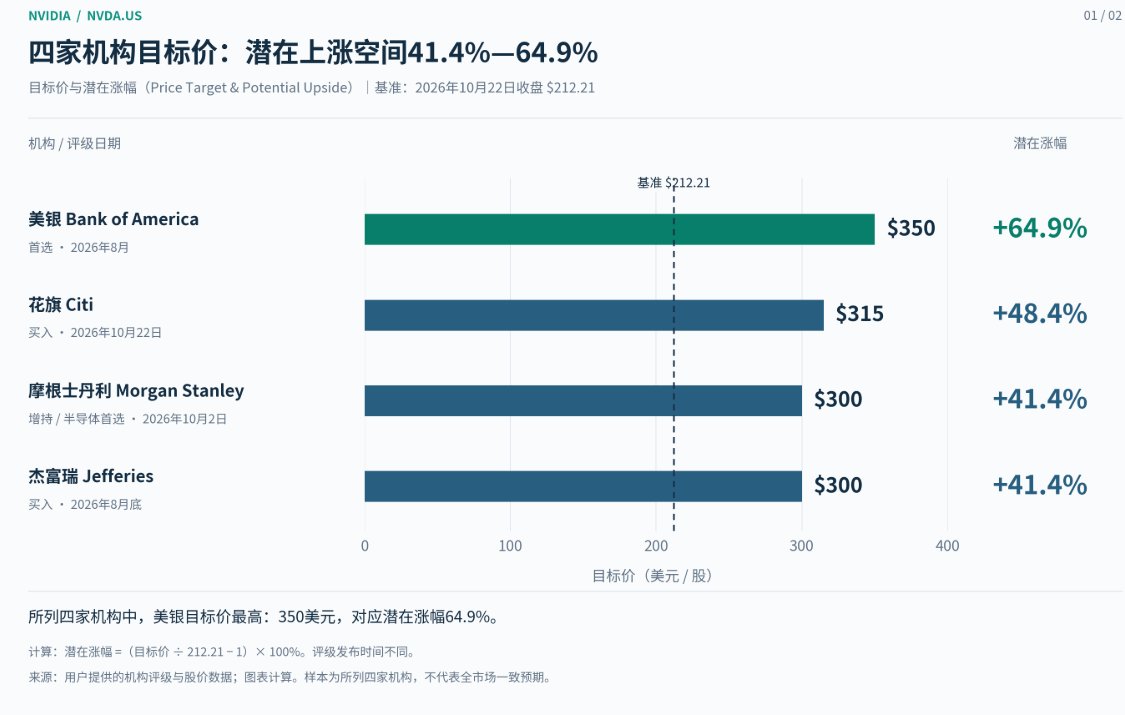
Nvidia, with a market capitalization of about 5.11 trillion US dollars, is still an important bullish pricing anchor for Zhongher Street in this round of intense market differences. Citi maintained a “buy” and target price of $315 in the Berlin GTC review on October 22, believing that the main factor limiting AI expansion is still the speed of manufacturing and deployment; Morgan Stanley resumed its “semiconductor first choice” status on October 2 and maintained a target price of $300. The Bank of America's August report also listed it as the first choice, with a target price of $350. Jefferies reiterated a “buy” of $300 at the end of August. These judgments are supported by the volume of Rubin and Vera CPUs, the expansion of the customer range, and Nvidia's ability to increase the computational output and system value that can be delivered per unit of electricity.
Based on Nvidia's closing price of $212.21 on October 22, $300, $315, and $350 correspond to potential growth potential of about 41.4%, 48.4%, and 64.9%, respectively; based on a total share capital of about 24.1 billion shares, it is estimated that the total share capital remains unchanged, corresponding to a market capitalization of about 7.23 trillion yuan, 7.59 trillion US dollars, and 8.44 trillion US dollars. This set of pricing expresses a judgment on future profit expansion. The fulfillment path still revolves around the delivery of the next-generation AI computing power cluster superplatform, the launch of customer computing power, and continuous procurement.
The highest target price in the above statistics comes from the $515 target price proposed by Raymond James analyst Simon Leopold, which is 137.91% higher than $216.47. He recently expressed this judgment once again in an interview with Bloomberg. The model predicts that revenue for the fiscal year ending January 2029 may be close to 1 trillion US dollars, and is estimated at about 22 times the 2028 natural year profit, corresponding to earnings per share of approximately $23.41. The keys underpinning this judgment are supply improvements to unlock delivery capacity, Rubin and Vera to expand system revenue, and customer growth such as enterprise, sovereign AI, and professional clouds. Therefore, this most optimistic target price is mainly based on significantly higher profit predictions. The production expansion agreement, modular deployment, and industrial application expansion conveyed by the Berlin GTC correspond to the key aspects of whether these predictions can be fulfilled. However, the target price still depends on revenue growth, profit margins, and whether valuation assumptions can be achieved, which does not mean that the stock price will necessarily reach the corresponding level.
Demand for AI computing power is still very strong, but the market is starting to keep asking who can quickly get back the investment
The market directly explained Tesla's reduction in annual capital expenditure as a weakening demand for computing power in the entire AI industry, which can be described as completely ignoring its investment structure and project pace. According to the AI capital expenditure forecast and outlook of the J.P. Morgan strategist team, hyperscale cloud vendors will spend about 950 billion US dollars in 2026, 1.4 trillion US dollars in 2027, and 3 trillion US dollars in 2030.
Tesla's third-quarter revenue of US$28.046 billion was basically the same, with adjusted earnings of $0.48 per share; management adjusted its annual capital expenditure forecast from over US$25 billion to about US$20 billion, but still expects investment in Robotaxi, Optimus, solar energy manufacturing, and AI computing power to expand in the next few years. Its capital expenditure covers automotive, energy, and robotics manufacturing, and is not a direct indicator of cloud computing needs. Terafab's large equipment investment was mainly carried out in subsequent years. The cost sharing between Tesla and SpaceX has not yet been determined, and the potential merger is still being explored by the Special Committee. Therefore, it is difficult to infer the final investment amount for related projects by observing Tesla's expenses in that year alone.
Tesla's earnings report also shows that profit improvements need to be dismantled from the source: the gross margin of the automobile business after excluding credit revenue rose from 16.3% to 18.1% in the second quarter, partly supported by structural improvements in the delivery area; the gross margin of energy increased from 20.4% to 33.1%, which clearly benefited from tariff refunds and reduction in warranty reserves. Free cash flow in the third quarter reached US$1,531 million, driven by a combination of increased operating cash flow and a month-on-month decline in capital expenditure. These changes are insufficient to prove that demand for AI applications and computing power resources has declined as described by some pessimistic strategists, nor can they directly prove that autonomous driving and robots have formed mature profit engines.
In contrast, Facebook and Instagram parent company Meta provided more direct evidence of AI commercialization. Revenue for the third quarter was US$64.601 billion, up 26% year on year, of which advertising revenue was US$63.61 billion; ad impressions increased 10%, and average advertising prices rose 14%. Fourth-quarter revenue guidance was US$73-76 billion, with a midpoint of US$74.5 billion, higher than market expectations of US$73.65 billion. Although legal fees reduced GAAP operating profit by 37% year over year, it still increased 11% after excluding this impact. What is more explanatory is that the company estimates that advertisers using AI business assistants get nearly 5% additional conversion at the same single conversion cost, and advertising investment is nearly 10% higher than those who have not adopted it — cutting-edge AI smart technology led by Muse is supporting Meta's current business growth by improving the input-output ratio of advertisers.
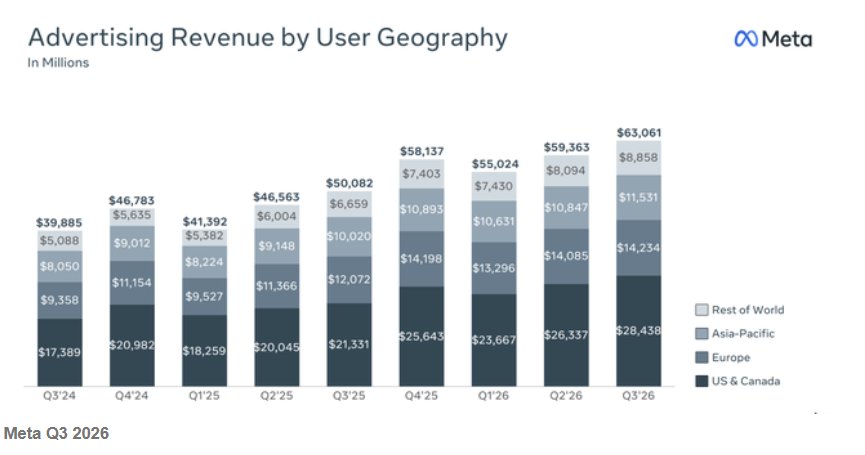
Muse can be said to have completely opened up Meta's new commercialization space — after about six weeks of launch, more than 10 million people in the US and Canada have set up personal smart devices, and about 25% of the set-up users will use it any day; the shopping function covers more than a quarter of the weekly users. Subscriptions, transaction services, enterprise APIs, Muse Code, and business agents form a follow-up revenue path. Management expects the new AI business to start contributing incremental revenue in 2027, and plans to increase computing power cost efficiency by more than ten times in the next year. What is particularly noteworthy is that the existing advertising business already reflects AI returns, and Muse's focus is to transform usage growth into sustainable unit economic benefits. After the disclosure of financial reports, Bank of America and Citibank raised Meta targets to $845 and $905 respectively, both maintaining “buying”; compared to Thursday's closing price of $648.85, this corresponds to potential increases of about 30.2% and 39.5%.
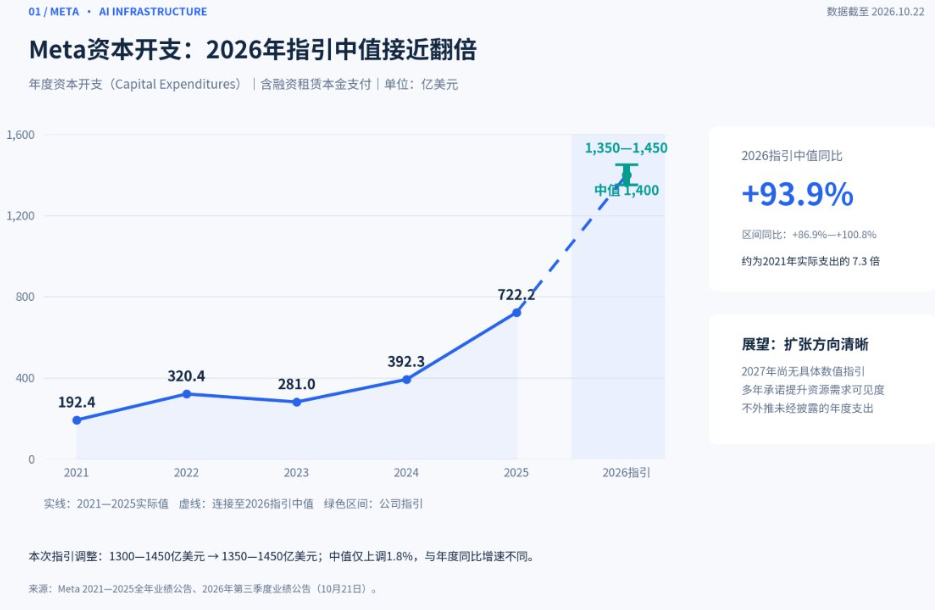
But the increase in revenue has yet to offset the cash consumption of the expansion. Meta's capital expenditure in the third quarter was US$34.91 billion, up about 80% year on year; the lower limit of guidance for the whole year was raised from US$130 billion to US$135 billion, and the upper limit remained at US$145 billion. After deducting the investment for the first nine months, capital expenditure for the fourth quarter is estimated to be about US$49.2 billion to US$59.2 billion, an increase of about 41% to 70% over the third quarter.
Meanwhile, Meta's free cash flow for the third quarter was negative US$2.12 billion, and the book value of debt was about US$83.67 billion, slightly higher than US$82.44 billion in cash and marketable securities. The addition of non-voting stock classes provides a tool for future financing; the proportional distribution of shares alone does not bring cash. The increase in third-party cloud and AI token procurement costs indicates that Meta continues to purchase external services in addition to self-construction. From this, it is understandable why its stock price is under pressure — those computing power resource suppliers in the AI computing power industry chain are supported by strong AI computing power demand, while Meta shareholders need to wait for additional revenue to cover depreciation, operating expenses, and capital investment in the expansion.
SpaceX provided another set of evidence that revenue was realized — the company's third-quarter revenue was $14.575 billion, up 161% year over year; revenue from the super-smart business, which included cloud services, software, and advertising, was $7.56 billion, up 830% year over year, and operating profit corrected to $431 million. Management said that short-term computing power contract renewal prices continue to rise, and the online computing power is expected to reach at least 13 gigawatts by the end of 2027. Bank of America raised the target price from 235 US dollars to 275 US dollars to maintain “buying”. It values that the revenue guide for the first quarter of 2027 billion to 37 billion US dollars significantly exceeded market expectations of about 22 billion US dollars before the earnings report; compared to the closing price of 144.75 US dollars on Thursday, the target price corresponds to about 90% of the potential increase space.
SpaceX's strong earnings report and outlook also provided demand-side support for Nvidia's Berlin GTC's computing power expansion narrative. Musk further stated that the online computing power capacity is expected to reach 2.5-3 gigawatts by the end of the year, and he is confident that another 10 gigawatts will be added in 2027. Next year's deployment will mainly use the Nvidia Vera Rubin platform. This expansion plan echoes the DSX POD shown by GTC to accelerate on-site deployment and expand production capacity in key supply chains: customers need faster access to computing power that can be put into operation, and Nvidia is focusing on shortening the distance between hardware delivery and computing power service revenue generation. For the semiconductor market, the realization of AI business revenue is mutually confirmed by the next-generation computing power procurement plan, providing more specific support for order growth expectations for the entire AI computing power industry chain, including Nvidia AI GPUs and HBM, data center high-speed optical interconnection, power supply, and liquid cooling chains, and adding fundamental catalysts to the “AI bull market narrative.”
Financing is still supported, and storage still has pricing power: what is the motivation for a super semiconductor counterattack or even a new round of bull market?
J.P. Morgan Chase's latest financing estimates draw a line between “cash pressure on individual companies” and “stagnating investment in the entire industry”: global listed technology companies are expected to generate about 2.2 trillion US dollars in operating cash flow this year. According to the bank's statistics, there is still a financing surplus of about 400 billion US dollars after covering related investments; the gap between Xinyun's operating cash flow of about 30 billion US dollars and 80 billion US dollars of investment is about 50 billion US dollars. The judgment is that financing pressure may change construction entities and financing methods, and that enterprises with more stable balance sheets still have the ability to undertake projects, and can also release capital by adjusting repurchase arrangements. At the same time, semiconductors' market capitalization weight of about 13% of the global index contributed about 21% of the risk. Increased fluctuations in concentrated holdings can easily trigger passive position reduction; the fall in positions from the September high means that the technical pressure that had previously amplified the decline is being digested.
Michael Wilson, the chief stock market strategist from Morgan Stanley, recently focused his layout ideas on profit quality and financing affordability. According to Morgan Stanley's calculation data, the quality factor has risen by about 6% since mid-August, and the equivalent weight S&P 500 has declined by nearly 4% during the same period; profit revisions for high-quality companies and low-quality companies are further divided, making him inclined to prepare for increased risk exposure.
The team of strategists led by Wilson predicts that in 2027, hyperscale cloud vendors and new cloud enterprises will spend about 1.58 trillion US dollars on AI capital, and the profits of AI-related companies are expected to increase further by about 25%, and non-AI companies by about 4%. This means that the adjusted selection criteria should pay more attention to order fulfillment, cash generation, and profit improvement capabilities; companies such as Nvidia, Broadcom, and Micron in the latest “Preferred Stock” screening list by the Wilson-led strategist team reflect this direction.
The market's eye on the topic of AI computing power — that is, the long and empty debate in the field of memory chips — is focused on whether the slowdown in price increases means that profits are about to collapse. Another Wall Street financial giant, Bernstein's objection has three levels: NAND and conventional DRAM contract prices are still expected to rise 15% to 20% and 10% to 15% month-on-month respectively in the fourth quarter, which is at an all-time high; under a high base, the absolute increase in NAND's price per GB is still considerable, which can significantly increase gross profit when the unit cost is relatively stable; the price upper limit of long-term agreements will also mechanically reduce the mixed average price increase. For example, assuming that 40% of sales volume has reached the price limit of Changxie, the market price of other sales has risen by 30%, and the overall average price increase is only 18%. Based on this, it cannot be assumed that demand has plummeted. SanDisk data center's share of bit-element shipments rose from 12% to 38%, and Changxie's lower price limit also strengthened the downward protection of some sales, forming the basis for the bank's opposition to pricing at the top of the traditional cycle with a lower multiple.
The Bernstein analyst team also pointed out that the average price of near-line hard drives per EB increased by only 13.6% year over year. Compared with the previous sharp price increases for DRAM and NAND, there is still more room for price repair; therefore, maintaining Seagate as the first choice, Western Digital and SanDisk “outperformed the market”, and the three companies' profit forecasts for the 2027 fiscal year were about 12% higher than the consensus. Bank of America's bullish logic further covers technological upgrades: advanced GPU and ASIC updates drive demand for HBM, SOCAMM, and enterprise-grade SSDs. Even if profit growth slows in 2028, absolute profit is expected to approach the high level of 2027.
Looking at the underlying architecture, multi-step agents simultaneously increase model reasoning, tool execution, and state management loads: GPUs and dedicated accelerators perform model computation, CPU execution of browsers, database queries and task orchestration, HBM and server DRAM carrying models, contexts and concurrent environments, enterprise SSDs store indexes and task states for high-frequency access, high-speed networks and optical interconnections support distributed switching, and power and liquid cooling determine the scale at which the cluster can continue to operate. Long-term storage data that still grows after screening, compression, and deduplication supports HDD capacity requirements. Therefore, demand expansion can be transmitted along multiple aspects of computing, memory, storage, interconnection, and infrastructure, and changes in the configuration of a single GPU are insufficient to represent changes in procurement throughout the data center.
This transmission has already been echoed by the manufacturing and deployment side — TSMC, the “king of chip foundry,” saw a 41.2% year-on-year increase in dollar revenue in the third quarter, and lithography giant ASML (ASML) said the current 2027-2028 supply plan was still insufficient to fully meet customer needs. The DSX POD released by GTC in Berlin has been pre-integrated and verified at the factory, shortening on-site deployment to as fast as 14 days after the site's electricity, cooling, and network are ready; partners such as Nvidia and Amkor have expanded production capacity for packaging, testing, and optical engines, improving future delivery capabilities. For Nvidia, Broadcom, AMD, Micron, SK Hynix, TSMC, and Amkor, the investment value is determined by their respective product shares, delivery pace, and profit margins, but they all benefit from the transformation of computing power requirements into deliverable systems.
Next week's market focus: Cloud giants and Intel financial reports are appearing one after another, and AI investment is facing a test
After experiencing a sharp drop in US semiconductor stocks and a counterattack by Chinese and South Korean technology stocks this week, the market will usher in a new round of key financial reports next week. Microsoft, Alphabet, Amazon, and Intel will announce results from October 28 to 29. From cloud services to chip manufacturing, the performance and management guidance of these companies will provide new clues for investors to determine AI needs, capital expenditure, and the prosperity of the semiconductor industry chain.
For Microsoft, Alphabet, and Amazon, the focus of the market will be on the business growth rate of Azure, Google Cloud, and AWS, and whether AI-related revenue can keep up with the growth rate of infrastructure investment. As data center construction continues to drive up capital expenses, investors will also pay attention to the three companies' subsequent investment plans, computing power supply progress, and cash flow performance. If the cloud business continues to grow strongly and AI commercialization becomes more advanced, it will help support the market's judgment on AI infrastructure needs; conversely, if capital expenditure continues to rise and returns are still uncertain, related stocks and their upstream supply chains may continue to face valuation pressure.
Intel's earnings report will provide another perspective on the semiconductor industry. Investors need to pay attention to their data center and client business performance, product competitiveness, manufacturing and OEM business progress, and management's judgment on future needs and business prospects. Unlike cloud giants who mainly answered “can AI investment be converted into revenue”, Intel's performance is more directly related to the traditional CPU market, data center processor demand, and progress in its own business transformation. Whether its earnings report can send a positive signal may also affect the overall sentiment of the market towards the semiconductor sector.
Therefore, the key to next week's earnings season is not only whether corporate revenue and earnings per share exceed expectations, but whether the different sectors can give mutually confirming signals: whether cloud giants will continue to expand AI investment, whether AI services can bring more clear revenue growth, and whether chip companies can improve business performance from expanding demand. If these signals improve overall, the recent semiconductor sell-off may be seen as a sentiment and valuation adjustment; however, if capital expenditure returns, business growth, or profit guidelines fall short of expectations, the market's fragmentation of the AI industry chain may also further intensify.
Taken together, the increase in memory chip prices, the expansion of advanced packaging production, and the continued construction of AI data centers still provide fundamental support for the semiconductor industry chain; the strong counterattack by Chinese and South Korean technology stocks also shows that some capital has not abandoned the AI growth narrative.
However, strong demand does not mean that stock prices only rise or fall. As the scale of investment in AI infrastructure continues to expand, the market is shifting from simply chasing computing power needs to paying more attention to profit quality, financing conditions, and return on investment. Next week's earnings reports from Microsoft, Alphabet, Amazon, and Intel will provide a new round of testing of this disagreement: can the expansion of AI computing power continue to support the semiconductor bull market narrative, or whether the market will further require companies to provide more clear proof of revenue and cash flow.