


The physical prices of some Middle Eastern crude oil sold outside the Persian Gulf have fallen because oil producers and global traders are becoming more and more skilled in transporting crude oil out of the Strait of Hormuz despite ongoing attacks.
According to an Asian refiner who received the offer, the number of offers for spot crude oil varieties has increased in recent days, and these shipments are being sold abroad at more competitive prices. They asked for anonymity because they didn't want to discuss commercial information by name.
These refiners said that in the signs of this transformation, a shipment of Iraqi Basra intermediate crude oil was traded on a ship-to-ship transfer in the Gulf of Oman outside the Strait of Hormuz. The transaction price was close to $10 per barrel compared to the Dubai spot benchmark price. However, a month ago, the price of crude oil in Basra in Iraq was still basically the same as the Dubai benchmark price.
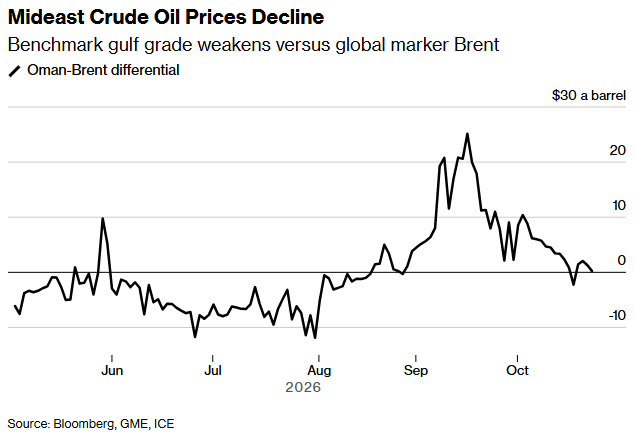
Middle Eastern crude oil prices fall
The focus of the global oil market is still on transportation flows in the Strait of Hormuz. At this point, the US-Iran war is nearing the end of its eighth month. Ahead of the US midterm elections in November, Tehran appears to have intensified its attacks on shipping. Meanwhile, President Donald Trump said that more crude oil is being shipped from the region than before the conflict broke out.
The decline in real prices of some Middle Eastern crude oil is in stark contrast to the trend of benchmark crude oil futures. The Brent crude oil contract is expected to rise for the third consecutive week, hitting its highest level since May on Friday. The divergence between the physical market and the futures market has always been a feature of this war.
Warren Paterson, head of commodity strategy at Dutch International Group, said: “Although transportation flows in the Middle East are currently being maintained well, what the market is really worried about is how long this situation will last in the face of a resurgence of attacks, which helps explain the divergence between the paper market and the physical goods market.”
He added: “The current rise in crude oil futures is not driven by fundamentals; the market is actually trading supply risks.” The latest Brent crude oil futures report is close to 115 US dollars per barrel, up from about 103 US dollars a month ago.
According to traders, the decline in the physical prices of Iraqi crude oil and other grades of crude oil stemmed from increasingly competitive offers, and these offers were accompanied by guarantees of the ability to transport oil out of the Gulf.
Apart from the activities surrounding the trading of Iraqi crude oil, the overall buying trend is also heating up. This week, refiners in India, Taiwan, and South Korea bought or issued tenders for crude oil that can be delivered in early 2027 at the latest. Meanwhile, Hafj crude oil from the Saudi-Kuwait neutral zone and Shaheen crude oil from Qatar all have offers that can be delivered by January next year at the latest.
Affected by this, prices of other physical crude oil grades in the region, including Omani crude oil, have also declined. The rise in Omani crude oil against the Dubai benchmark price has recently slipped to a three-month low. The price of Murban crude oil exported from outside the Strait of Hormuz also weakened somewhat.