


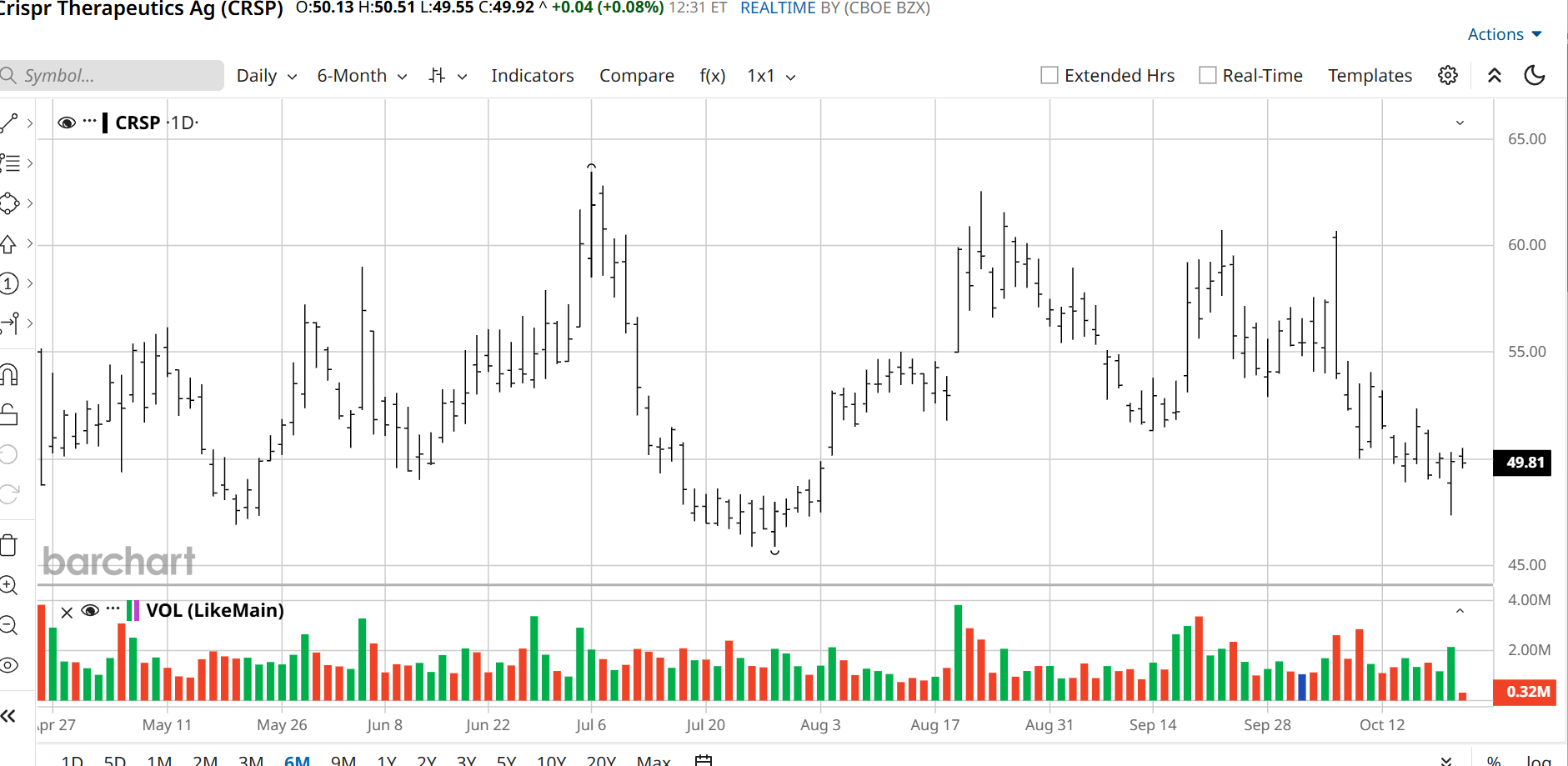
CRISPR Therapeutics' (CRSP) CFO recently resigned, potentially signaling that CRSP stock could be heading for a downturn. Further, the shares are changing hands at an exorbitant valuation, while most of the company's drugs will likely not complete late-stage trials for many years. Given these points, investors should think about unloading CRISPR's shares.
About CRISPR Therapeutics
The company develops drugs using a gene-editing technique known as CRISPR/Cas9 and focuses on attempting to treat genetic diseases. In Q2, it generated revenue of $10.2 million.
The CFO's Resignation May Bode Poorly for CRISPR
On Oct.19, CRISPR disclosed that its CFO, Raju Prasad, had decided to step down “to pursue external opportunities.” Although CFOs sometimes resign because of issues that have nothing to do with their companies' outlook, such as personal reasons and the ability to work for a larger company, occasionally they do leave because their firms' outlook is deteriorating. Consequently, Prasad's resignation adds some risk to CRSP stock.
CRSP's Pipeline Is Not Very Advanced
One of CRISPR's drugs, a treatment for transfusion-dependent beta-thalassemia (TDT) and sickle cell disease called Casgevy, was approved in 2023 and 2024, respectively. But the other treatments in its pipeline do not appear to be in advanced stages of clinical development, so it will likely be at least two or three years until CRSP stock is meaningfully boosted by anticipation of revenue from these drugs. CRSP presented Phase 1 data for its treatment for LDL cholesterol and triglycerides, CTX-310, and Phase 1 data for zugo-cel, a potential treatment for autoimmune diseases and B-cell blood cancers, is due to be presented next month.
CRISPR reported in August that CTX-310 had delivered in its Phase 1a trial “deep and durable reductions in circulating ANGPTL3, triglycerides (TG), and low-density lipoprotein (LDL) that were sustained through one year of follow-up.” Indeed, the triglycerides and LDL cholesterol of adults who took the drug fell by as much as 78% and 84%, respectively. On average, they dropped 48% and 53%, respectively. Still, CTX-310 is only in a Phase 1b trial, although data from the latter study is supposed to be presented in November. But it will nevertheless likely be years before the Street starts raising its revenue estimates for CRSP based on the drug's potential.
The Valuation of CRSP Stock Is Extremely High
The shares are changing hands at an extremely high price-to-sales ratio of 1,378 times. But on a positive note, analysts, on average, expect the company's sales to surge to $151 million in 2027. That would bring the firm's price-sales ratio down to 31.8x. However, 31.8x is still an elevated valuation.
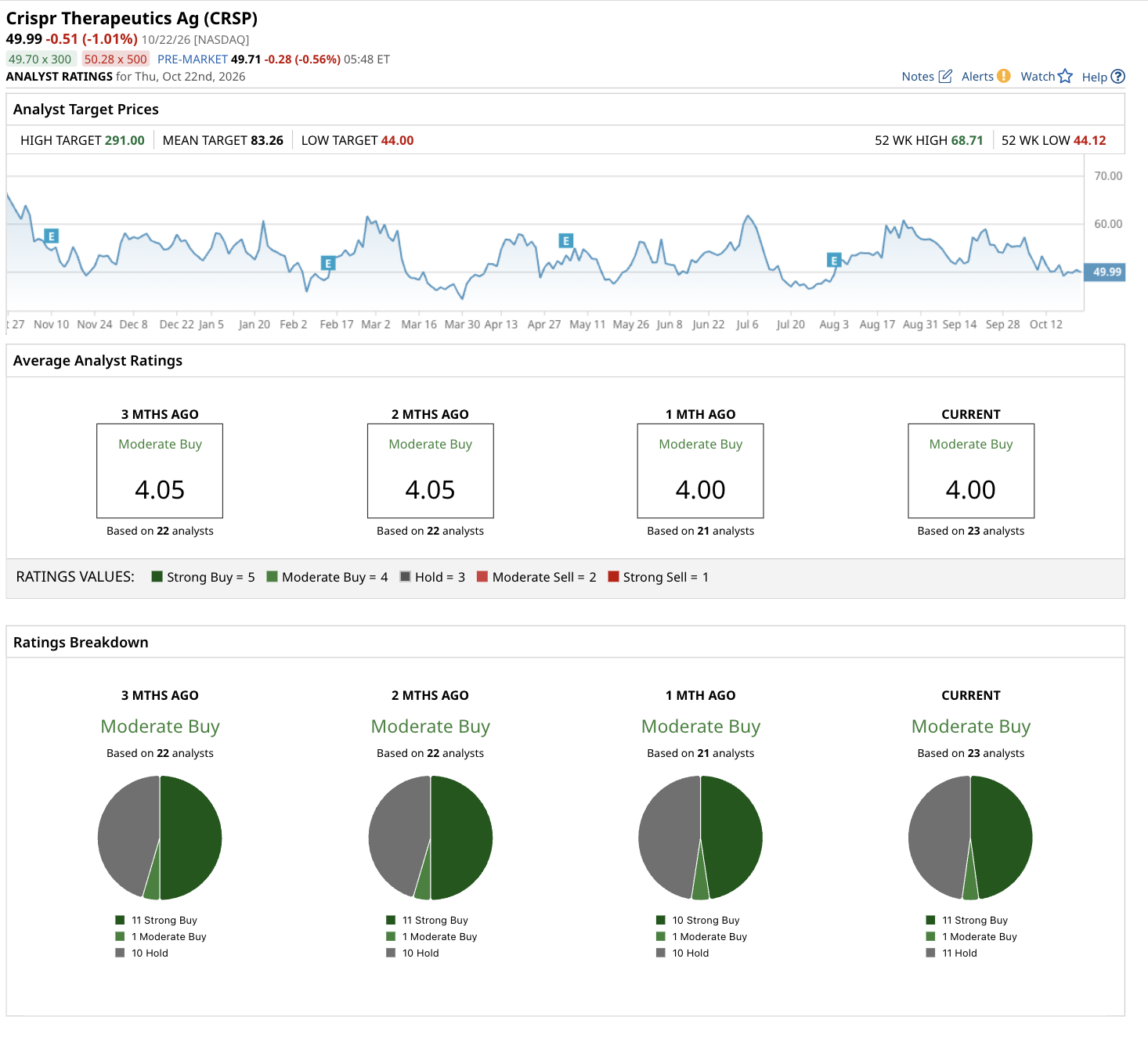
Even so, Wall Street maintains a bullish outlook for the stock with a consensus “Moderate Buy” rating. Of the 23 analysts covering CRSP stock, 11 rate it a “Strong Buy,” one rates it a “Moderate Buy,” and 11 rate it a “Hold.”
Given the early-stage nature of the drug maker's pipeline and the resignation of its CFO, I don't see CRSP stock as a top-notch pharmaceutical name at this point.
On the date of publication, Larry Ramer did not have (either directly or indirectly) positions in any of the securities mentioned in this article. All information and data in this article is solely for informational purposes. For more information please view the Barchart Disclosure Policy here.