


The Zhitong Finance App learned that on October 23, KPMG released the “Fintech Trends for the First Half of 2026” report. Fintech investment continued to grow in the first half of 2026, building on the strong performance of 2025. Global fintech investment (including venture capital and private equity) increased from US$72.2 billion in the second half of 2025 to US$103.1 billion in the first half of 2026, which is expected to hit a new high of investment in four years. The global fintech industry continues to mature, and companies continue to expand their business scale, enrich their product matrices, and explore new markets.
Analysis by financial technology category
Payment technology
Investments in the payments sector jumped sharply in the first half of 2026, reaching US$44.2 billion, compared to US$20.2 billion for the full year of 2025. Most of this increase came from an unconventional transaction: Global Payments bought Worldpay for $24.3 billion. The deal reflects a broader capital allocation theme the bank has observed over the past 18 months — investors are still confident in the payments sector, but capital is concentrated on a few large transactions, and favors companies with scale effects, profitability, and focus on infrastructure rather than early speculative investments.
Insurance technology
In 2025, total investment in insurtech reached a four-year high of 9.8 billion US dollars, but this was mainly driven by a few hyperscale exchanges, rather than general improvements in industry fundamentals; in the first half of 2026, total investment in this sector fell back to 3.7 billion US dollars. The number of transactions is particularly weak, with only 124 transactions worldwide; if this trend continues, it will be the lowest number of transactions since 2016.
network security
In the first half of 2026, global fintech-oriented cybersecurity companies received an investment of US$550 million; compared to US$1 billion in 2025, this is significantly lower than the level of earlier years. Trading activity is sluggish, with only 44 transactions in the middle of the year, which is expected to hit a six-year low.
digital assets
In the first half of 2026, total global investment in the digital asset sector was US$11.1 billion, with a total of 467 transactions; although lower than the full year of 2025 of US$21.9 billion and 1,335 transactions, this total amount is still quite impressive, exceeding the annual levels of 2023 and 2024 respectively. The US accounted for more than half (US$5.9 billion) of total digital asset investment in the first half of 2026, although it accounted for less than half of the transactions (187 transactions).
Regulatory technology
In the first half of 2026, regulatory technology attracted a total of US$2.9 billion in global investment; although the number of transactions fell to 133, the lowest level since 2017, the pace of investment accelerated slightly compared to US$4.8 billion for the whole of 2025. The Americas attracted most of the investment in regulatory technology, including the three largest deals in the first half of 2026.
Wealth technology
Investments in Fortune Tech were extremely weak in the first half of 2026, at least as far as venture capital, private equity, and M&A deals were concerned. During this period, there were only 32 transactions in the global wealth technology sector, totaling 220 million US dollars, down from 74 transactions and 1.4 billion US dollars for the whole of 2025. If this trend continues, the sector could experience the lowest level of investment since 2018.
Analysis by investment region
America Zone
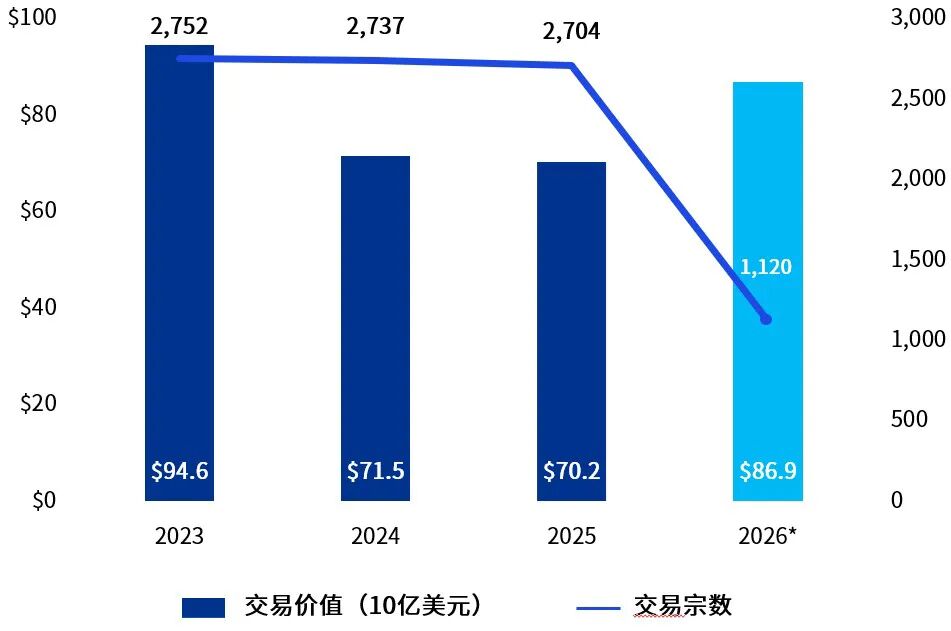
Fintech investment in the Americas rose sharply, from US$47.1 billion and 1,315 transactions in the second half of 2025 to US$86.9 billion and 1,120 transactions in the first half of 2026. Among them, the US accounts for 80.8 billion US dollars, 933 transactions, and covers the top ten global transactions in 2026.
Figure: Total Fintech Investment in the Americas (Venture Capital, Private Equity and M&A) 2023-2026*
Europe, Middle East, and Africa
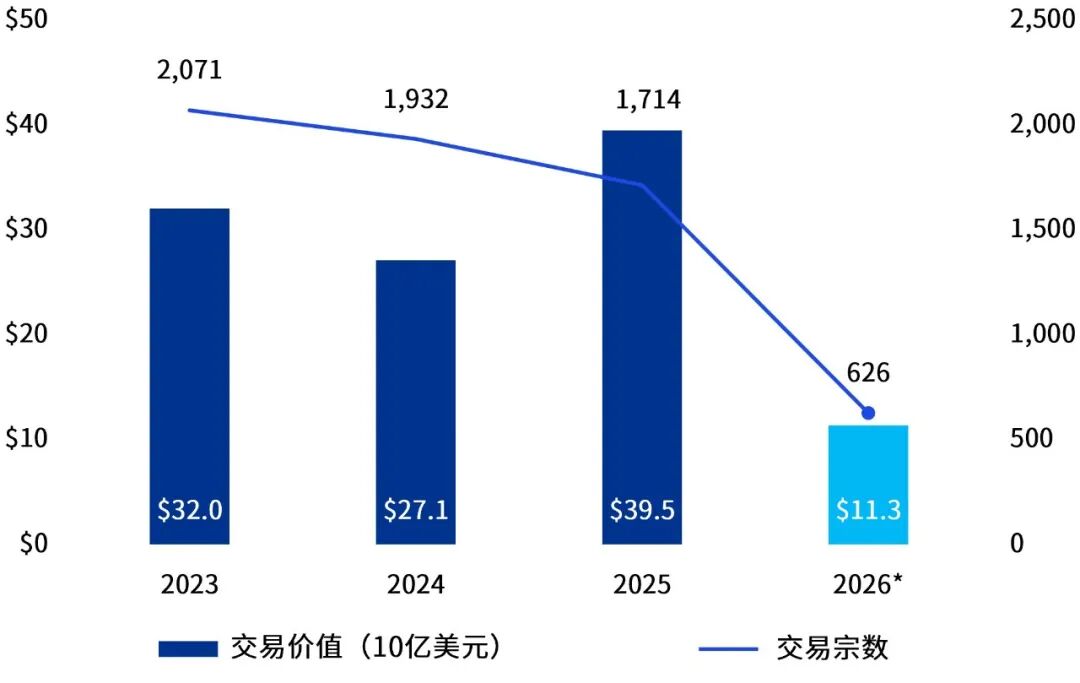
Against the backdrop of continued geopolitical and macroeconomic uncertainty, fintech investment in Europe, the Middle East, and Africa started sluggish in 2026. The region attracted $11.3 billion in investment in the first half of 2026, involving 626 transactions.
Total fintech investment in Europe, Middle East and Africa (venture capital, private equity and mergers and acquisitions) 2023-2026 *
Asia Pacific
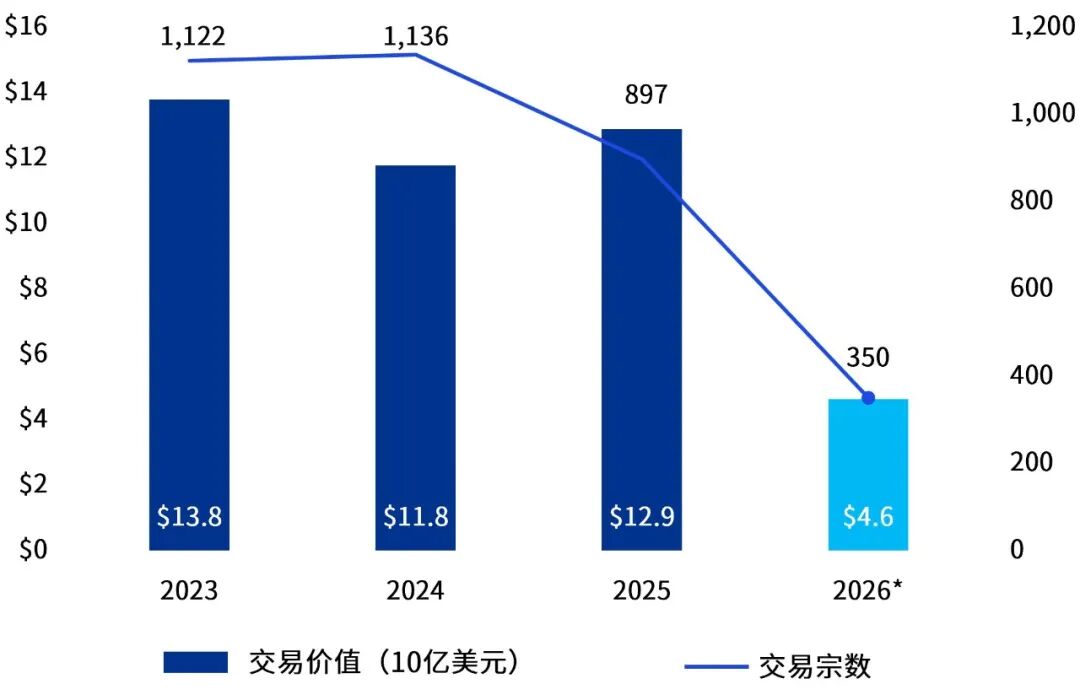
In the first half of 2026, fintech investment in the Asia-Pacific region was US$4.6 billion, with a total of 350 transactions, down from US$7.1 billion and 426 transactions in the second half of 2025. Trading volume was particularly sluggish in the first quarter of 2026 ($1.2 billion), then rebounded to $3.4 billion in the second quarter. There are many reasons for this weakness, including fintech investors continuing to reevaluate late-stage valuations, changing regulations, and geopolitical risk exposure.
Asia Pacific Fintech Investments (Venture Capital, Private Equity and M&A) 2023-2026 *
Trend forecasting
The report predicts the development trend of fintech in the first half of 2026:
Infrastructure has become the main investment focus: as the market's attention to stablecoins and digital assets continues to increase, and the market needs to expand and implement related solutions on a large scale on a regional and global scale, infrastructure may become the main layout direction for investors. In addition to infrastructure related to stablecoins and digital assets, the scope of investment may be further expanded: traditional financial institutions around the world are paying more and more attention to upgrading their core infrastructure to enhance competitiveness and better protect data and core business operations.
Interest in artificial intelligence is growing, but actual business value is more important: artificial intelligence is expected to continue to attract huge investment in various industries; however, as the market becomes more aware of the high cost of artificial intelligence, the investment direction may gradually shift from pilot projects to startups that can actually prove the ability to create value. AI native startups are expected to gain more popularity, and investors are looking for artificial intelligence startups with unique and difficult to replicate value propositions.
Intelligent agency business is driving investment in various related fields such as cybersecurity: intelligent agency commerce, that is, the model of using AI intelligent agents to complete shopping and transactions on behalf of individuals and enterprises, continues to develop, and investment in supporting fields will grow accordingly, including cybersecurity, digital identity management, etc., to ensure that transactions are authorized and protected to resist attacks by malicious actors. Payment solutions and infrastructure for smart agency businesses are also expected to receive investment.
The intensification of integration is particularly evident in the payment sector: industry integration in various segments of fintech may be further intensified, the performance of the payment circuit is particularly obvious, and the advantages of leading companies in the industry will continue to be highlighted. The activity of private equity investors may increase, seeking opportunities to acquire and integrate struggling companies that are difficult to obtain financing and have insufficient market share, and reshape corporate competitiveness.
Support the sovereign capacity building of the fintech ecosystem: The global emphasis on sovereign capabilities in the fields of artificial intelligence and national defense will be extended to the financial services market. The market will pay more attention to creating localized and regional autonomous solutions in digital identity management, cybersecurity, and other financial service infrastructure fields.
epilogue
After years of contraction, fintech investments are regaining their footing. Although the number of transactions is still sluggish, the increase in capital investment and the recovery of exit activity reflect growing investor confidence, particularly on platforms with scalable capabilities in the digital assets and artificial intelligence sector. As liquidity improves, KPMG expects this new momentum to translate into more active trading over the coming year.