


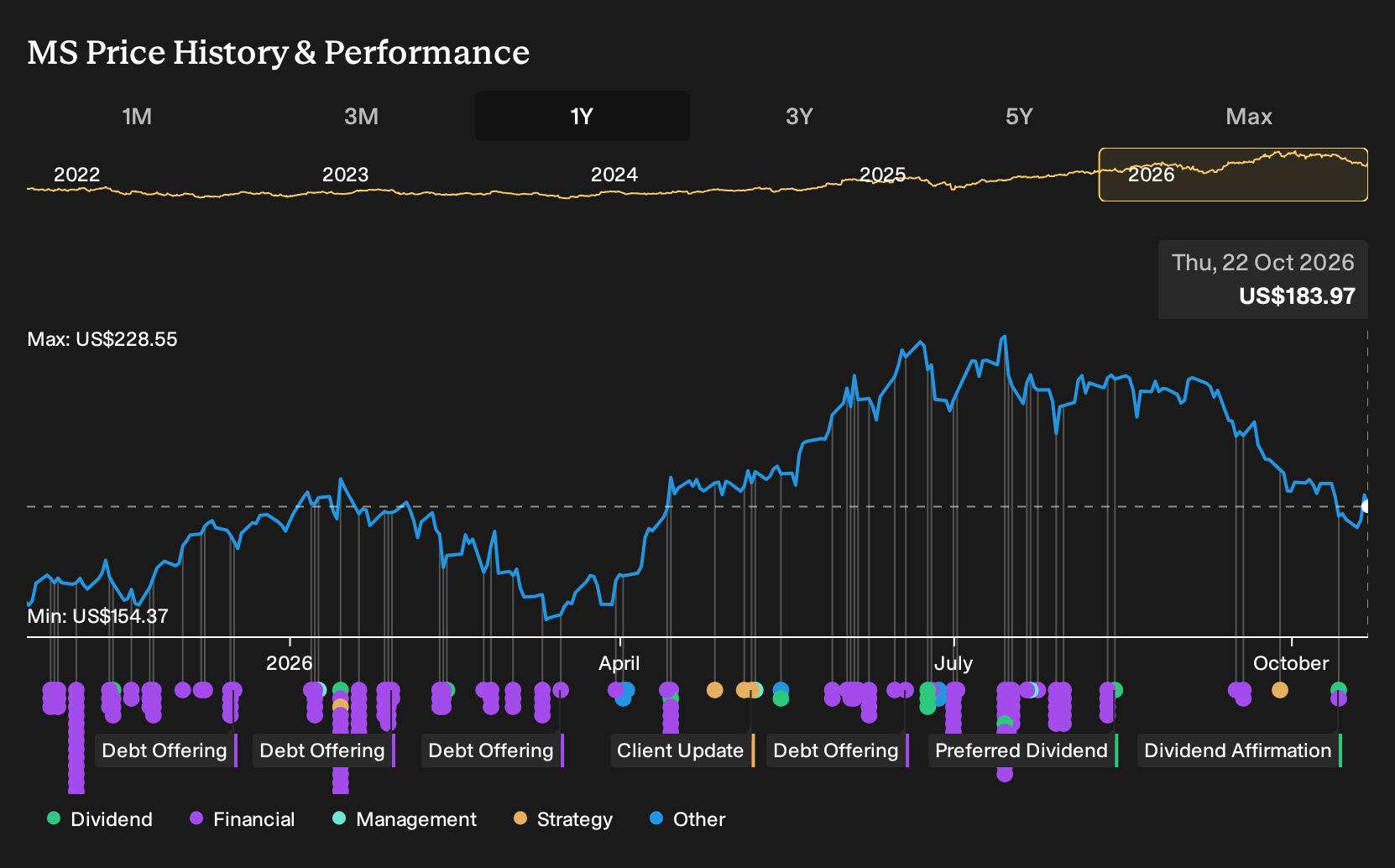
- Morgan Stanley recently reported Q3 2026 net income of US$4,909 million and nine month net income of US$16,057 million, affirmed a quarterly dividend of US$1.1500 per share, and received the 2026 Wealth Management Advisory Platform of the Year award for its Single Advisory Platform.
- The combination of strong reported profitability, a maintained cash return to shareholders, and third party recognition for its advisory platform underscores how central fee based wealth and workplace relationships are to Morgan Stanley’s operating model.
- We will now look at how Morgan Stanley’s affirmed dividend and platform award could influence the longer term investment narrative around the firm.
Compare Morgan Stanley’s fee focused wealth model with other banks that pair strong balance sheets and consistent cash generation in our hand picked list of solid balance sheet and fundamentals (26 results).
Morgan Stanley Investment Narrative Recap
To own Morgan Stanley, you need to be comfortable with a fee-heavy wealth and investment management model that leans on advisory relationships rather than pure trading. The recent Q3 2026 net income outcome and affirmed dividend support the view that the operating story still hinges on stable fee pools, adviser productivity and workplace asset flows.
The most important near-term swing factor is execution in wealth and workplace, especially adviser retention and client conversion from stock plans into higher-margin advice. The largest risk remains fee compression and product mix shifting toward cheaper passive vehicles, which the latest results and announcements do not materially change.
The dividend affirmation at US$1.1500 per share is the clearest new data point for readers focused on near-term catalysts. It indicates that management is maintaining the current cash return level, which matters when free cash flow cover is described as tight and when capital has alternative uses in technology, hiring or acquisitions.
For an investor, this dividend decision links directly to the risk and catalyst list. It allocates a portion of earnings to regular distributions and leaves less scope to respond to adviser competition, regulatory shifts or fee pressure through heavier reinvestment. As a result, execution in wealth management and across the broader Morgan Stanley platform remains the central factor to monitor.
Morgan Stanley's narrative projects US$91.4b revenue and US$19.4b earnings by 2029. This assumes 4.6% yearly revenue growth and a US$0.4b earnings decrease from US$19.8b today.
Uncover why Morgan Stanley's fair value indicates a 16% potential upside to its current price that could narrow quickly.
Exploring Other Perspectives
For Morgan Stanley, the alternate narrative hinges on AI driven productivity as the big swing factor. The most optimistic analysts were already pencilling in US$97.9b of 2029 revenue and US$24.3b of earnings before this dividend news and platform award. Those forecasts reflect a far stronger fee engine than the consensus view. The latest results and Taiwan symposium could nudge those opinions again. As you weigh your own stance, treat these different forecasts as a reminder that reasonable people can read the same bank very differently.
Explore 3 other Morgan Stanley fair value estimates, including one that suggests up to 38% upside from the current price.
The Verdict Is Yours
Disagree with existing narratives? Extraordinary investment returns rarely come from following the herd, so go with your instincts.
- A great starting point for your Morgan Stanley research is our analysis highlighting 3 key rewards and 1 important warning sign that could impact your investment decision.
- See our latest analysis for Morgan Stanley. The report includes a comprehensive fundamental analysis summarized in a single visual, the Snowflake, making it easy to evaluate Morgan Stanley's overall financial health at a glance.
Looking for more investment ideas beyond Morgan Stanley?
If you want to stress test your view on Morgan Stanley, set it alongside other companies with different income mixes, payout profiles and balance sheet strength using the Simply Wall St Screener.
- For readers hunting for mispriced quality, use the 29 high quality undervalued stocks to see which businesses combine stronger fundamentals with what the model views as attractive pricing.
- If resilience matters more to you than excitement, filter for sturdier balance sheets and steadier cash generation through the 30 resilient stocks with low risk scores and compare those profiles with Morgan Stanley's risk mix.
- Those who enjoy finding earlier stage opportunities can scan the 9 elite penny stocks with strong financials and then decide which, if any, deserve a place on a watchlist next to larger holdings.
Have feedback on this article? Concerned about the content? Get in touch with us directly. Alternatively, email editorial-team@simplywallst.com