


SpaceX (SPCX), the rocket and satellite company of Elon Musk, has reported a profitable quarter for the first time in its history. Yet it wasn't the rockets or Starlink that drove this; it was artificial intelligence, or superintelligence (SI), as Musk's company now calls it. However, it was not that the rockets and satellites segments of the company lacked a major milestone, as SpaceX launched its first-ever Starship mission that generated revenue, carrying 26 Starlink V3 satellites, although it came true a few months later, as projected by the company.
However, it was a quarter with fewer platitudes and more performances, as CFO Bret Johnsen said, “We are building the infrastructure of the future with discipline — focused on capital efficiency, strong returns on invested capital, and maintaining a robust, investment-grade balance sheet — while moving with the velocity to capture the opportunity in front of us.”
But were the latest results a positive on all fronts, or were there some chinks? Let's find out.
Q3 Sees SpaceX Coming Into Its Own
SpaceX's Q3 2026 results don't dispel all fears about the company or emphatically confirm that it will achieve what it set out to do, but they certainly give SpaceX bulls a shot in the arm. Along with turning profitable on a company-wide basis for the first time, Q3 2026 revenue and earnings surpassed Street expectations, too.
Revenues soared by 161% from the previous year to $14.6 billion, with the company reporting a net income of $4.4 billion compared to a net loss of $1.1 billion in the year-ago period. Space and Connectivity, the two mainstays of the company until this quarter, saw revenues of $1.8 billion and $5.2 billion, respectively. However, the space segment saw a slight loss of $7 million as capex increased by 44.3% on a YoY basis to $1.6 billion. Connectivity profits almost doubled, however, to $2.4 billion as segment capex increased at a much slower rate of 53.2% to $1.5 billion.
However, some operational metrics showed declines, which can be interpreted as SpaceX focusing more on its SI segment than its erstwhile growth drivers. Total launches and payloads in orbit both shrank to 35 and 476 metric tons from 44 and 525 metric tons, respectively, in the prior year. Similarly, Starlink consumer ARPU fell to $69 from $83, although subscribers climbed by 89% in the same period to 13.6 million, with 1.6 million added in Q3.
Yet, the headline-stealer was the Superintelligence segment, which houses Grok and Cursor, among others. The segment saw revenues multiply by 9.2x over one year to come in at $7.6 billion, along with generating profits of $431 million, compared to a loss of $1.7 billion in the same period a year ago. That said, capex also rose to $16.4 billion from $4.8 billion in the prior year, as the company continues to ramp up compute capacity, which now stands at 1.7 GW, up from 0.6 GW at the end of Q3 2025. Musk posits SpaceX's compute capacity will reach 13 GW by the end of 2027.
Notably, earnings came in at $0.35 per share, compared to a loss of $0.36 per share reported in the prior year. This was also far ahead of the consensus estimate of earnings of $0.16 per share.
Notably, the company's backlog at the end of the quarter stood at $63 billion, of which it expects $42 billion to be recognized within the next year. This would include sales in Q1 of 2027, during which the company expects to see total revenues between $33 billion and $37 billion.
Along with all these activities, SpaceX is now generating some serious cash flows, too. For the nine months ended September 30, 2026, SpaceX reported net cash from operating activities of $13.1 billion, up substantially from $4.1 billion, as the company exited the September quarter with a cash balance of $51.3 billion, much higher than its short-term debt levels of $2.7 billion. However, in Q3, the company’s total capex stood at $19.6 billion, and this is only expected to go higher as the company undertakes initiatives in SI, Space, and Connectivity, with the company expecting the same to be between $35 billion and $40 billion in Q4.
Moreover, SpaceX expects to make its SRAM test chip functional by either May or June 2027 and enter volume production by Q3 2028.
Meanwhile, SPCX stock continues to remain overvalued. Its forward P/E, P/S, and P/CF of 5,115.61x, 44.25x, and 71.89x, are all above the sector medians of 12.78x, 1.12x, and 7.66x, respectively, by some margin. With a total market cap of $1.9 trillion, SPCX stock is down about 1% from its IPO price.
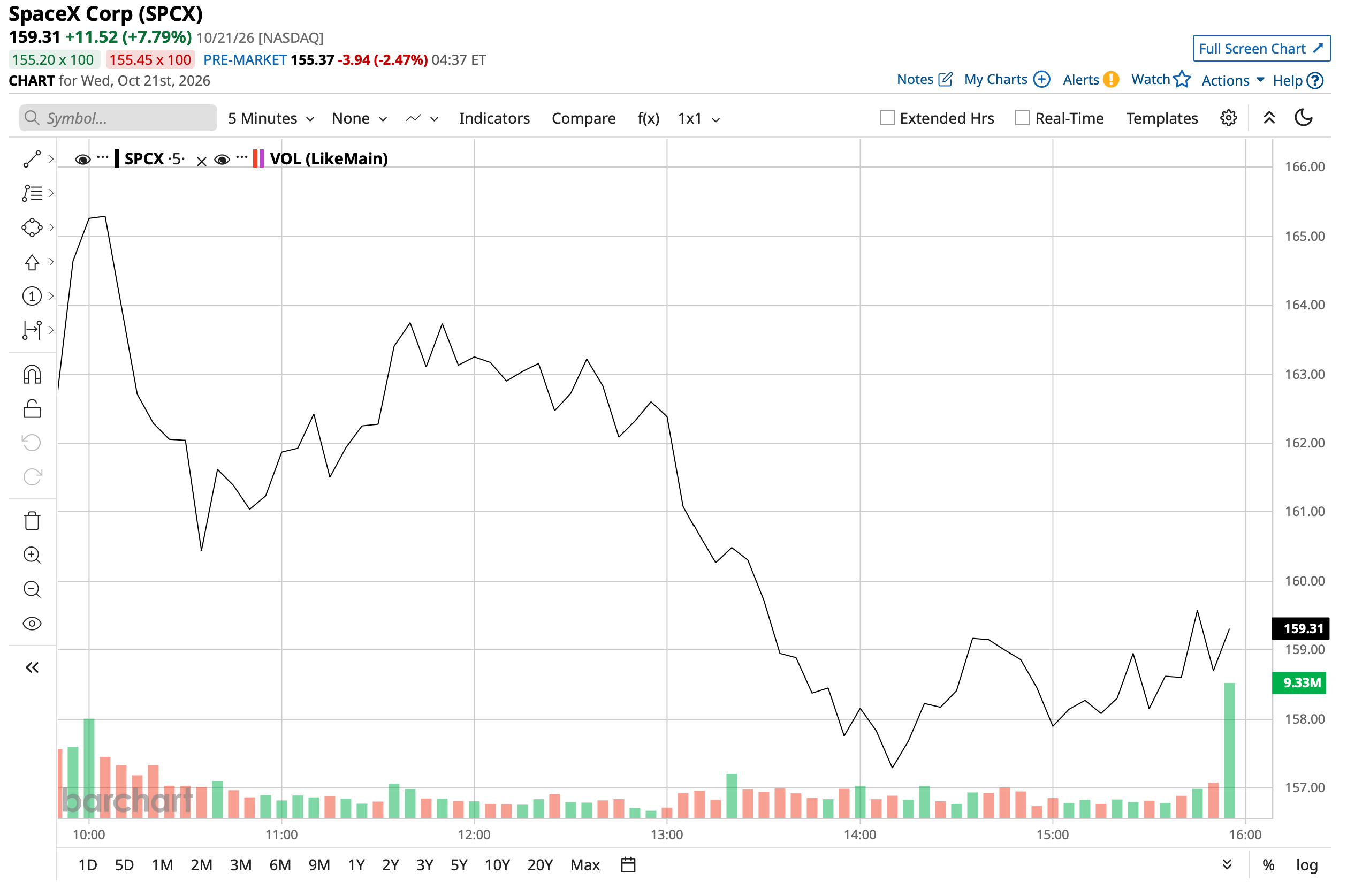
However, this can change dramatically if SpaceX eventually delivers on its promise of generating total revenues anywhere between $500 billion and $1 trillion by the end of next year, as predicted by Musk in the company's earnings call.
Analyst Opinion On SPCX Stock
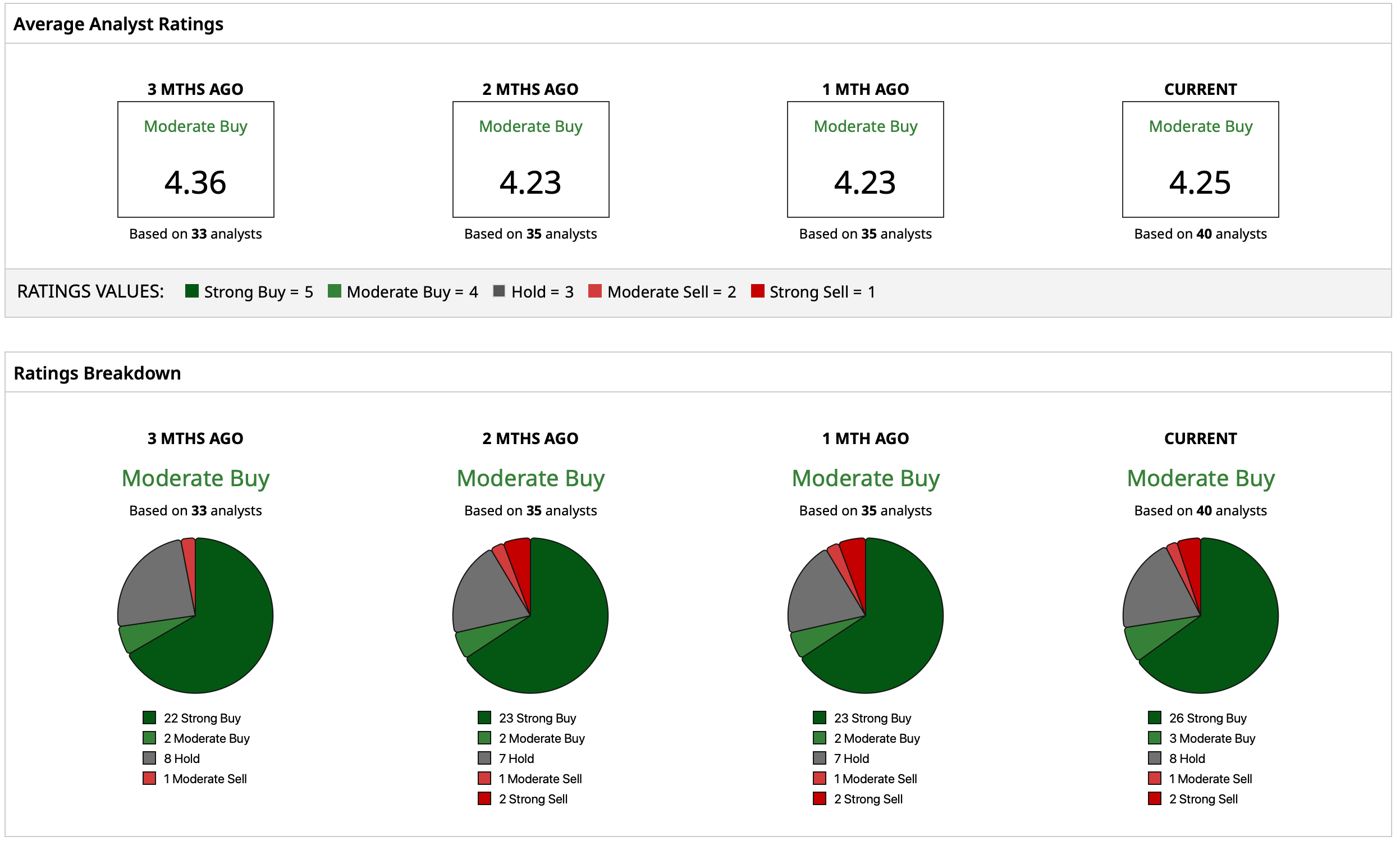
Overall, analysts have deemed SPCX stock to be a “Moderate Buy” with a mean target price of $226.35, which denotes a potential upside of 42.1% from current levels. Out of 40 analysts covering the stock, 26 have a “Strong Buy” rating, three have a “Moderate Buy” rating, eight have a “Hold” rating, one has a “Moderate Sell” rating, and two have a “Strong Sell” rating.
On the date of publication, Pathikrit Bose did not have (either directly or indirectly) positions in any of the securities mentioned in this article. All information and data in this article is solely for informational purposes. For more information please view the Barchart Disclosure Policy here.