


Options traders are convinced that Verizon (VZ) stock will reclaim some of its recent losses after the telecommunications giant reports earnings on Oct. 26. Consensus is for VZ to record $1.27 in earnings per share (EPS) for its third financial quarter, which would represent nearly 5% growth on a year-over-year basis.
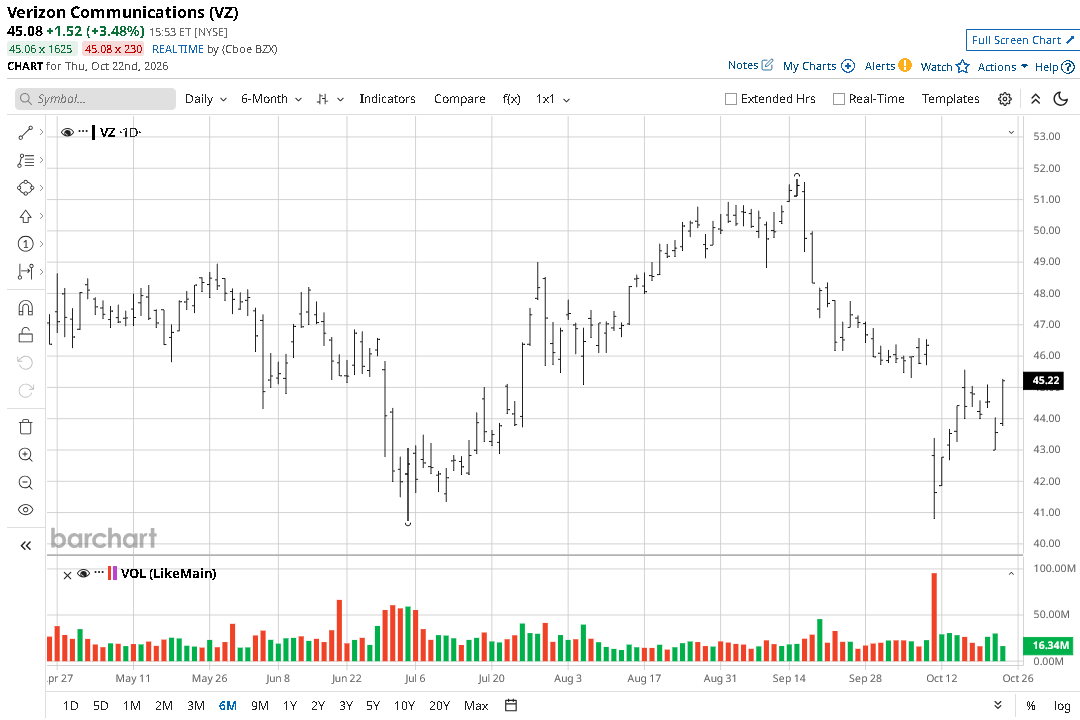
Heading into the quarterly print, Verizon shares are down more than 10% versus their year-to-date high.
Options Sentiment Is Bullish for Verizon Stock
VZ shares are currently hovering around their 20-day moving average (MA), with a decisive break below the $45 level expected to accelerate bearish momentum in the near term.
Still, traders are increasingly betting on call options, with the put-to-call ratio on contracts expiring Oct. 30 set at 0.60x as of this writing. A reading below 1.00x is typically interpreted as bullish.
According to the latest data from Barchart, the upper price on those options contracts currently sits at $46.72, indicating potential upside of more than 4% through the end of next week.
Note that Verizon currently pays a rather lucrative 6.26% dividend yield as well, which makes it a compelling long-term buy heading into 2027.
Should You Invest in VZ Shares Today?
Ahead of the Q3 earnings event, Verizon stock is trading at a forward price-to-earnings (P/E) ratio of about 8x, which makes it cheaper to own than both AT&T (T) and T-Mobile (TMUS).
Still, insiders have not recorded even a single buy transaction in the trailing 12 months, the optics of which are clearly bearish for the NYSE-listed giant.
Additionally, SpaceX’s (SPCX) recent spectrum deal poses a serious competitive threat to VZ’s core broadband business as well.
It leaves Verizon needing to demonstrate that subscriber growth and cash generation can support its dividend while funding network investment in an increasingly competitive telecom market.
What’s the Consensus Rating on Verizon?
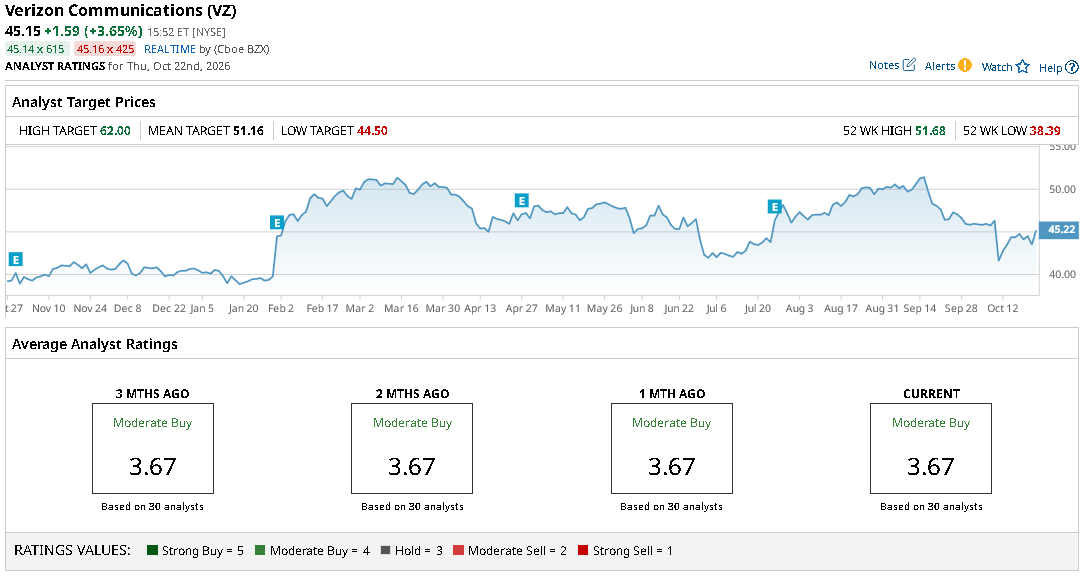
Wall Street analysts are nevertheless entering Verizon’s quarterly release with a bullish stance.
According to Barchart, the consensus rating on VZ stock sits at “Moderate Buy,” with the mean price target of about $51 indicating potential for a more than 10% rally in the months ahead.
On the date of publication, Wajeeh Khan did not have (either directly or indirectly) positions in any of the securities mentioned in this article. All information and data in this article is solely for informational purposes. For more information please view the Barchart Disclosure Policy here.