


The Zhitong Finance App learned that just as the US semiconductor sector experienced a severe setback on Thursday, capital in the Asian market undertook popular AI computing power and semiconductor stock targets at a low level. On October 22, the Philadelphia Semiconductor Index fell 6.72%, the Nasdaq Composite Index fell 2.60%, and Nvidia and Micron fell 4.40% and 6.26% respectively. The next day, Korea's KOSPI index reversed from an intraday decline of more than 4% to a close of 0.30%, SK Hynix rose 4.42%, and Samsung Electronics rose slightly by 0.47%; China's GEM index rebounded from an intraday decline of more than 3% to close 4.16%, and the turnover of the three markets of Shanghai and Shenzhen reached about 1.97 trillion yuan. The restoration of memory chips and optical communication leaders has become an important driving force behind this round of reversal of Chinese and South Korean technology stocks.
SK Hynix suspended the evaluation of Solidigm's listing, easing investors' concerns about repeated listings and valuation discounts; Xinyisheng disclosed repurchase plans of 800 million to 1 billion yuan, and several optical communication companies announced operating progress, strengthening the market's confidence in orders and product upgrades. Low-level undertakings after oversales reinforce each other with positive news at the company level, driving some technology leaders to take the lead in restoration. A senior analyst said that after the concentrated sell-off of technology stocks in the Chinese and Korean markets over the past two weeks, some investors may have profiably closed short positions, and capital to buy at low points has begun to enter the market. When new sales weaken, and short recovery and bottom-up capital appear at the same time, this may cause a sharp rebound in semiconductor and broad technology stocks in the Chinese and South Korean stock markets on Friday.
According to LSEG Lipper capital flow data, equity fund subscription data provides a broader financial background. In the week ending October 21, the net inflow of global equity funds was US$28.16 billion, up from US$19.88 billion the previous week, for the fifth consecutive week; in particular, equity funds in the Asian market had a massive net inflow of US$11.53 billion, the highest level since at least December 2022, while equity funds in the European market attracted a whopping US$9.14 billion and the US attracted US$5.07 billion.
However, although the US equity fund was net purchased for the second week in a row, its size decreased by about 62% from the previous week's US$13.37 billion. This set of data reflects the relatively optimistic allocation of global capital before the sharp fall in US stocks on Thursday — that is, global investors are still increasing their exposure to stocks, especially to the Asian stock market, where gains have clearly not been as high as the US and are falling back, while reducing their efforts to buy back the US stock market, which recently hit a new high.
Needless to say, the two core variables supporting the radiation of buying power in the stock market are the return trajectory of 10-year US Treasury yields and the profit cashout of semiconductor and cloud computing giants linked to the theme of AI computing power. The yield on US 10-year Treasury bonds fell nearly 38 basis points from the 24-and-a-half-year high of 5.3645% in early October, and fell below 5%; of about 24% of the S&P 500 companies that have announced results, profits exceeded expectations, and about 73% of the approximately 18% constituent stocks that have disclosed results in the MSCI Global National Index exceeded expectations. Although the MSCI World Index still fell 1.31% on October 22, the semiconductor sector, which is closely related to the topic of AI computing power, has strongly expanded profits and reduced pressure on discount rates, providing a foundation for capital to re-evaluate technology stocks.
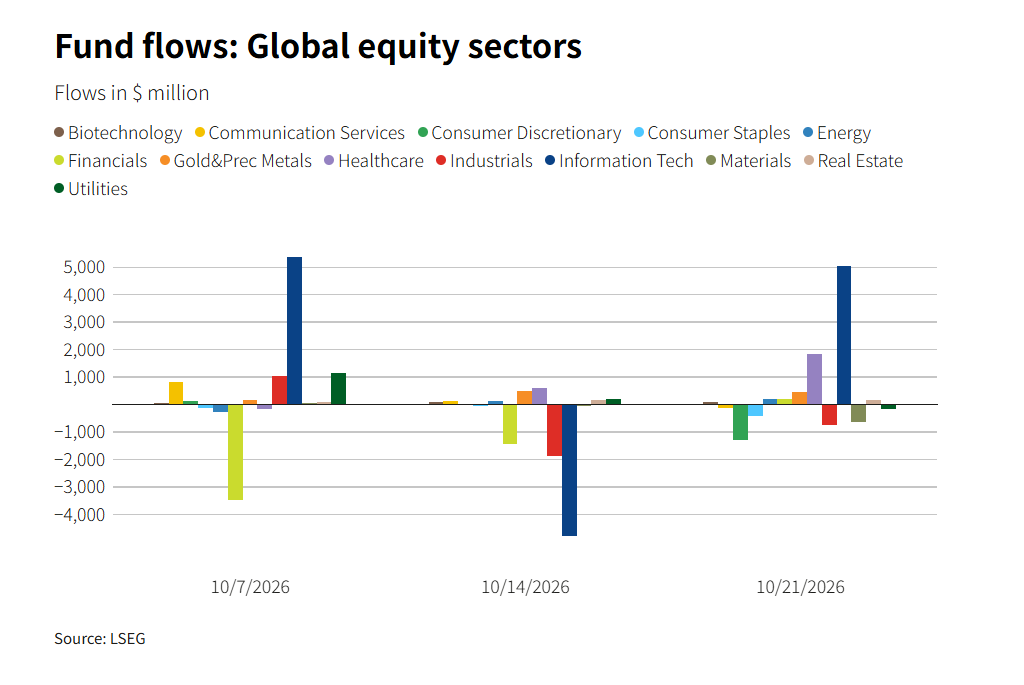
Looking at the storm of AI trading and technology stock sell-off — that is, the memory chip sector, which has recently been hit hard, LSEG Lipper's capital flow showed a net inflow of 5.05 billion US dollars in global technology industry funds that week, reversing the sharp outflow situation the previous week. Fundamental optimism is still strong. According to KeyBanc's recent Asian research data, AI data centers are still absorbing the supply of AI computing power resources such as storage on a large scale, driving price increases until 2027. The agency predicts that the HBM hybrid price is expected to rise sharply by 80% to 100% in the first quarter of 2027. At the DRAM memory price level, KeyBanc predicts that the fourth quarter of 2026 will rise 15% to 20% month-on-month under the strong price increase base in the third quarter, and 10% to 15% in the first quarter of 2027; in terms of future NAND pricing, it is predicted that the fourth quarter of 2026 will rise by about 20% month-on-month under the strong base in the third quarter, and another 10% to 15% in the first quarter of 2027.
Technology return, credit diversion: capital begins to select “who can stand the test of financing”
According to LSEG Lipper capital flow data, global capital is increasing technology exposure while increasing requirements for enterprise size, liquidity, and financing capacity. Global technology sector funds had a net inflow of US$5.05 billion in the week, reversing the previous week's net outflow of US$4.77 billion; healthcare funds absorbed US$1.83 billion, while non-essential consumer goods funds had an outflow of US$1.29 billion.
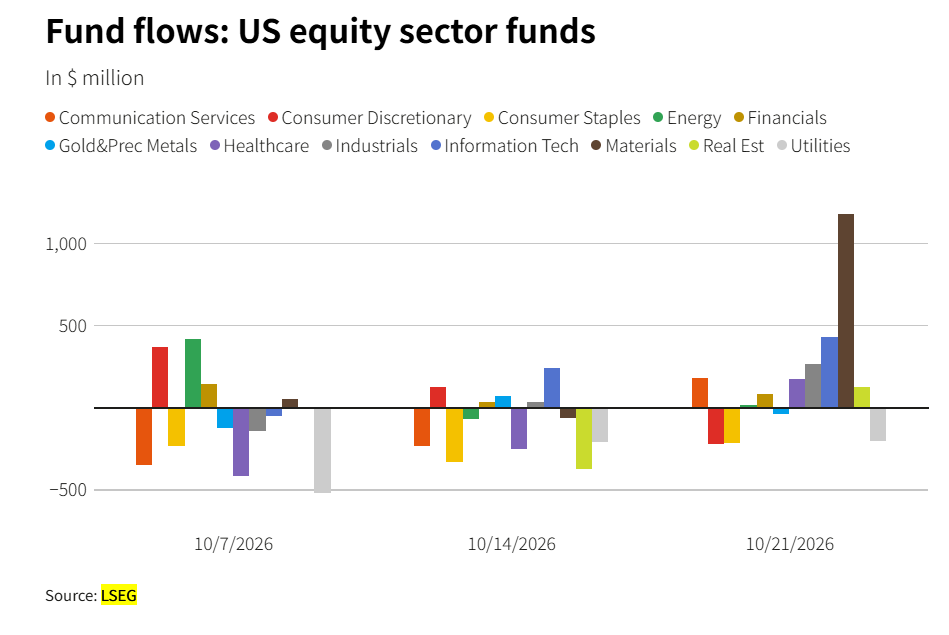
Within the US market, large-cap and mid-cap funds attracted 8.63 billion dollars and 1.92 billion US dollars respectively, while small-cap funds had outflows of 4.24 billion US dollars. US industry funds ended two consecutive weeks of redemptions, with a total inflow of US$1.8 billion, with metal mining, technology and industry receiving net inflows of US$1.18 billion, US$429 million and US$269 million respectively. The most notable allocation trend here is that global capital is more willing to take the risk of investing in the stock market with strong profit support, and is still keeping a distance from companies that are less able to afford financing. This also explains why the Asian stock market, which has the vast majority of strong fundamentals leading forces in the global AI computing power industry chain, is receiving a stronger inflow of capital.
The bond market is also fragmented. Global bond funds attracted cash for the fifth week in a row, with a net inflow of US$9.44 billion, of which the Swiss franc denominated bond fund had an inflow of US$6.8 billion, the highest since November 2024. Short-term bond funds attracted US$2.78 billion; high-yield bonds and government bond funds had outflows of US$1.68 billion and US$550 million respectively. US bond funds had a net outflow of US$969 million, ending 26 consecutive weeks of net purchases: long-term government bonds and treasury bond funds had outflows of US$3.3 billion, while short- and medium-term similar funds and municipal bond funds had inflows of US$1.76 billion and US$1.56 billion, respectively. Benchmark interest rate expectations under the decline in expectations of the Federal Reserve's interest rate hike, and the downward trajectory of 10-year and 30-year US Treasury yields can be said to have significantly improved the valuation environment, yet investors are still actively controlling credit risk and long-term risk.
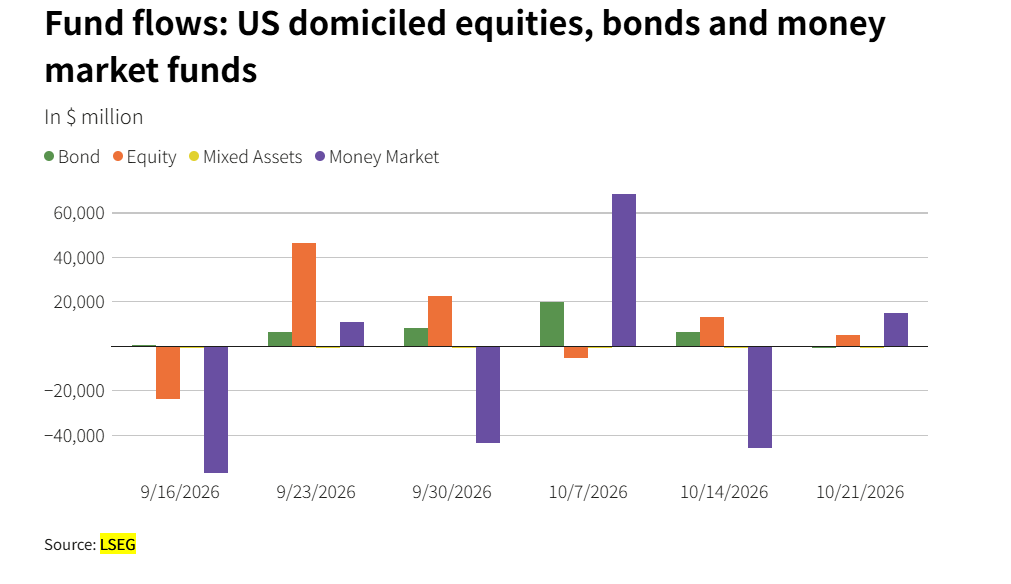
Cash and safe-haven assets have not lost their investment appeal. Global money market funds switched from an outflow of 47.51 billion US dollars to an inflow of 15.86 billion US dollars, of which the US turned from an outflow of 45.93 billion US dollars to an inflow of 14.82 billion US dollars; gold and other precious metals funds attracted 1.29 billion US dollars, the fifth net inflow in the past six weeks. Energy funds received 41.5 million US dollars. Data covering 29,174 emerging market funds showed that equity funds attracted 6.28 billion US dollars, the highest since August 5, and bond funds had a slight outflow of 48.72 million US dollars. The overall configuration shows the combined characteristics of “preferential stock placement, flexible cash retention, and strict credit screening”.
These global capital flow dynamics and trends shown by LSEG Lipper's capital flow data also explain to a certain extent why J.P. Morgan Chase and UBS still see room to buy and increase positions on AI computing power topics and a wider range of semiconductor and technology stocks.
According to J.P. Morgan Chase estimates that this year's cash flow is about 2.2 trillion US dollars, and the corresponding investment is about 1.8 trillion US dollars, forming a financing surplus of about 400 billion US dollars; the financing pressure on new cloud vendors may change who builds the project, but it may not necessarily end the entire AI capital expenditure cycle. At the same time, the bank estimates that semiconductors contribute about 21% of global stock portfolio risk, yet only account for about 13% of market value weight. Centralized holdings and risk limit adjustments can amplify short-term declines. UBS, on the other hand, pointed out that the relative strength indicators of Hang Seng Technology and the Shanghai and Shenzhen 300 fell to about 27 and 23.9, respectively, and that short positions in US stocks were high, increasing the possibility of oversold repair and shortfall recovery. The positive judgments of the two companies share the same direction: selling pressure is being released, and leaders in the AI computing power industry chain with strong fundamentals, supported by cash flow and orders, are in a better position to take the lead in repricing.
In the context of AI monetization and the relaying of computing power orders, Nvidia is still an absolute optimistic pricing anchor for Wall Street bulls
The financial reports of Facebook and Instagram's parent company Meta show the core contradiction of current AI transactions — that is, commercialization surrounding the big wave of AI is being realized at an accelerated pace, and infrastructure spending is also consuming cash faster. The company's third-quarter revenue was US$64.601 billion, up 26% year on year, and advertising revenue reached US$63.61 billion; excluding US$9.89 billion in legal fees, operating profit increased 11% year over year, and revenue guidance for the fourth quarter was US$73-76 billion. However, capital expenditure for the quarter reached US$34.91 billion, and free cash flow was negative US$2.12 billion. The lower limit of capital expenditure guidance for the whole year was raised from US$130 billion to US$135 billion, and the upper limit remained at US$145 billion. Future expenditure commitments of approximately $825 billion further extended the time frame for the market to assess return on investment; however, this is an annual leasing and procurement arrangement, not a single year of capital expenditure.
AI revenue support can already be observed from advertising effectiveness: after Meta expanded the application of the GEM advertising model, the conversion volume of off-site conversion ads and app ads increased by 1.7% and 9.6%, respectively. Muse attracted more than 10 million users about six weeks after its launch in the US and Canada, and about 25% of active users use it every day.
Meta is promoting transaction service fees, personal and business subscriptions, and expects to increase Muse's computing power cost efficiency by more than ten times over the next year. The advertising business provides the ability to generate current cash, and Muse provides room for new user and transaction growth; Muse has not disclosed revenue separately, and user shopping amounts cannot be directly regarded as Meta revenue. The establishment of newly established non-voting shares was initially implemented through allotments to existing shareholders, which is equivalent to a stock split. However, the future use of financing has deepened the market's concerns about financing costs and capital requirements.
Deriving from infrastructure mechanisms, agents such as Muse expand the scope of use and simultaneously increase model reasoning, tool execution, and state management requirements: GPUs and custom accelerators are responsible for model computation, CPU carrying browsers, database queries, and business orchestration; HBM and server DRAM accommodate models, contexts, and concurrent working environments; enterprise-grade SSDs store indexes and persistent states; HDD undertakes long-term stored data that has been screened, compressed, and deduplicated. The network, optical interconnection, electricity, and liquid cooling all support continuous operation. This corresponds to Nvidia and AMD's accelerated computing, Broadcom's custom chips and interconnections, Micron and SK Hynix's memory, Seagate and Western Digital's high-capacity storage, and manufacturing and testing opportunities for TSMC and Amkor. The expansion of capital expenditure is strengthening the demand base of the entire industrial chain. Specific orders and profits still depend on each company's product share and delivery capacity.
Wall Street financial giant Bank of America's positive judgment on the storage industry also revolves around the demand for SOCAMM and enterprise-grade SSDs brought about by the introduction of HBM4 and advanced GPU and ASIC updates. Different levels of memory and storage take on different tasks, and changes in the configuration of a single GPU cannot be directly equivalent to a drop in demand for the entire data center. The DSX POD released by GTC in Berlin moved the integration of computing, networking, power supply and liquid cooling to the manufacturing process, shortening on-site deployment time to as fast as 14 days at sites where electricity, cooling, and networks are ready, and is scheduled to be delivered in early 2027. The meaning of the investment is to improve the conversion speed of “equipment delivery - computing power online - service revenue”, not to remove restrictions on power supply and construction conditions.
SpaceX provided another set of evidence that revenue was realized — the company's third-quarter revenue was $14.575 billion, up 161% year over year; revenue from the super-smart business, which included cloud services, software, and advertising, was $7.56 billion, up 830% year over year, and operating profit corrected to $431 million. Management said that short-term computing power contract renewal prices continue to rise, and the online computing power is expected to reach at least 13 gigawatts by the end of 2027. Bank of America raised the target price from 235 US dollars to 275 US dollars to maintain “buying”. It values that the revenue guide for the first quarter of 2027 billion to 37 billion US dollars significantly exceeded market expectations of about 22 billion US dollars before the earnings report; compared to the closing price of 144.75 US dollars on Thursday, the target price corresponds to about 90% of the potential increase space.
SpaceX's strong earnings report and outlook also provided demand-side support for Nvidia's Berlin GTC's computing power expansion narrative. Musk further stated that the online computing power capacity is expected to reach 2.5-3 gigawatts by the end of the year, and he is confident that another 10 gigawatts will be added in 2027. Next year's deployment will mainly use the Nvidia Vera Rubin platform. This expansion plan echoes the DSX POD shown by GTC to accelerate on-site deployment and expand production capacity in key supply chains: customers need faster access to computing power that can be put into operation, and Nvidia is focusing on shortening the distance between hardware delivery and computing power service revenue generation. For the semiconductor market, the realization of AI business revenue is mutually confirmed by the next-generation computing power procurement plan, providing more specific support for order growth expectations for the entire AI computing power industry chain, including Nvidia AI GPUs and HBM, data center high-speed optical interconnection, power supply, and liquid cooling chains, and adding fundamental catalysts to the “AI bull market narrative.”
Nvidia, with a market capitalization of about 5.1 trillion US dollars, is still an important bullish pricing anchor for Zhongher Street in this round of long and short differences. Citibank maintained a “buy” target price of $315 on October 22; Morgan Stanley maintained a target price of $300 and resumed its “semiconductor first choice” status in October; the target price given by Bank of America in August was $350. Based on the closing price of $212.21 on October 22, $300, $315, and $350 correspond to potential upside of about 41.4%, 48.4%, and 64.9%, respectively. The core of these target price bets is that next-generation platform delivery, customer computing power launch, and continuous procurement can drive profit growth. As far as the semiconductor sector and technology stock market trajectory are concerned, capital return and oversold repair provide counterattack conditions, while order conversion and cash returns determine how far the market can go.