


- Wells Fargo has reshaped its leadership, with Kleber Santos now serving as sole CEO of Consumer Banking and Lending, and Saul Van Beurden moving to a dedicated role leading AI across the group.
- The bank is tying day-to-day consumer banking operations directly to a focused enterprise AI build-out, which could affect how efficiently Wells Fargo runs deposits, cards, auto, and small business lending.
- The next area of attention is how Wells Fargo's refocused AI leadership could influence its broader investment narrative around efficiency and growth.
Compare Wells Fargo's renewed push into AI-led consumer banking with other potential beneficiaries of the same trend by scanning a curated set of 55 AI infrastructure stocks in one place.
Wells Fargo Investment Narrative Recap
To own Wells Fargo, you need to be comfortable with a large, regulated bank that leans heavily on interest income, while trying to grow fee businesses and keep expenses in check. The key short term swing factor is still net interest income and deposit mix, and the latest guidance for 4Q26 and full year NII keeps expectations anchored.
The sharpened split between Kleber Santos over Consumer Banking and Lending and Saul Van Beurden over AI does not radically change that near term driver. It mostly affects how efficiently Wells Fargo may pursue card growth, small business lending and cost savings, while the biggest risk stays centered on margin pressure and the profitability of newer credit card vintages.
The clearest data point to watch alongside this AI and consumer focus is Wells Fargo’s 3Q26 earnings print and NII outlook. Net interest income of US$12,517m in the quarter and guidance of about US$13b for 4Q26, plus around US$50b for 2026, frame what the Santos and Van Beurden setup is working with operationally.
That earnings update also showed net income of US$5,951m for the quarter and US$17,611m for the first nine months, with loan charge offs of US$983m. For investors, those figures help you judge whether new AI led efficiency efforts and consumer growth pushes at Wells Fargo improve returns without letting credit costs or funding pressures erode the core earnings engine.
Wells Fargo's narrative projects US$103.9b revenue and US$24.0b earnings by 2029. This assumes 7.7% yearly revenue growth and a US$2.0b earnings increase from US$22.0b today.
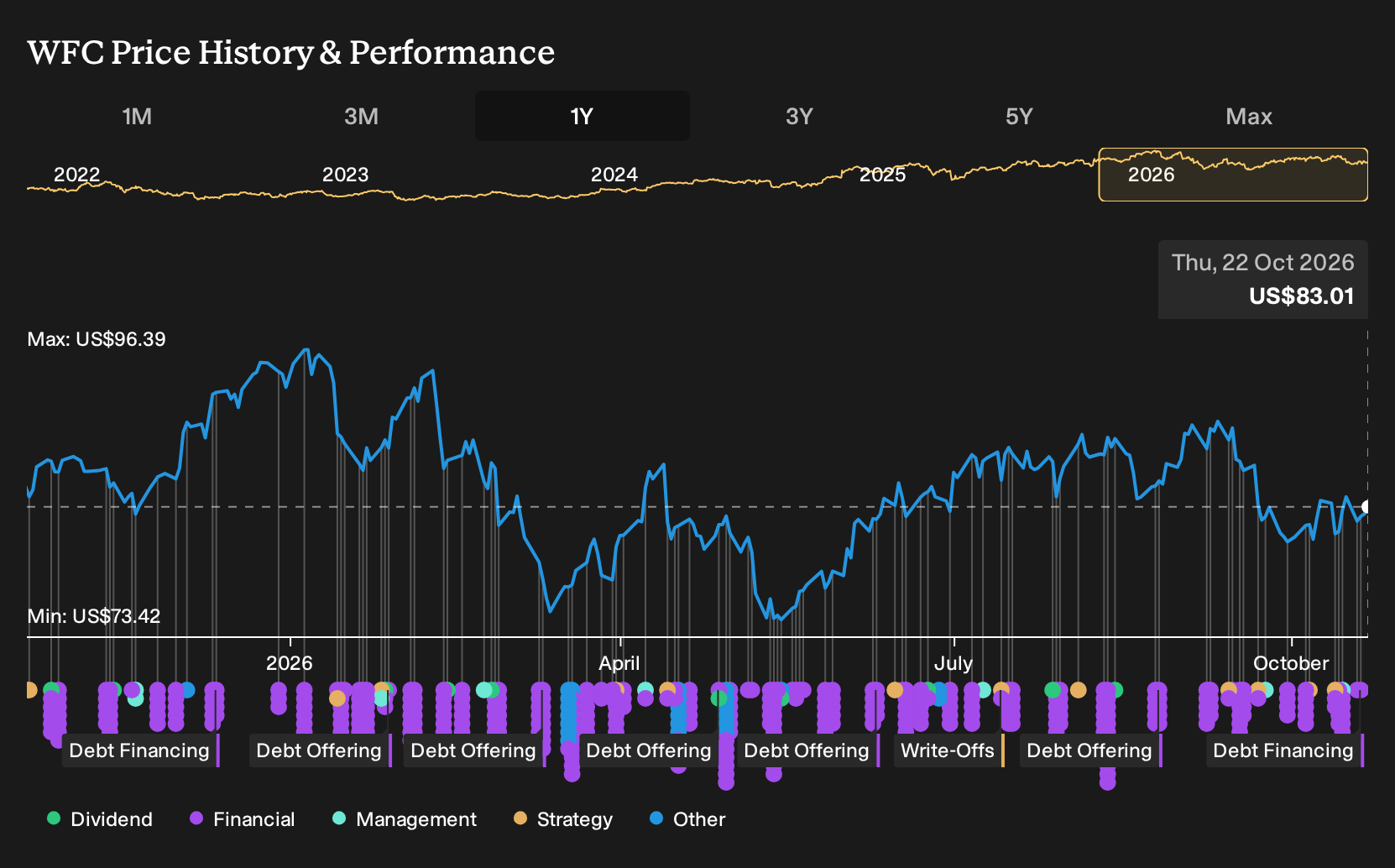
Uncover why Wells Fargo's fair value indicates an 18% potential upside to its current price that could narrow quickly.
Exploring Other Perspectives
Two fair value estimates from the Simply Wall St Community cluster between about US$97.90 and US$124.84, which shows how far apart views on Wells Fargo can be. You are weighing these against risks around net interest margin pressure and credit card profitability, plus catalysts like expense discipline and AI led efficiency. Consider that spread as a prompt to explore more viewpoints before deciding how Wells Fargo fits your portfolio.
Explore another Wells Fargo fair value estimate, including one that suggests it could be worth just $97.90.
Reach Your Own Conclusion
Don't just follow the ticker; dig into the data and build a conviction that's truly your own.
- A great starting point for your Wells Fargo research is our analysis highlighting 4 key rewards and 1 important warning sign that could impact your investment decision.
- See our latest analysis for Wells Fargo. The report includes a comprehensive fundamental analysis summarized in a single visual, the Snowflake, making it easy to evaluate Wells Fargo's overall financial health at a glance.
Looking For More Investment Ideas Beyond Wells Fargo?
Once you have a view on Wells Fargo, it helps to widen the lens and compare it with other opportunities that fit different risk and income profiles. The Simply Wall St Screener gives you a quick way to line up those options side by side and pressure test where you want to allocate your next dollar.
- If you want potential mispricing with solid fundamentals, scan a focused 29 high quality undervalued stocks that may offer better value than the broad market.
- If capital preservation sits high on your priority list, sort through a 30 resilient stocks with low risk scores that keeps volatility and risk scores front of mind.
- If you care most about balance sheet strength and business quality, work through a curated list of solid balance sheet and fundamentals (26 results) that filters for financial resilience first.
Have feedback on this article? Concerned about the content? Get in touch with us directly. Alternatively, email editorial-team@simplywallst.com