


Meta (META) is taking an ambitious leap into AI, but that is coming with a hefty price tag, and investors’ patience is wearing thin. The company reported its third quarter earnings Wednesday with revenue surging 26% and earnings up 265%. Yet, free cash flow slipped into the red as capital spending outpaced the cash flowing in, and a massive legal charge weighed on profitability.
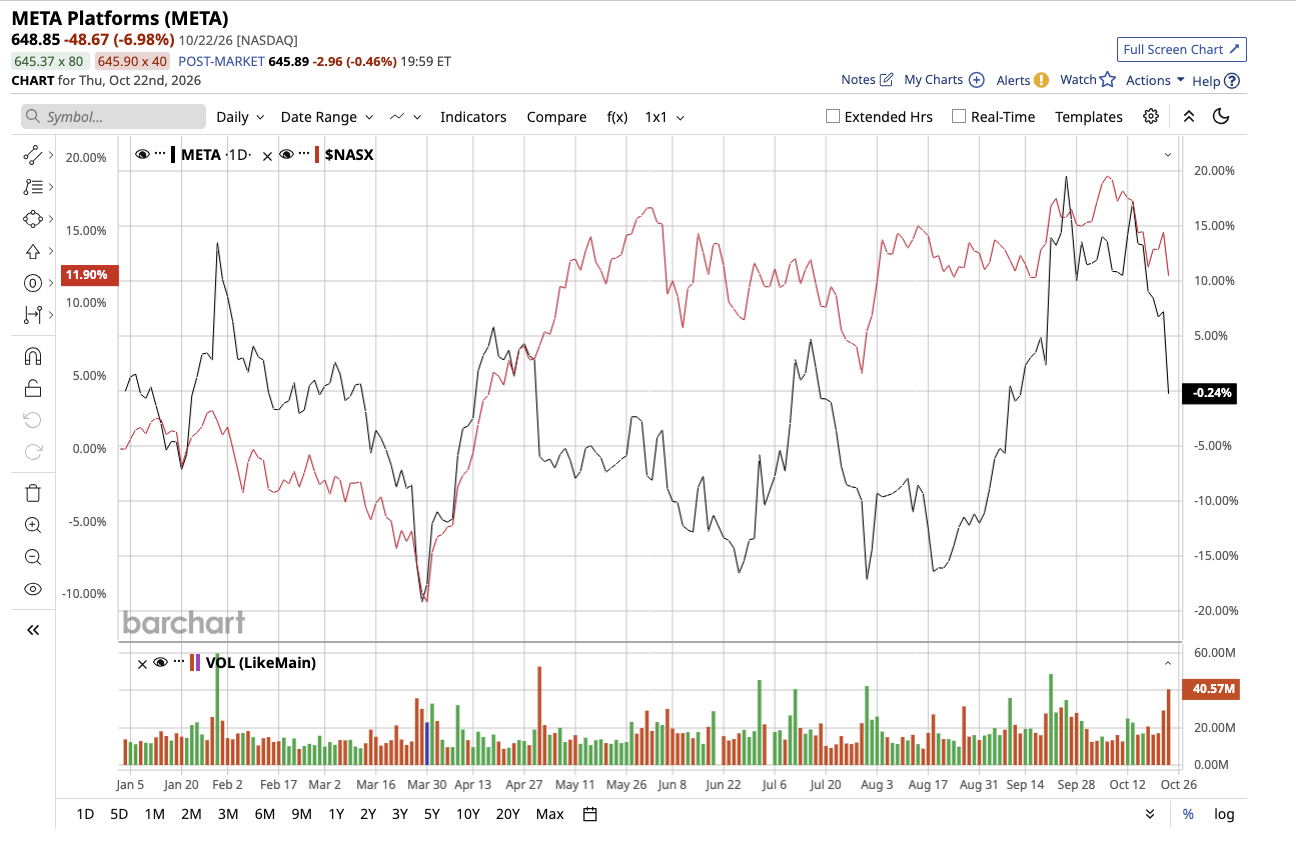
The stock dropped about 7% after the results and is back in the red for the year.
Meta's advertising machine is still humming, but investors want answers on how expensive this AI gamble will be before it starts paying off.
Revenue Is Booming, but the Cash Picture Has Changed
In the third quarter, Meta generated $64.6 billion in revenue, a 26% increase from $51.24 billion a year earlier. Diluted earnings per share (EPS) also climbed 265% to $3.83. The company is still finding ways to unlock more value from its advertising platform rather than relying on AI spending alone to boost growth.
Yet it was the cash picture that unsettled investors. Meta pulled in a hefty $32.79 billion from its operations but poured even more—$34.91 billion—into capital expenditures and finance lease payments. That resulted in a negative free cash flow of $2.12 billion. Simply put, Meta’s ambitious investments outpaced the strong cash it generated this quarter.
Investors should know that negative free cash flow in one quarter doesn’t automatically mean a business is struggling to generate cash. For a company of Meta’s scale, which is pouring in a lot of money into AI infrastructure such as data centers, servers, and networking equipment, this is part of a planned investment cycle. However, if negative free cash flow becomes a pattern or capital spending continues to outpace operating cash flow, investors will demand more convincing evidence that these investments are truly driving additional revenue and profit.
Furthermore, AI spending wasn’t the only concern in Q3 results, which might have worried investors. The company also bore a hefty $9.89 billion legal expense in Q3 following a settlement arrangement reached with 52 state attorneys general in August 2026 over allegations concerning social media's impact on teenagers' mental health. With the overall deal calling for payments that could reach $18.59 billion, this is a huge financial commitment. The charge hit Meta's bottom line harder. Operating income plunged to $12.99 billion, a steep 37% drop from last year, with diluted EPS falling to $3.83. Had it not been for the legal charge, operating income would have soared to $22.88 billion and diluted EPS to $7.40.
The Advertising Business Is Paying for the AI Ambition
Meta’s advertising business for its social media apps continues to fund its AI goals. In Q3, advertising revenue grew to $63.1 billion, a 26% increase from last year. The company delivered 10% more ads, and the average price per ad went up by 14%. This shows Meta is seeing higher ad demand and better monetization. Its AI-based recommendation systems and ad tools are also making it easier for users to find content and engage with posts and for advertisers to run successful campaigns.
But improving the current business is just one part of Meta's strategy. The company is also investing in new AI products like Muse, its personal AI agent. CEO Mark Zuckerberg believes Muse could bring in future revenue. He said over 10 million people in the U.S. and Canada set up Muse personal agents in about six weeks after launch, and about a quarter use it daily. Still, Muse has not yet proven it can make enough money to cover the high computing costs of serving many users.
The Spending Isn't About to Slow Down
If this quarter worried investors, Meta’s outlook doesn’t offer much comfort. Management has raised its full-year 2026 capital expenditure forecast to $135 billion to $145 billion, including principal payments on finance leases. The company is signaling it will double down on bold investments in both its core business and the fast-evolving world of AI well beyond this year. For the fourth quarter, Meta expects revenue to range between $73 billion to $76 billion. Management also said it expects full-year operating income to exceed 2025's level after excluding the Q3 legal charge.
If AI continues to improve ad performance and new products like Muse create additional revenue streams, today's spending could support future growth. However, if costs rise faster than monetization, pressure on free cash flow could persist even as reported revenue remains strong.
Is It Time to Worry About META Stock?
Meta’s Q3 showed remarkable revenue and earnings growth. Yet, the negative free cash flow was something investors couldn’t ignore, especially at a time when AI spending fears were already rattling the market. Furthermore, while the $9.89 billion legal charge was a one-time hit to Q3 earnings, the financial consequences might last longer. And billions more in legal charges may be on the horizon too. The roughly 7% share price decline reflects this tension. Negative free cash flow is a red flag that deserves attention, especially as management signals more heavy spending ahead. Still, a single quarter hardly proves Meta’s investment strategy is off kilter. With a robust balance sheet, the company remains well-equipped to fuel its ambitions.
For long-term investors, the wisest move is to neither shrug off the cash-flow decline nor conclude that the AI strategy is finished. Meta's core business remains strong. In the coming quarters, I would keep a close eye on:
- Capital expenditure growth
- Free cash flow
- Advertising monetization
- Signs that new AI products can generate revenue at sustainable margins
I would also monitor how the legal settlement payments affect cash generation over time and adjust my position in META stock accordingly.
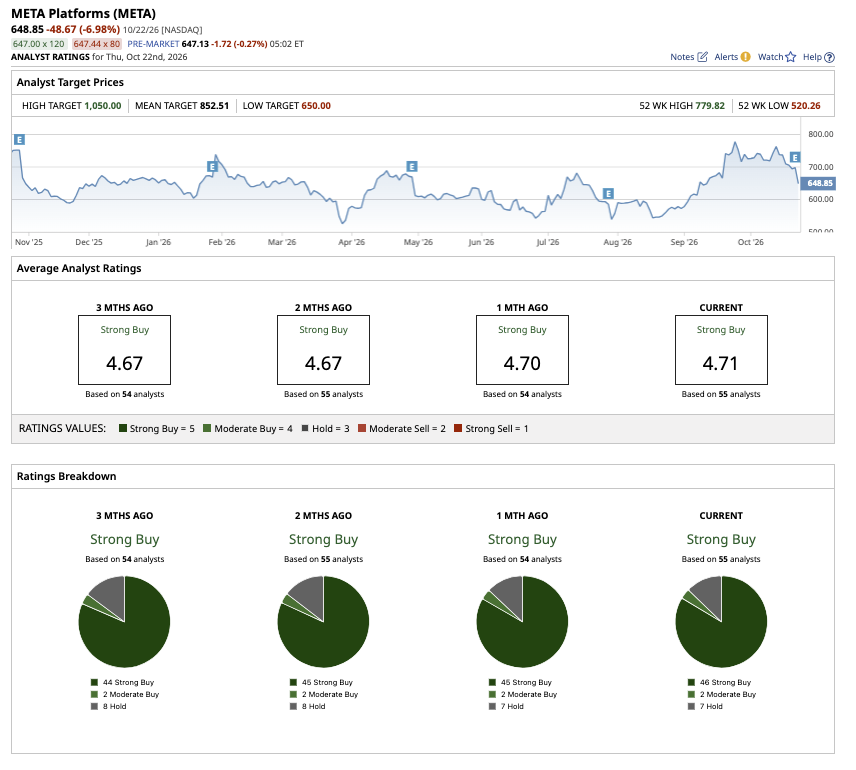
On Wall Street, META stock holds a consensus “Strong Buy” rating. Of the 55 analysts covering the stock, 46 rate it a “Strong Buy,” while two say it is a “Moderate Buy,” and seven rate it a “Hold.” The average target price of $852.51 implies an upside potential of 31.4% from current levels. But the high price estimate of $1,050 suggests META can climb 61.8% from here.
On the date of publication, Sushree Mohanty did not have (either directly or indirectly) positions in any of the securities mentioned in this article. All information and data in this article is solely for informational purposes. For more information please view the Barchart Disclosure Policy here.