


Consumer confidence is sliding, inflation expectations sit at uncomfortable levels and fuel costs are being pushed around by Middle East conflict risks. That mix can pressure many retailers, yet it can also push shoppers toward discount and value-focused options. For investors, trade downs can reshuffle where spending goes. This article explains how that backdrop is connected to three U.S. discount and value-oriented consumer stocks exposed to these news catalysts.
The stocks below are just a starting sample, and the full screen surfaced 12 more U.S. discount and value-oriented consumer companies with equally compelling narratives that are not covered in this article. To identify and analyze the ideas that best fit your own playbook, head straight into the U.S. Discount and Value-Oriented Consumer Stocks screener
Del Monte (DMC)
Overview: Del Monte Corporation produces and sells fresh and prepared fruits and vegetables worldwide, supplying everyday food essentials across retail, club, and foodservice channels.
Operations: Del Monte generates most of its revenue from Fresh and Value-Added Products at about US$2.5b, plus roughly US$1.4b from Bananas.
Market Cap: US$1.3b
Del Monte and the trade down grocery basket
Del Monte matters for this value-focused screen because it fills grocery carts with basic fruit and vegetable staples that consumers may rely on when budgets tighten.
"Reallocation of Costa Rica farmland away from higher cost banana farms into premium Del Monte Gold, Honeyglow and other pineapple varieties, alongside strong pricing and demand for these proprietary pineapples, may point to a future volume and mix shift that could affect fresh segment gross margins and earnings quality."
What could influence the story from here is how one pressure on everyday produce economics resolves for Del Monte’s value-oriented basket.
That pressure point is just the start, and the full narrative for Del Monte explains how Del Monte’s mix shifts, capital choices, and risk pressures could be decoupling beneath the headline produce story.

J. M. Smucker (SJM)
Overview: J. M. Smucker manufactures branded everyday pantry staples like coffee, spreads, snacks, and pet products that often anchor value-focused at-home consumption.
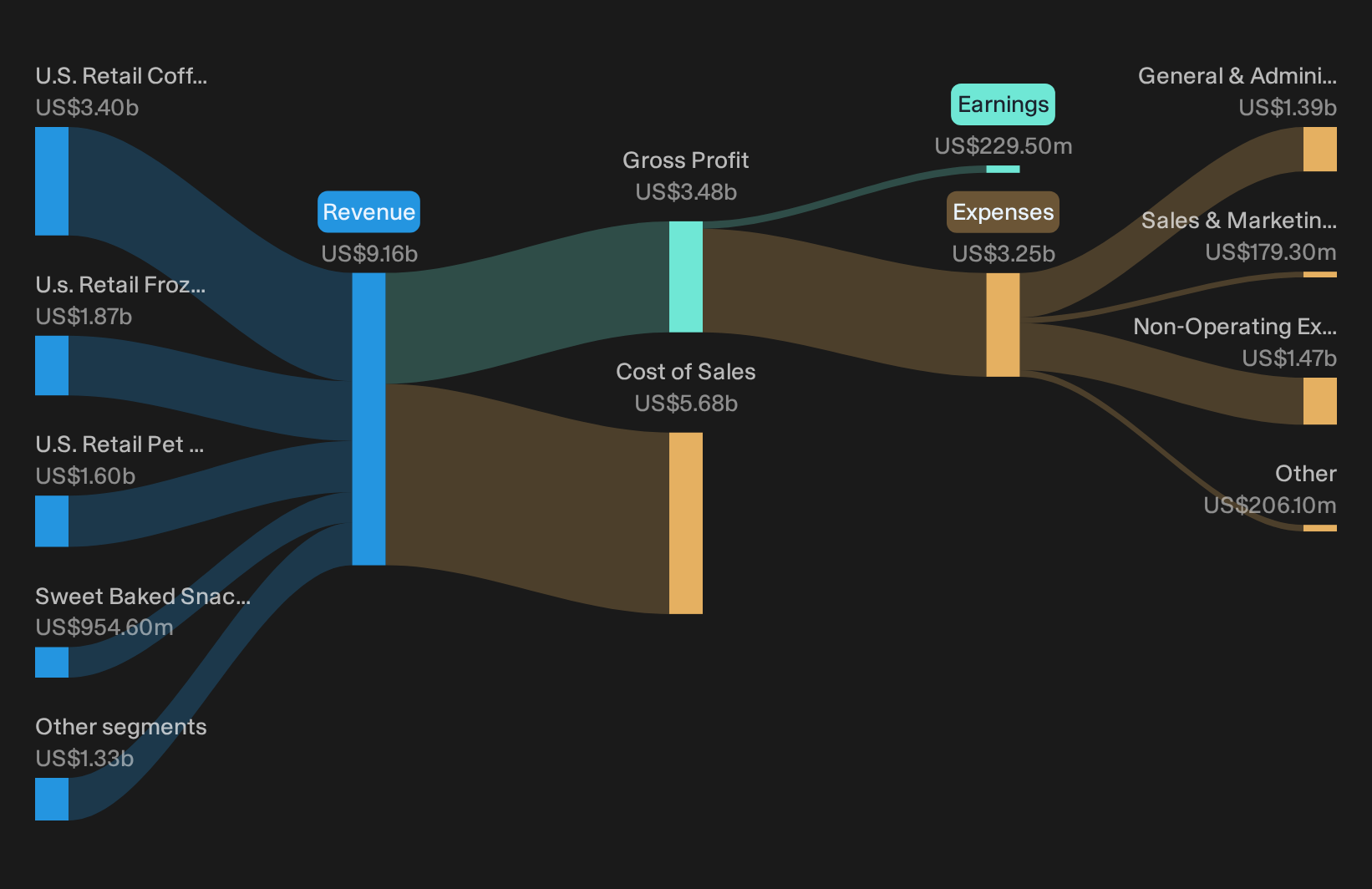
Operations: J. M. Smucker generates about US$3.4b from U.S. Retail Coffee, US$1.9b from Frozen Handheld and Spreads, US$1.6b from Pet Foods, US$1.0b from Sweet Baked Snacks, plus smaller contributions from Other and Segment Adjustments, with most sales in the United States.
Market Cap: US$13.7b
J. M. Smucker fits this discount and value-oriented screen because its coffee, spreads, frozen sandwiches, and pet foods often become the at-home substitutes that households reach for when inflation, weak sentiment, and higher fuel costs push them away from more expensive out-of-home options.
"Ongoing expansion of the Uncrustables platform, including record quarterly volume and the move past US$1b in annual net sales, positions J. M. Smucker to keep lifting frozen handheld revenue and support earnings as fixed production costs are spread over higher output."
What could matter most for J. M. Smucker is how one lingering cost and debt pressure shapes the payoff from that at-home value shift.
That cost and debt overhang is exactly where the story turns, and the full narrative for J. M. Smucker shows how J. M. Smucker’s at-home value shift could still accelerate.
Kraft Heinz (KHC)
Overview: Kraft Heinz is a global packaged food producer whose value-focused pantry brands stock grocery, value, and club stores worldwide.
Operations: Kraft Heinz generates about US$18.4b in revenue from North America, roughly US$3.5b from international developed markets, and about US$2.9b from emerging markets.
Market Cap: US$27.9b
Kraft Heinz matters for this discount and value-oriented screen because its ketchup, cheese, ready meals, and cold cuts often become the budget-friendly brands shoppers reach for when confidence weakens and grocery aisles turn into a hunt for reliable low-frills staples.
"The company is now leaning into a $600 million investment plan across product superiority, pricing, marketing, sales, and R&D, while also simplifying the U.S. operating model with new leadership, revised incentives, and rewired decision-making processes."
What investors will watch most closely is how one subtle shift in consumer trade downs ultimately feeds through to Kraft Heinz margins and cash generation.
As that trade down pattern plays out, the full narrative for Kraft Heinz unpacks whether Kraft Heinz’s reinvestment plan is quietly building accelerating brand power and more resilient cash generation.

Seeking Alternatives Before The Crowd?
Fresh ideas move first. Breakout stories can gain momentum while they are still under the radar for now. Do not get caught reacting after prices start flying. Consider acting before major moves occur.
- Track potential income opportunities while prices swing and scan a curated pool of potential high-yield payers using the 6 dividend fortresses.
- Look for early-stage potential before headlines catch up and review a hand-picked group of nimble businesses through the 20 high quality undiscovered gems.
- Explore opportunities related to possible future infrastructure build-outs and sift through a focused basket of enablers using the 42 power grid technology and infrastructure stocks.
Have feedback on this article? Concerned about the content? Get in touch with us directly. Alternatively, email editorial-team@simplywallst.com