


Apple (AAPL) recently named Qnity Electronics (Q) as a partner in its American Manufacturing Program, building on a relationship that began in March 2026. The news comes as Qnity shares have pulled back over the past four months following a strong first half.
Qnity Electronics began trading on the New York Stock Exchange last November after separating from DuPont de Nemours (DD). The roughly $22.7 billion semiconductor materials company has continued to grow since then. In the second quarter of 2026, revenue rose 22% year-over-year (YOY), adjusted EPS increased 53% YOY, and management raised its full-year outlook.
Can the Apple partnership and Qnity's role in the iPhone 18 Pro camera help Q stock move closer to Wall Street’s price target? Let’s take a closer look.
The Numbers Behind Qnity Electronics' Investment Case
Qnity Electronics supplies materials used to make chips, package them, and connect electronic components. Shares of Q stock are up 34% year-to-date (YTD), even after a 21% decline over the past three months.
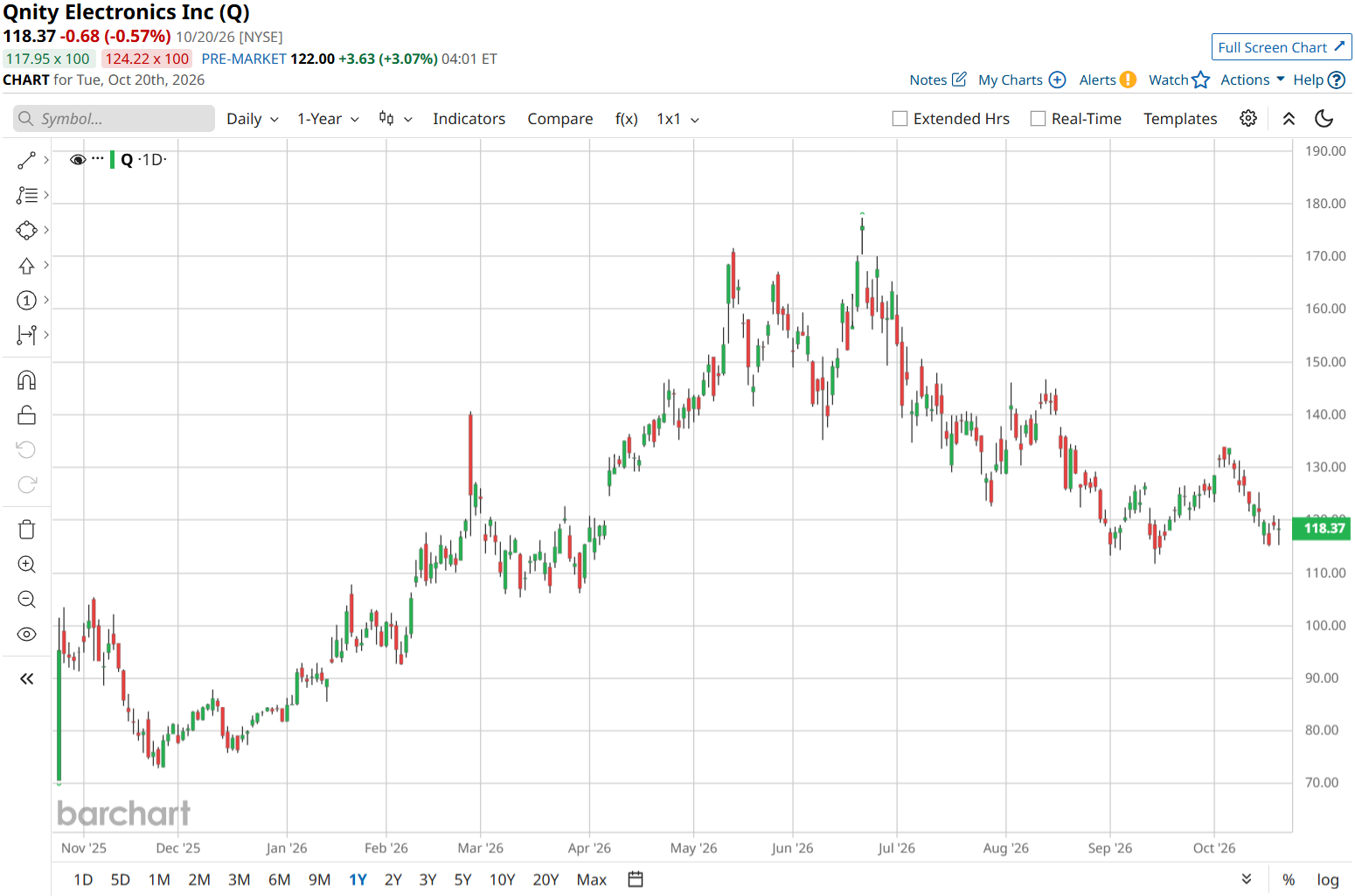
But the pullback hasn’t made Q stock cheap. Its forward price-to-earnings (P/E) ratio of 27.2 times sits above the sector median of roughly 21 times, so investors are still paying a premium for expected earnings.
Released on Aug, 4, the company's Q2 results offer a stronger reason to consider Q stock. Sales rose 22% YOY to $1.43 billion from $1.17 billion. Semiconductor Technologies sales increased nearly 16% YOY to $744 million, while Interconnect Solutions grew 30% YOY to $685 million. Gross profit increased 23% YOY to $666 million from $540 million, slightly outpacing sales growth.
The earnings picture was mixed. GAAP net income fell 31% YOY to $136 million from $198 million, while diluted EPS dropped 34% to $0.59 from $0.90. Adjusted results were stronger; adjusted operating EBITDA rose 24% to $431 million, while adjusted EPS increased 53% to $1.19. Adjusted free cash flow (FCF) also grew 16% YOY to $259 million, giving the company more cash to put back into the business.
Management also raised its 2026 forecast. The company now expects full-year revenue of $5.55 billion to $5.65 billion, adjusted operating EBITDA of $1.675 billion to $1.725 billion, adjusted EPS of $4.40 to $4.60, and adjusted FCF of $600 million to $700 million.
How Apple Fits Into Qnity’s Growth
Apple has selected Qnity to produce technology for the iPhone 18 Pro camera’s new variable aperture through its American Manufacturing Program. The deal is part of Apple’s $600 billion, four-year commitment to U.S. manufacturing and innovation.
U.S. companies across more than 12 states are making nearly 100 components for the iPhone Duo and iPhone 18 Pro. But that $600 billion figure is not Qnity’s contract value, while a separately announced $100 million, three-year commitment will go to Perryman for titanium used in the iPhone Duo and other Apple devices.
Meanwhile, Qnity is adding products for artificial intelligence (AI) chips and data centers. Its new chip-packaging platform brings together metallization, bumping, dielectric, and fine-line patterning technologies to build densely packed and vertically stacked chip systems. These processes help manufacturers make smaller connections, fit more into each package, and produce more usable chips.
Qnity Electronics also recently introduced two memory-cooling solutions using Laird Graphite-over-Foam and Thermal Interface Material technologies. These solutions can help keep high-density memory “cool, reliable, and serviceable as AI pushes memory density and power to new levels.”
What Do Analysts Expect From Qnity?
Qnity will report earnings on Nov. 4, before the market opens. Analysts expect September-quarter EPS of $1.18, up 17% YOY from $1.01 per share. For full-year fiscal 2026, analysts expect EPS of $4.41, which would mark a 32% YOY increase from $3.35.
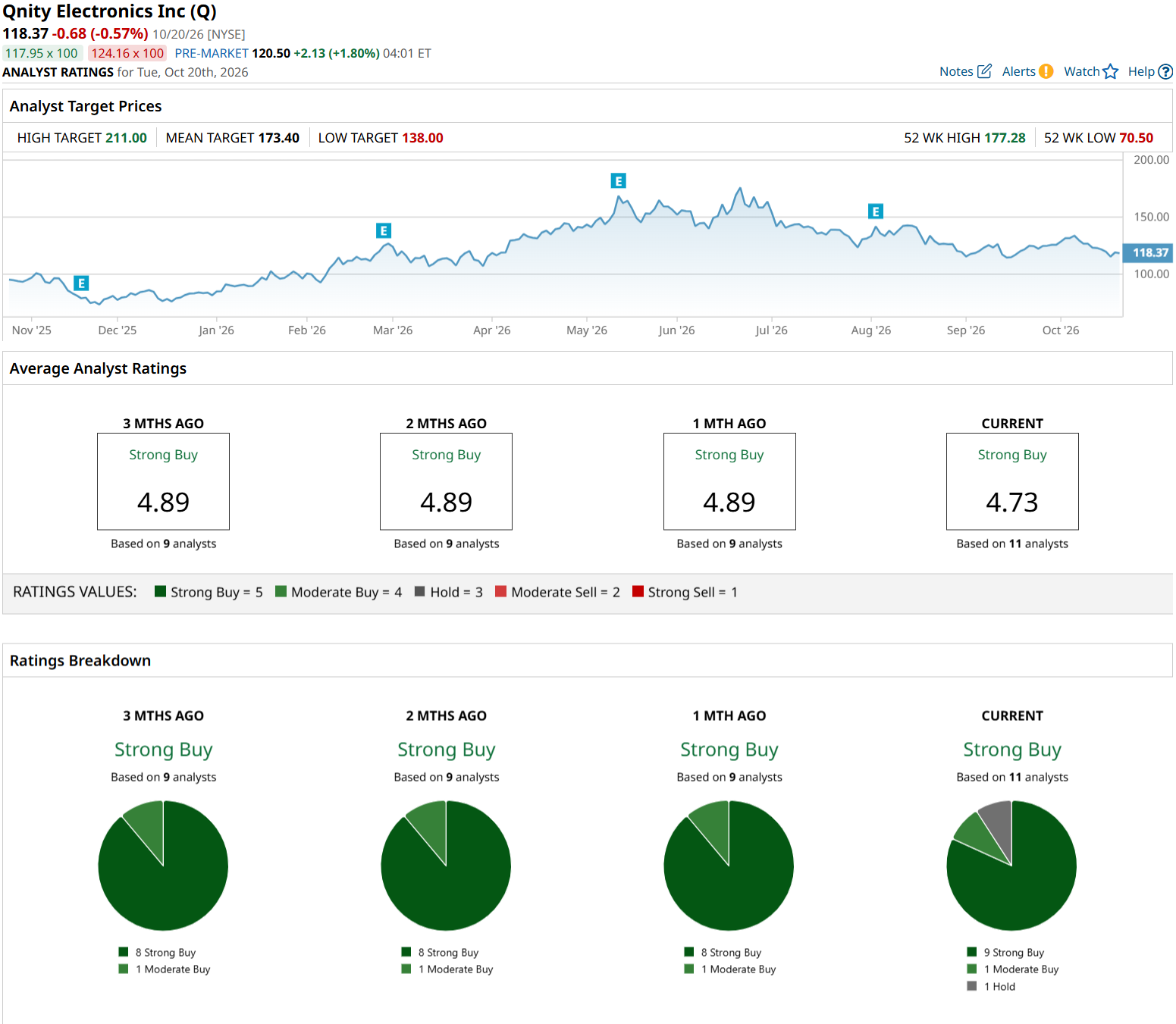
Recent analyst ratings have mostly been positive. On Oct. 12, Barclays analyst Aleksey Yefremov began coverage with an “Overweight” rating and a $211 price target. Truist Securities followed on Oct. 14 with a “Buy” rating and a $170 price target for Q stock. Still, not every analyst update pointed higher. On Oct. 15, RBC Capital analyst Arun Viswanathan cut his price target to $160 from $189 while keeping an “Outperform” rating.
Based on 11 analysts with coverage, Qnity Electronics stock has a consensus “Strong Buy” rating on Wall Street. The average price target of $173 implies potential upside of about 57% from current levels.
Conclusion
Apple’s selection is a meaningful win for Qnity, but not yet a reason to assume a major earnings boost. The news strengthens Qnity’s position with a marquee customer, while the undisclosed contract value limits what investors can realistically price in. The stronger investment case rests on growing sales, rising adjusted earnings, and opportunities in AI-related materials. I expect shares of Q stock to move higher if Qnity delivers on those earnings expectations, rather than because of Apple’s name alone. Still, the premium valuation leaves little room for disappointment, making the Nov. 4 earnings report a more immediate test than the partnership announcement.
On the date of publication, Ebube Jones did not have (either directly or indirectly) positions in any of the securities mentioned in this article. All information and data in this article is solely for informational purposes. For more information please view the Barchart Disclosure Policy here.