


Why Hancock Whitney’s latest earnings update matters for investors
Hancock Whitney (HWC) just reported third quarter results that showed lower net income and earnings per share compared with last year, while management continued to focus on growth plans and paused share repurchases.
Hancock Whitney’s shares have shown stronger long term momentum than short term trading suggests, with a roughly flat reaction over the past month but a year to date share price return of 14.04% and a 1 year total shareholder return of 35.80%, as investors weigh softer earnings against capital actions such as completed buybacks and the current pause in repurchases.
Scan how Hancock Whitney compares with other regional banks facing similar credit costs and capital trade offs using our hand picked list of solid balance sheet and fundamentals (25 results).
After a 35.8% 1 year total return and a share price that still sits below both analyst targets and intrinsic value estimates, Hancock Whitney now forces a sharper question: Is the discount a mispricing or simple caution about softer earnings and paused buybacks?
Most Popular Narrative: 13% Undervalued
Hancock Whitney’s most followed narrative sets a fair value of $84.53 against a last close of $73.51. The story hinges on whether management’s execution can close that gap under a 7.24% discount rate.
The main factor is that Hancock Whitney continues to execute on organic growth, balance sheet repricing, and the integration of One Florida Bank while keeping credit quality and operating efficiency within its current ranges.
The current share price implies investors are treating Hancock Whitney’s earnings power and capital returns as lower quality than recent guidance and raised price targets suggest.
See why 4 investors see Hancock Whitney as 13% undervalued.
Result: Fair Value of $84.53 (UNDERVALUED)
Still, the narrative around Hancock Whitney only holds if weaker recent revenue and profit figures improve and if the large hiring push actually translates into quality new business.
Find out about the key risks to this Hancock Whitney narrative.
Another View: What Hancock Whitney’s P/E Is Telling You
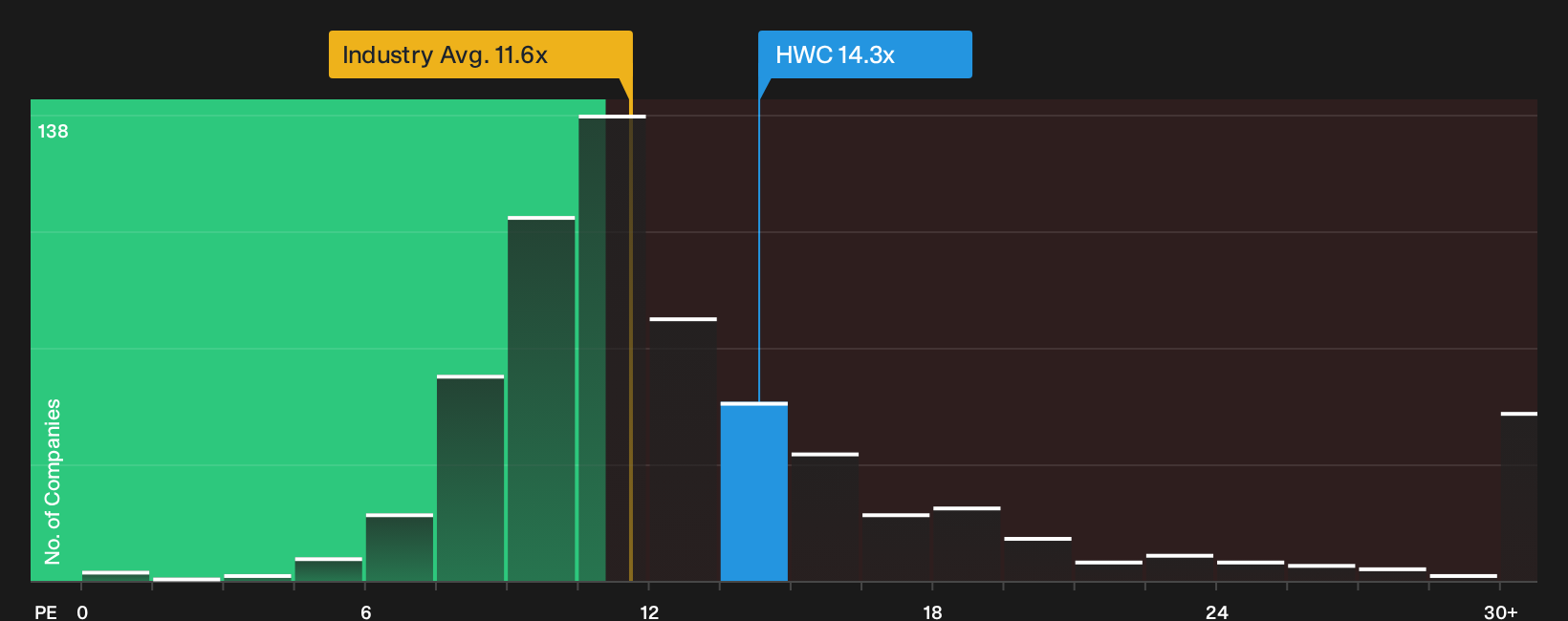
On a cash flow lens, Hancock Whitney screens as undervalued, yet the simple earnings multiple paints a tougher picture. The shares trade on a P/E of 14.3x compared with 11.6x for the US Banks industry and 11.7x for peers, while the fair ratio sits close by at 14.5x.
That means investors are already paying a premium versus the wider sector, with only a narrow gap to the fair ratio. The question is whether the recent earnings softness and lower 9.7% return on equity justify paying above industry levels, or whether the long term hiring and expansion story deserves that richer tag.
To stress test that earnings based view against a forward looking fair ratio and peer comparison, take a closer look at the valuation breakdown and how the market could move toward the fair ratio over time, starting with See what the numbers say about this price — find out in our valuation breakdown.
Next Steps
Mixed signals around Hancock Whitney can feel confusing, so move quickly from headline takes to your own view by weighing both the 3 key rewards and 1 important warning sign.
Looking for more Hancock Whitney style investment ideas?
If Hancock Whitney has sharpened your focus on quality, do not stop here. Use targeted screeners to quickly surface other opportunities that fit your approach.
- Target resilient balance sheets and steady fundamentals by scanning a curated list of solid balance sheet and fundamentals (25 results) that filters for financial strength first.
- Hunt for potential mispricings by reviewing a focused 27 high quality undervalued stocks that highlights companies with solid cash flows and conservative valuations.
- Prioritise stability and income by checking a hand picked 5 dividend fortresses aimed at stocks combining higher yields with more durable profiles.
Have feedback on this article? Concerned about the content? Get in touch with us directly. Alternatively, email editorial-team@simplywallst.com