


Vodafone Group has delivered a powerful multi year share price recovery, which naturally raises a fresh question for investors about whether the current valuation is adequately supported by its sales base. With the business also involved in new connectivity projects, the link between what you pay for the stock today and the revenue it generates has become a key focus.
- Over the past 3 years the stock has gained 88.9%, putting more pressure on the question of how closely the share price now tracks the scale of Vodafone's underlying sales.
- A recent collaboration with AST SpaceMobile and several major European carriers to explore space based cellular broadband can influence how investors think about future revenue opportunities and the timing of any sales growth tied to wider network coverage.
- There is a second opinion on Vodafone Group worth weighing. See what analysts think Vodafone Group's shares could be worth.
For investors, the debate is whether Vodafone's current share price is appropriately aligned with the level and trajectory of its sales.
If you want to test the same question about price versus sales across a wider field than Vodafone Group, scan the 8 high quality undervalued stocks.
Is Vodafone Group Still Cheap on Sales?
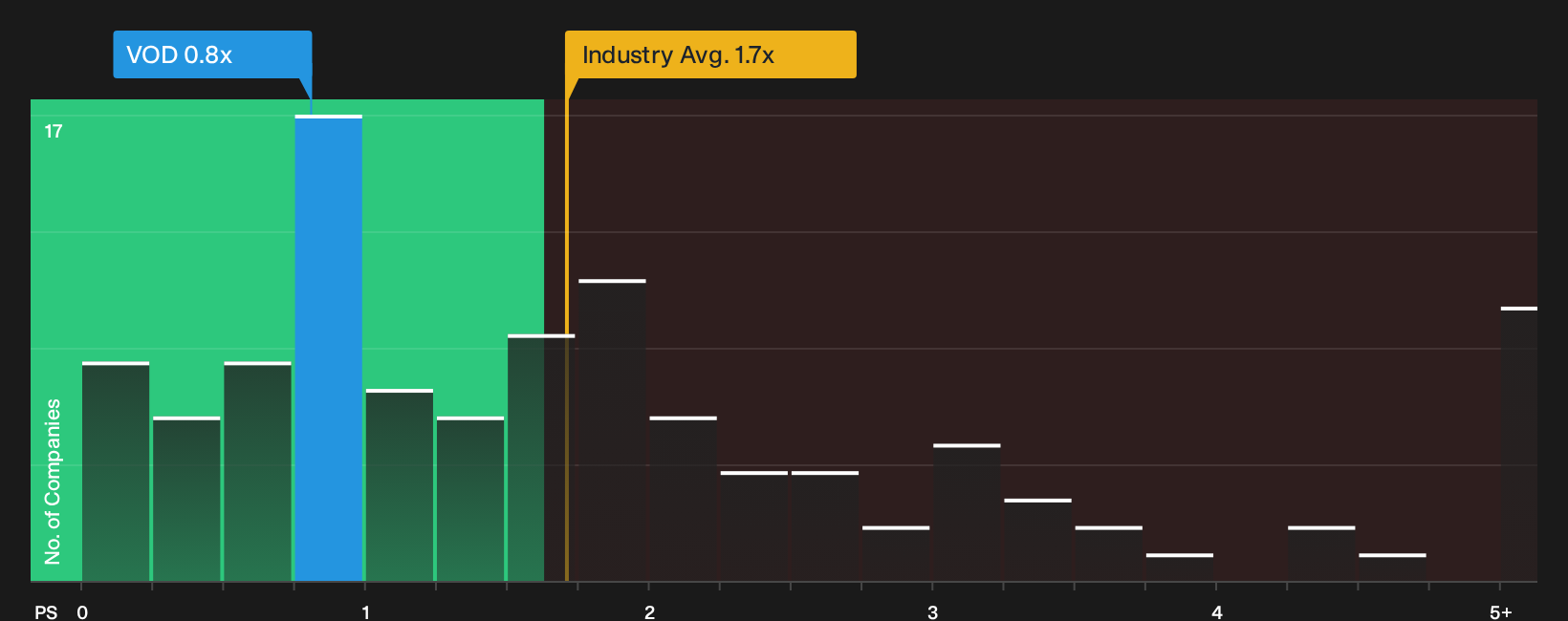
P/S is often a useful way to think about telecom groups like Vodafone Group because revenue tends to be more stable than accounting earnings. On this yardstick, Vodafone trades on a P/S ratio of 0.8x, which is well below the Wireless Telecom industry average of 1.7x and also below the peer group average of 2.2x.
Because the AST SpaceMobile collaboration has refocused attention on longer term connectivity projects, it matters that the multiple still sits under the level suggested by a fair value framework that blends growth, profitability, size and risk for Vodafone. That gap points to a share price that the model assesses as undervalued relative to the sales base, so any view on the stock hinges on how durable those revenues appear to be and on the outlook for margins over time. Explore the numbers behind Vodafone Group's P/S valuation.
The Vodafone Group Narrative: What Would Justify Today's Price?
Simply Wall St Narratives pick up where Vodafone Group's price to sales puzzle leaves off by spelling out which paths for growth, margins and earnings would need to play out for the stock to be worth materially more or materially less than it is today on the market, and they sit on Simply Wall St's Community page. Where a single ratio or model gives you one headline figure, these narratives set out the future Vodafone Group's valuation leans on so you can watch in real time whether that story is actually unfolding.
The Vodafone Group community is split between those who see enough in the UK integration and Africa to support today’s pricing and those who think German pressure leaves little margin for error.
Bull case: roughly fairly valued
"The integration of VodafoneThree in the U.K., with increased annual cost and CapEx synergy ambitions of £800 million by FY2030 and a path to £1b by FY2032, is expected to improve net margins and free cash flow as duplicate network and operating costs are removed..."
Discover why this Narrative puts Vodafone Group at roughly fairly valued.
Bear case: 39% overvalued
"Although Vodafone Group points to continued good growth in adjusted EBITDAaL and free cash flow and has set an ambition for double digit free cash flow growth, the expectation that Germany's EBITDA will decline again in FY 27 due to TV and mobile pricing headwinds introduces a risk that group earnings fall short of these goals if the largest European market does not stabilise as assumed..."
Explore why this Narrative puts Vodafone Group at 39% overvalued.
One more check for Vodafone Group before you close the file
Price against sales tells you what the market pays for Vodafone Group today, but analyst projections a few years out show what expectations are already baked in or missing. Explore where analysts expect Vodafone Group to be in a few years.
Have feedback on this article? Concerned about the content? Get in touch with us directly. Alternatively, email editorial-team@simplywallst.com