


St. Joe (JOE) is back in focus after the company installed new senior leaders over its residential real estate and private club operations in Northwest Florida, sharpening attention on how the business is positioned today.
Recent trading has been softer in the very short term, with St. Joe’s share price slipping 2.71% over the last day. However, the 90-day share price return of 8.77% and 1-year total shareholder return of 33.64% suggest momentum has been building as investors weigh these leadership changes alongside the hurricane recovery update and increased focus on the company’s Northwest Florida assets.
Scan for other real estate developers showing similar leadership and regional catalysts by reviewing the hand picked 21 high quality undiscovered gems, which may occupy a comparable sweet spot to St. Joe.
After a 1 year total return of 33.64% and fresh leadership in key units, St. Joe is not an obscure backwater play anymore. Does the current valuation still offer a skew that rewards new money for taking the risk?
Price-to-Earnings of 31.3x: Is it justified?
On simple headline numbers, St. Joe trades on a P/E of 31.3x, which is a rich tag for a real estate developer given the last close at $67.57 and positions the stock at a clear premium to many peers.
The P/E ratio compares what investors are paying today for each dollar of St. Joe earnings. For a business with three operating segments and meaningful exposure to Northwest Florida real assets, that kind of multiple usually implies the market is willing to pay up for earnings quality, consistency or perceived durability rather than treating it as a cyclical land bank.
That premium sits in tension with other parts of the picture. The firm is flagged as having a high level of debt and 100% of its liabilities tied to higher risk funding sources, yet it also reports high quality earnings, a 48.7% earnings growth rate over the past year, 10.2% per year profit growth over five years, and net profit margins currently at 22.5% compared with 19.4% previously.
Set against the broader sector, the P/E multiple looks stretched. St. Joe trades at 31.3x earnings, more than double the US Real Estate industry average of 14.4x and above the peer group average of 26.7x. The market is therefore paying a clear premium for this earnings stream, which leaves less room for disappointment if those profits or margins soften.
See what the numbers say about this price — find out in our valuation breakdown.
Result: Price-to-Earnings of 31.3x (OVERVALUED)
Still, the St. Joe narrative can break if higher risk funding costs bite harder than expected, or if demand in Northwest Florida cools and pressures pricing.
Find out about the key risks to this St. Joe narrative.
Another view on St. Joe’s value
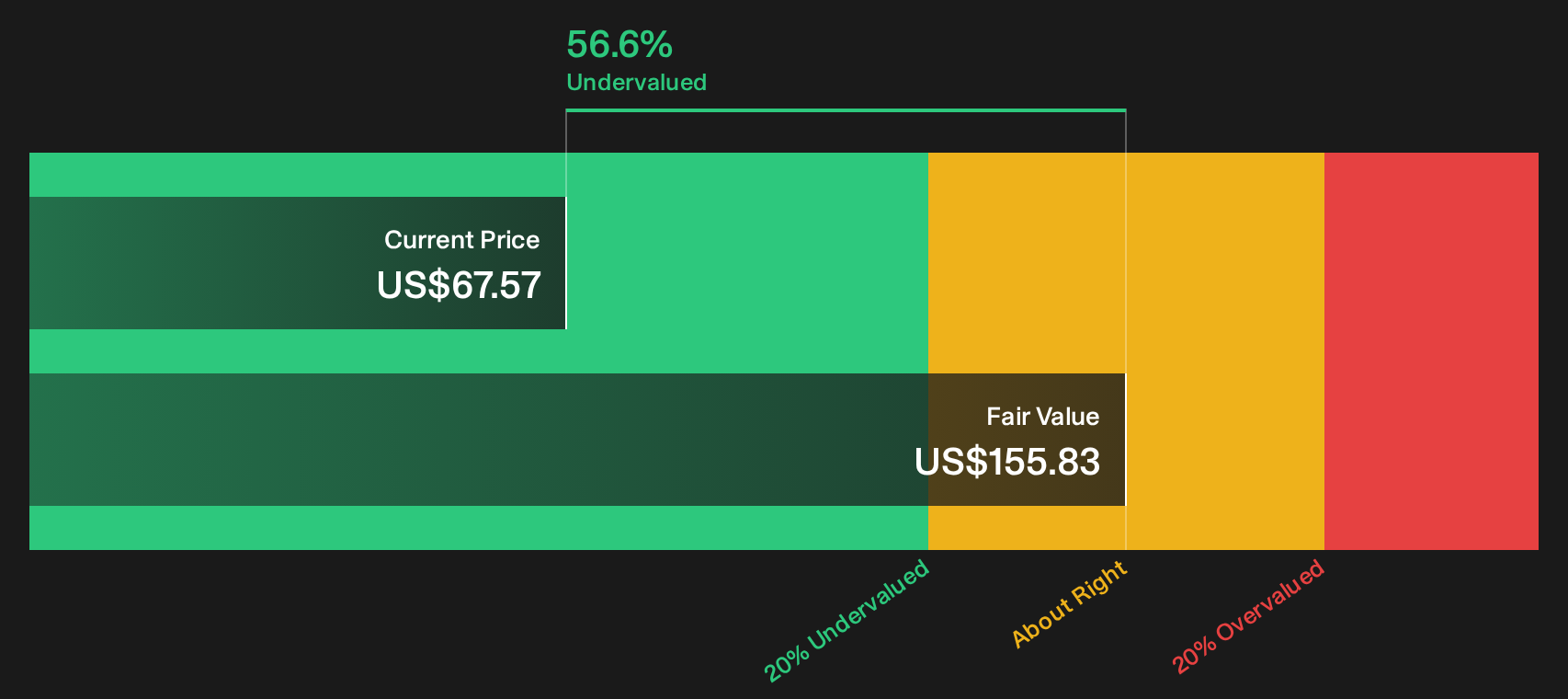
Sticker shock on a 31.3x P/E is one thing. A very different picture appears when you look at St. Joe through the SWS DCF model, which estimates future cash flows support a fair value of about $155.83 per share versus the current $67.57 price, implying the stock trades well below that mark.
For anyone weighing the gap between a premium earnings multiple and a discounted cash flow signal, the next step is to understand how that model is built and what would need to change for the gap to close, or stay wide, in your view. Look into how the SWS DCF model arrives at its fair value.
Simply Wall St performs a discounted cash flow (DCF) on every stock in the world every day (check out St. Joe for example). We show the entire calculation in full. You can track the result in your watchlist or portfolio and be alerted when this changes, or use our stock screener to discover 27 high quality undervalued stocks. If you save a screener we even alert you when new companies match - so you never miss a potential opportunity.
Next Steps
Mixed signals on St. Joe can either make you hesitate or push you to investigate the numbers yourself and move fast while sentiment is split. To weigh those cross currents on your own terms, start with the 2 key rewards and 1 important warning sign
Looking for more investment ideas beyond St. Joe?
If you stop with St. Joe, you only see one angle. Cast the net wider so you can compare opportunities side by side before committing capital.
- Target potential mispricings by reviewing companies trading below their implied worth with the 27 high quality undervalued stocks.
- Focus on resilience and capital preservation by scanning a 30 resilient stocks with low risk scores that aims to keep downside shocks in check.
- Anchor your research on financial strength by using the list of solid balance sheet and fundamentals (25 results) to highlight businesses with sturdier fundamentals.
Have feedback on this article? Concerned about the content? Get in touch with us directly. Alternatively, email editorial-team@simplywallst.com