


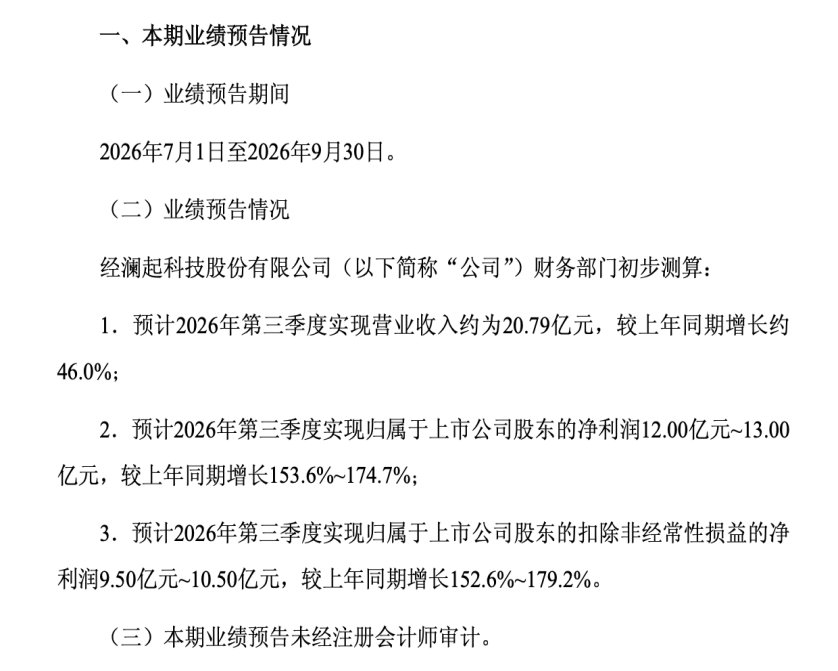
On October 20, Lanqi Technology (06809) announced Yingxi. It is expected to record profit of 1.2 billion to 1.3 billion yuan in the third quarter ending September 30, 2026, an increase of 153.6% to 174.7% over the previous year; revenue is about 2,079 billion yuan, an increase of about 46% over the previous year.
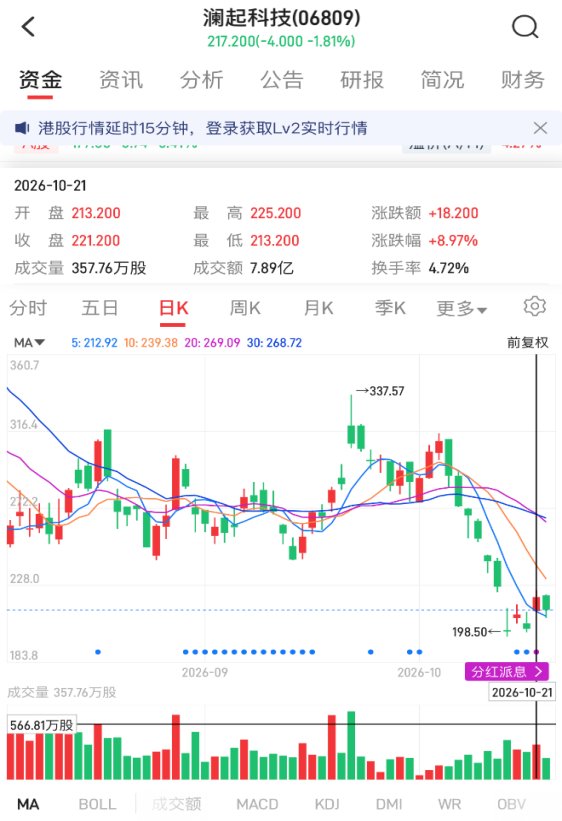
On the first trading day after Yingxi, the company's stock price rose nearly 9%. Against the backdrop of the biggest drop of about 70% in the previous month, this single-day rebound appears to be a forced correction of Yingxi's pricing of the “deceleration in performance” in the previous period. Foreign banks also quickly gave positive feedback: Citi said in the research report that Lanqi Technology's initial performance in the third quarter far exceeded expectations and reaffirmed the “buy” rating, with a target price of HK$425; Goldman Sachs also published a research report to maintain the “buy” rating, with a target price of HK$500 for H shares. Institutional ratings echo Yingxi data, further strengthening the market's revised expectations for excessive pessimistic pricing in the early stages.
Yingxi dismantling: Exceeding expectations is not only the growth rate, but also the quality of profit
The market's first level of expectation is that the difference is on the profit side. According to Citi's estimates, the median net profit of 1.2 billion to 1.3 billion yuan was about 34% higher than the market's consensus expectations and the bank's own forecast; Goldman Sachs's estimate was more aggressive, and the median was about 47% higher than market expectations. This means that in the biggest decline of about 70% in the previous month, the implicit assumption in pricing was a “deceleration in performance,” but the actual data not only did not slow down, but rather accelerated: revenue and net profit grew by 32.85% and 81.46% year-on-year respectively in the second quarter, and jumped above 46% and 153%, respectively, in the third quarter. The slope of the growth rate itself is the most direct tool for falsification.
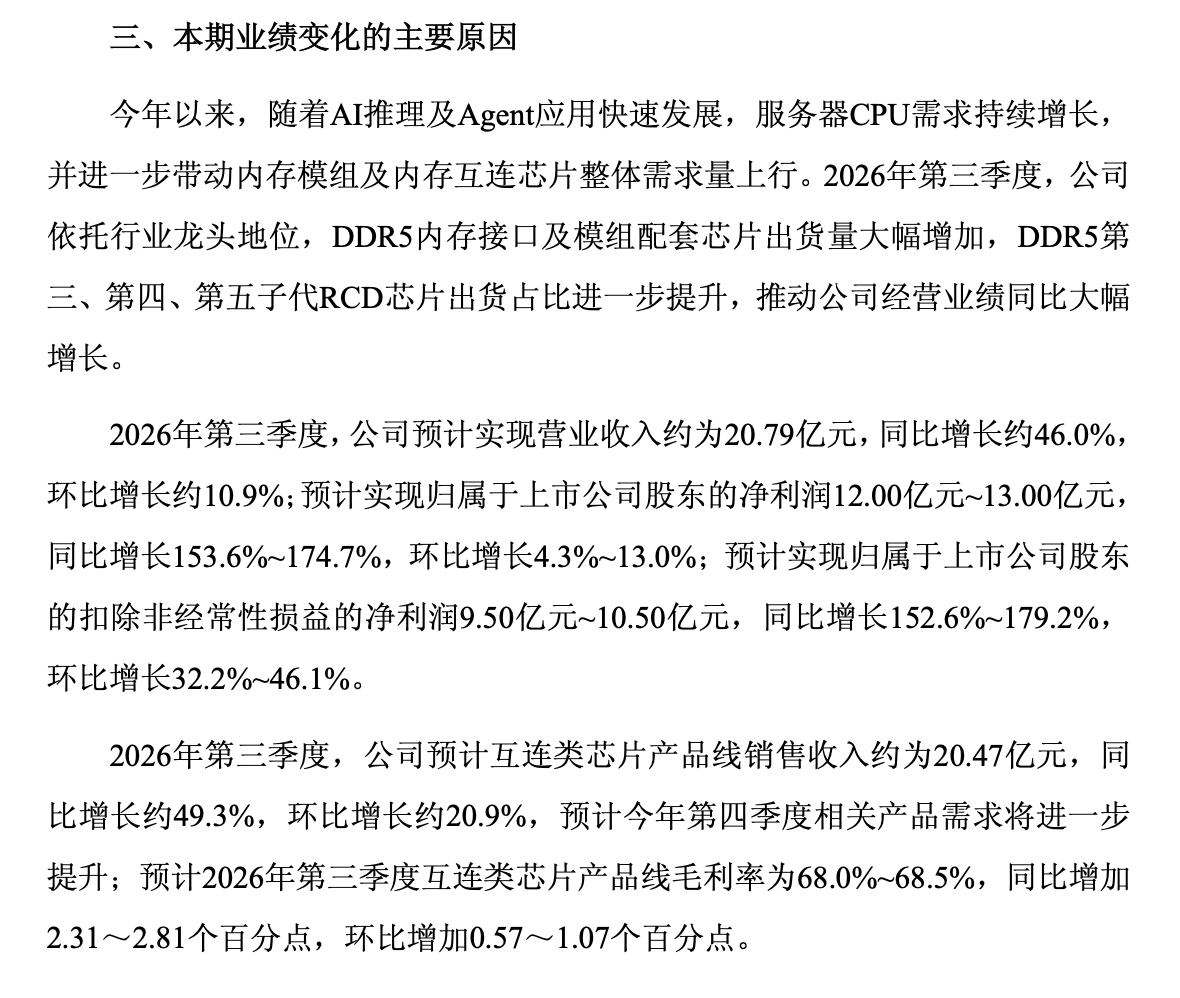
However, what really makes this profit worth perusing is not the profit growth rate of 153% to 174% itself, but the source of profit elasticity. The announcement attributed the increase to the rapid implementation of AI inference and agent applications; server CPU demand continued to rise, driving overall demand for memory modules and interconnect chips; shipments of DDR5 memory interfaces and module supporting chips increased dramatically, and the share of third, fourth, and fifth generation RCD chip shipments further increased. Revenue from interconnect chips in a single quarter was about 2,047 billion yuan, up 49.3% year on year and 20.9% month on month; gross margin guidance was 68.0% to 68.5%, up 2.31 to 2.81 percentage points year on year, and continued to improve month over month. Citi sees gross margin performance as a direct relief to concerns about rising OEM costs. The meaning of this set of data is that growth is not price in exchange for volume, but rather a sharp rise in volume and price driven by product structure upgrades. The improvement in profit quality is more persuasive than the revenue growth rate.
The deeper lack of expectations is due to the question of “what does Lanqi Technology rely on to grow”, which has been misinterpreted by the market for a long time. Over the past few months, Lanqi Technology has been widely embedded in the “storage cycle” pricing framework: the profit expectations of original storage manufacturers such as Samsung and SK Hynix fluctuated, memory spot price expectations fluctuated, and the company was involved in the “storage bear market” narrative as a memory interface chip supplier. However, Citi made a key distinction in the research report after Yingxi: Lanqi's memory interface business is mainly driven by CPU shipments and number of memory channels, not memory prices.
After a 9% rebound: foreign investors first increased their positions and recovered successfully
If Yingxi's solution is “whether performance is false and pessimistic,” then the solution to financial action is “who sets the price and where.”
According to the Hong Kong Stock Exchange disclosure, J.P. Morgan Chase's good position ratio in Lanqi Technology's H shares rose from 7.06% to 7.35% on October 15, increasing its holdings by 0.29 percentage points. It is worth noting that this increase in holdings occurred in a window where stock prices were still hovering at a low level before the announcement of Yingxi's announcement, rather than a follow-up increase after the news came to fruition. The ratio of short positions also increased from 2.64% to 3.06% during the same period, indicating that foreign investors are not one-way bets, but they chose to raise at the stage where pessimism is strongest for directional positions. After Yingxi, the stock price rose by nearly 9%, and J.P. Morgan Chase's pioneer position gained a profit as a result.
The agency ratings simultaneously strengthened this judgment after Yingxi. Goldman Sachs maintained a “buy” with a target price of HK$500 for H shares and $377 for A shares; Citi reiterated its “purchase”, with a target price of HK$425 for H shares and $320 for A shares; and Lyon also maintained a “high confidence to outperform the market” rating. The increase in J.P. Morgan Chase's holdings and the target prices of many foreign banks together form a double verification of “fundamental anchor+financial pioneer”.
However, a positive line of nearly 9% does not automatically equal a trend reversal. Among the causes of the decline in the previous month, in addition to the decline in sector-based storage sentiment, there is another clue that has not completely dissipated: the South Korean prosecution launched an anti-monopoly site search of Lanqi's Korean office in July. Together with Renesas and Rambus, they were investigated whether they colluded with prices when supplying Samsung and SK Hynix. Lanqi's announcement confirmed that it was fully cooperating with the investigation. As of the disclosure date, none of the company, directors, or employees had been formally charged, but it clearly stated that “it is impossible to predict the timing and outcome of the investigation at this stage.” This uncertainty still hangs over the valuation. Furthermore, the sustainability of AI infrastructure capital expenditure, potential adjustments to international customer supply chain strategies, and the structural impact of alternatives such as SOCAMM and LPDDRX on memory interface requirements are all risk variables listed by Citi after being optimistic.
Nor was the rebound on the first trading day after Yingxi. The Hong Kong stock storage and AI hardware sectors collectively strengthened on the same day, and the beta sector provided a window for individual stock alpha to be cashed out. However, when sentiment in the sector ebbs down, whether Lanqi Technology can continue to obtain overrated prices based on the fundamentals anchored by Yingxi is the real yardstick for testing the success of this round of restoration. J.P. Morgan Chase raised its shareholding ratio from 7.06% to 7.35% before Yingxi, and has already cast a “first-hand vote” with real money. Next, whether demand for interconnect chips in the fourth quarter can meet management's further growth guidelines will determine whether this 9% is an initial seam in the valuation gap or the starting point for a new round of revaluation.