


Fresh comments from Bill Ackman backing a swift exit of Federal National Mortgage Association (FNMA) from government conservatorship, along with Treasury Secretary Scott Bessent’s timeline remarks, have pushed the company’s future structure and autonomy back into focus.
Federal National Mortgage Association’s share price has been volatile this year, with the stock down 20.2% on a 30 day share price basis and 63.73% year to date. However, the 3 year total shareholder return of about 4.5x and 5 year total shareholder return of more than 3.5x still reflect a very large longer term gain. Recent conservatorship headlines are therefore landing against a backdrop where long term holders have seen substantial value swings, while shorter term momentum has faded.
Compare the conservatorship story playing out at Federal National Mortgage Association with other potential value setups by scanning our hand picked list of 27 high quality undervalued stocks across the market.
Federal National Mortgage Association has already delivered very large multi year gains, then handed back a big chunk recently. Is the real upside now largely in the rear view mirror or still ahead at today’s price?
Most Popular Narrative: 62% Undervalued
The most followed narrative pegs Federal National Mortgage Association’s fair value at $10.50, compared with the last close at $3.99. This frames a wide gap that fans of the stock view as driven by how conservatorship, capital and earnings power ultimately get resolved.
The large $4.1 trillion guaranty book and role as the largest guarantor of U.S. residential mortgage debt put the company in a position to benefit as housing finance demand trends support sustained guaranty fee revenue and earnings.
Ongoing repricing of the guaranty book, with higher average guaranty fees in single family, supports the potential for a firmer net interest margin and can be a tailwind for net revenues.
See why 4 investors see Federal National Mortgage Association as 62% undervalued.
Result: Fair Value of $10.50 (UNDERVALUED)
Still, the story around Federal National Mortgage Association can shift quickly if conservatorship timelines remain unclear or if multifamily credit stress pushes losses higher.
Find out about the key risks to this Federal National Mortgage Association narrative.
Another View: Valuing Federal National Mortgage Association By P/E
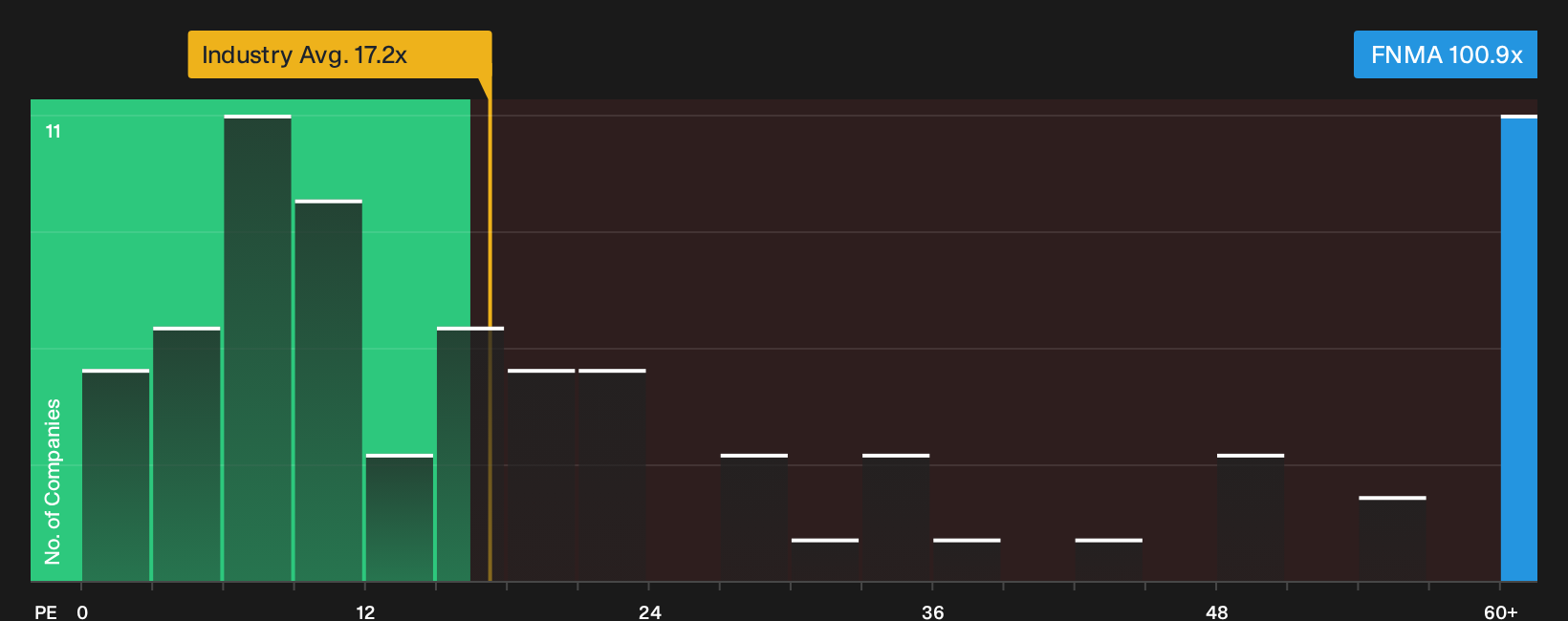
The SWS DCF model points to Federal National Mortgage Association trading well below an estimated future cash flow value of $228.16, which supports the popular undervalued story. A different lens tells a very different tale, because the current P/E of 100.9x is far above the industry at 17.7x, peers at 24.3x and an SWS fair ratio of 2.6x, which suggests a lot of valuation risk if sentiment or assumptions change.
Before leaning on either approach too heavily, it is worth asking which one fits how you think earnings, policy and conservatorship play out from here, and which downside you are more comfortable with if the crowd is wrong in the short term.
See what the numbers say about this price — find out in our valuation breakdown.
Next Steps
Mixed sentiment runs through this Federal National Mortgage Association story, so move fast, review the same numbers, and weigh the 2 key rewards and 3 important warning signs.
Looking for more investment ideas beyond Federal National Mortgage Association?
If you only stop at Federal National Mortgage Association today, you risk missing other opportunities that could fit your style, time horizon and risk comfort.
- Target potential high upside with a focused group of 7 elite penny stocks with strong financials that already clear strong financial quality checks.
- Zero in on pricing gaps by scanning a curated set of 27 high quality undervalued stocks that pair cash generation with sturdier balance sheets.
- Prioritise capital preservation and steadier sleep at night by reviewing 30 resilient stocks with low risk scores that score well on resilience and risk metrics.
Have feedback on this article? Concerned about the content? Get in touch with us directly. Alternatively, email editorial-team@simplywallst.com