


Rates look stuck, inflation pressure has not gone away, and growth expectations are softer, yet the power grid still has to keep the lights on. That mix can pull money away from some parts of the market and toward steadier cash generators. This article walks through three U.S. electric utilities and grid infrastructure stocks from our screener that appear especially exposed to today’s macro crosscurrents.
The three stocks below are only a sample from this idea, and the full screen pulled out 17 more U.S. electric utilities and grid infrastructure companies with equally compelling stories that are not covered here.
If you want to identify and analyze your own highest conviction picks in this space, head straight to the U.S. Electric Utilities & Grid Infrastructure screener.
Entergy (ETR)
Overview: Entergy produces, transmits, and sells electricity to 3.1 million customers across Arkansas, Louisiana, Mississippi, and Texas within a regulated utility framework.
Operations: Entergy generates about US$13.4b in revenue primarily from its utility segment in the United States, with only minor unallocated items and eliminations.
Market Cap: US$51.7b
Entergy fits the electric utilities and grid infrastructure theme because it is a large, regulated power provider whose cash flows can look relatively steady when growth slows and inflation stays sticky. This is exactly when income oriented investors often pay more attention to this kind of business.
"Substantial long term electricity demand growth from industrial development, population migration to the Gulf South, and large scale data center expansions in Entergy’s service territory now includes approximately 7 to 12 GW of hyperscale data center potential, 3 to 5 GW of traditional industrial demand, and signed agreements with AWS and Meta that together support the updated outlook for roughly 8.5% to 9% annual retail sales growth, which could lift regulated revenue and earnings over time."
What happens to that long term earnings path depends heavily on how one unseen cost pressure interacts with this ambitious buildout plan.
That unseen pressure is the real swing factor for Entergy’s long range buildout story, and the full narrative for Entergy explains how it could accelerate or stall earnings quality.

Consolidated Edison (ED)
Overview: Consolidated Edison delivers regulated electric, gas, and steam services to millions of customers across New York and parts of New Jersey, anchoring a major U.S. grid.
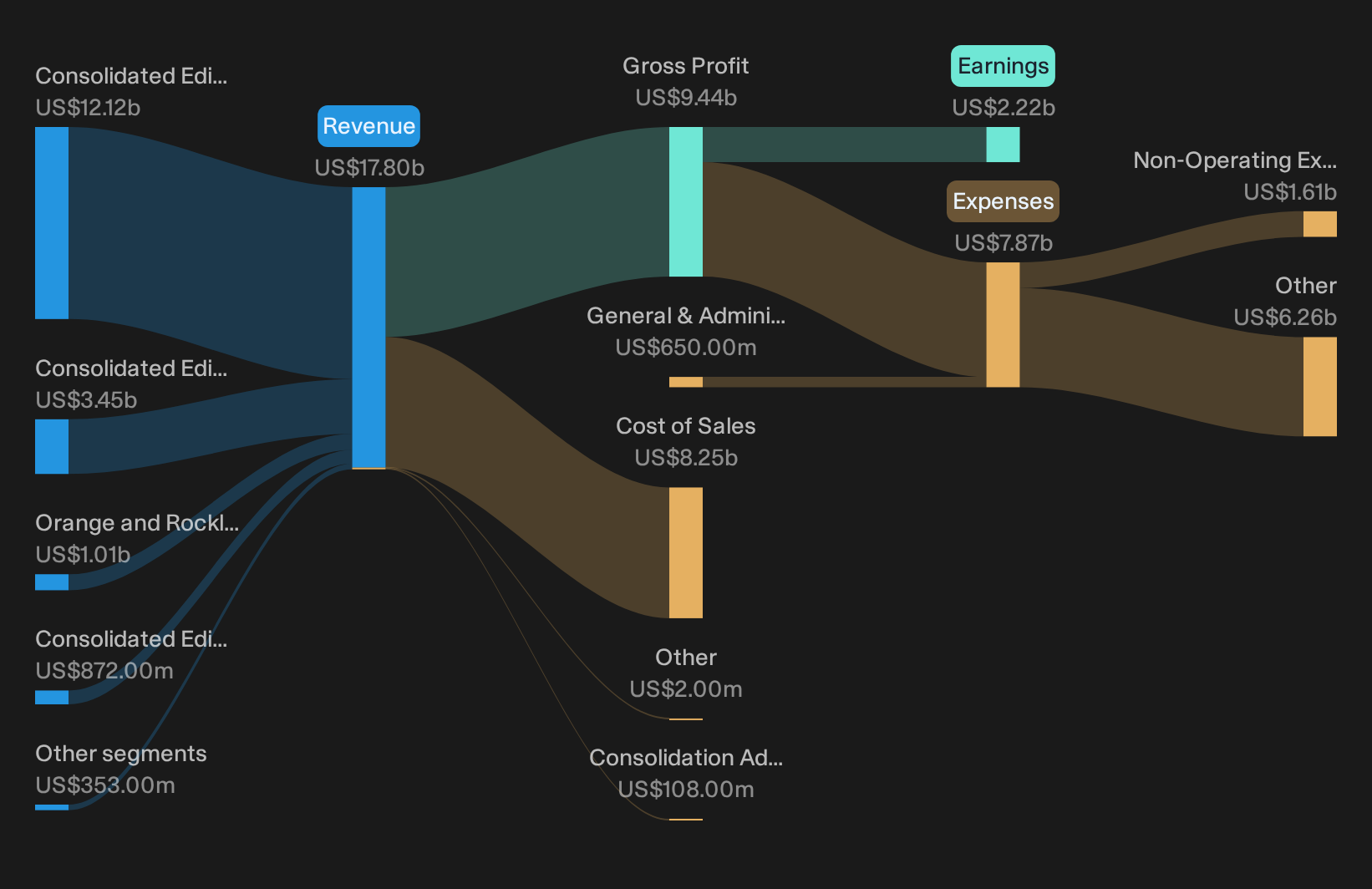
Operations: Consolidated Edison generates about US$17.7b in revenue, led by CECONY electric at US$12.1b, CECONY gas at US$3.4b, and CECONY steam at US$872m.
Market Cap: US$43.0b
Consolidated Edison sits squarely in this U.S. Electric Utilities & Grid Infrastructure theme because it is paid to keep one of the country’s most demanding power systems reliable while spending heavily on hard assets that sit in a regulated rate base.
"Planned infrastructure investment of about US$38b over the next five years and US$72b over the next decade at CECONY is expected to expand Consolidated Edison’s regulated asset base, which can support future revenue and earnings tied to that growing rate base."
What that means for investors ultimately comes down to how one unresolved regulatory and affordability pressure shapes the returns on all that spending.
Those affordability and regulatory crosswinds are exactly what the full narrative for Consolidated Edison unpacks, separating headline capex from the underlying return trajectory that Consolidated Edison investors often care about most.
OGE Energy (OGE)
Overview: OGE Energy is a regulated electric utility that generates, transmits, and distributes power to customers across a large Oklahoma service territory.
Operations: OGE Energy generates all of its US$3.2b in revenue from its electric company in the United States, reflecting a pure-play regulated utility profile.
Market Cap: US$10.1b
OGE Energy fits this grid-focused screen because it ties regulated wires and power plants directly to resilient demand. Its investment calendar is now closely watched by investors looking for steady cash flows rather than rapid growth stories.
"Ongoing and planned investments in generation capacity and transmission infrastructure are now backed by a draft 2026 resource plan that identifies about 1.9 gigawatts of incremental capacity needs by 2031 and specific projects such as 550 megawatts of capacity additions in 2026, the 300 megawatt Frontier Storage project in 2027, and Southwest Power Pool assigned 765 kV transmission work."
What happens to that grid buildout ultimately depends on how one regulatory pressure shapes the balance between rising capital needs and bill affordability.
That pressure point is exactly where the full narrative for OGE Energy shows how OGE Energy’s grid buildout, capital cycle, and bill trends could be quietly decoupling from the headline story.

Seeking Alternatives Beyond The Usual Suspects
Fresh ideas get caught early, before momentum starts flying and prices move out of reach. Scan new angles while it matters, under the radar for now. Consider acting before wider attention arrives.
- Hunt for cash flowing miners positioned for potential metals strength with a curated set of 35 elite gold producer stocks that focus on scale, reserves, and operating discipline.
- Spot infrastructure players linked to AI-related activity by tracking 55 AI infrastructure stocks that plug directly into data center and compute demand.
- Explore grid-focused companies as electrification spreads using a filtered group of 42 power grid technology and infrastructure stocks involved in upgrading and modernizing transmission assets.
Have feedback on this article? Concerned about the content? Get in touch with us directly. Alternatively, email editorial-team@simplywallst.com