


- Citigroup received approval from China’s securities regulator to set up Citigroup Securities China Company Limited, a wholly owned onshore unit in Shanghai that can offer equities brokerage, underwriting, research, principal trading and a wide set of capital markets services to domestic and foreign clients.
- This onshore license gives Citigroup direct access to China’s capital markets, which can reshape how its global institutional and wealth clients raise, trade and allocate capital across the region.
- We will look at how Citigroup's China securities approval fits into its investment narrative built around services scale and efficiency.
Scan how Citigroup’s onshore move fits into a broader capital markets reset by reviewing hand picked 42 power grid technology and infrastructure stocks that are also building infrastructure around trading, liquidity and global capital flows.
Citigroup Investment Narrative Recap
To own Citigroup, you need to believe the bank can keep turning its global services, cards and wealth engines into steady earnings while holding its line on regulation and costs. The China securities approval fits that thesis as another way to deepen client flows, although the impact looks gradual rather than a near term swing factor.
In the near term, the big swing factor is still execution on simplification and capital deployment, including balance sheet mix and share repurchases. Competitive and regulatory risk sits in the background. Any control lapse or loss of relevance to fintech and digital payment rivals could matter more to the story than the new onshore China unit.
The earnings print on 13 October looks more important for a near term Citigroup view than the China news alone. Revenue for the quarter was US$23.85b, up 7.9% year on year, with net interest income at US$16.98b and net income at US$5.25b. That provides fresh evidence on profitability while the China platform is still being built.
Those results, plus higher net income over the first nine months of 2026, set the bar for what the Banamex IPO, AI rollout and capital return program need to support. If future quarters hold this earnings profile while Citigroup beds down onshore China capabilities, the narrative around services scale and efficiency has more operational backing.
Citigroup Forecasts and What They Assume
Citigroup's analyst blueprint ties the China securities license into a bigger earnings story that already has specific numbers attached to it. Consensus estimates call for revenue growth of 9.3% a year over the next three years, with current profit margins of 21.4% expected to ease to 20.6% as the business leans into technology, control spending and balance sheet actions. On these assumptions, earnings today of US$17.9b are projected to reach US$22.4b by 2029, an increase of US$4.5b that would need to come through a mix of higher fee income, interest revenue and cost discipline rather than one single new growth engine.
Citigroup's narrative projects US$108.8b revenue and US$22.4b earnings by 2029. This requires 9.3% yearly revenue growth and an earnings increase of about US$4.5b from US$17.9b.
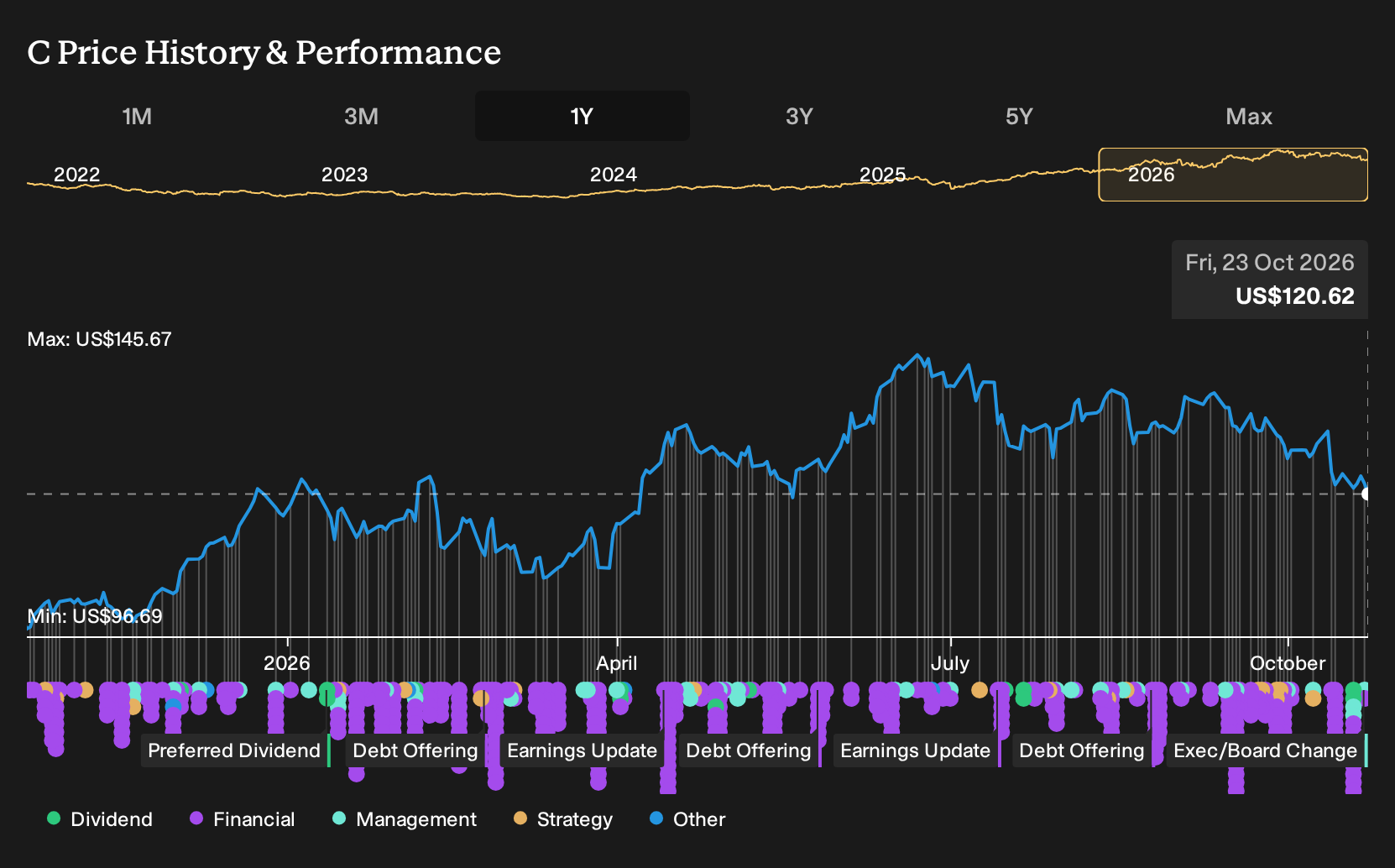
Valuation work built off these inputs anchors on that same 2029 forecast. The consensus view assumes Citigroup reaches US$108.8b of revenue and US$22.4b of earnings in that year and trades on a P/E of 11.3x, which is in line with where the stock is described today and fractionally below the cited 11.4x multiple for the wider US banks group. At a current share price of US$122.27, the average analyst target of US$150.71 sits 18.9% higher, with individual expectations stretched between US$127.00 and US$170.00. This spread gives a sense of how much opinion already differs on execution and capital allocation.
For anyone weighing the China move, these numbers are useful as a reference point rather than a forecast you must accept. The onshore brokerage license, AI rollout, Banamex IPO and capital return plan all feed into the same question: Can Citigroup convert its large services footprint and securities pipeline into that roughly US$4.5b step up in earnings by 2029 while margins soften only modestly and the P/E holds around 11.3x? The answer will partly depend on how quickly the Shanghai unit feeds deal flow and trading activity back into the global platform and whether that flow is strong enough to matter against the much larger revenue and earnings base described in the consensus case.
Uncover why Citigroup's fair value indicates a 25% potential upside to its current price that may be short-lived.
Exploring Other Perspectives
One alternate angle you may want to consider is the bullish catalyst around execution. The most optimistic analysts were already sketching out Citigroup reaching about US$112.8b in revenue and US$25.2b in earnings by 2029, based on 11.3% yearly top line growth, before this China license was granted. That camp sees the Shanghai approval as the kind of development that could eventually push their already upbeat narrative further, while more cautious views focus on whether all this complexity actually adds execution risk. Use these gaps in opinion as a prompt to explore several viewpoints rather than relying on any single storyline.
Explore 4 other Citigroup fair value estimates, including one that suggests as much as 66% upside from the current price.
Reach Your Own Conclusion
Disagree with existing narratives? Extraordinary investment returns rarely come from following the herd, so go with your instincts.
- A great starting point for your Citigroup research is our analysis highlighting 6 key rewards that could impact your investment decision.
- See our latest analysis for Citigroup. The report includes a comprehensive fundamental analysis summarized in a single visual, the Snowflake, making it easy to evaluate Citigroup's overall financial health at a glance.
Looking For More Investment Ideas Beyond Citigroup?
If the Citigroup story has you thinking about portfolio balance, it can help to set it alongside other opportunities that share similar quality, income or risk profiles. The Simply Wall St Screener lets you compare Citigroup with other businesses on the same metrics you care about, rather than relying on headlines alone.
- For investors who want potential mispricing with underlying quality checks, review our 27 high quality undervalued stocks that combine fundamentals with a disciplined lens on valuation.
- If capital preservation and steadier profiles matter to you, scan a curated 30 resilient stocks with low risk scores that score well on resilience and lower measured risk.
- When you want financial strength and cleaner balance sheets to anchor your research, start from a focused list of solid balance sheet and fundamentals (25 results) and then layer on your own earnings and valuation work.
Have feedback on this article? Concerned about the content? Get in touch with us directly. Alternatively, email editorial-team@simplywallst.com