


Although Kevin Walsh has refused to “predict the path and final answer” of monetary policy since taking office as Chairman of the Federal Reserve in May — Walsh has continued to refuse to disclose any forward-looking guidance and refusing to disclose any monetary policy path in his speeches, the market is still actively searching for public statements by other Federal Reserve officials and any implicit language shown in all FD-related developments, such as the Federal Reserve's monetary policy statement and the Beige Book.
Walsh wanted the market to independently judge interest rates based on economic trends, but other officials continued to send signals to suspend interest rate hikes, so traders still set prices around the Fed's speech. On October 14, heated inflation data once raised the probability of an October rate hike from about 20% to 50%, then most of the increase was erased — which can be described as highlighting that the market is not only judging inflation, but also comprehensively judging whether the Fed is willing to take immediate action based on statements from Fed officials and the contents of the Beige Book. Walsh did not deny suspending expectations, and was viewed as an acquiescence by traders — however, the US Federal Reserve FOMC, where Walsh is at the helm, is not inclined to correct market pricing, which is not tantamount to a promise to act according to market expectations.
Walsh strives to refuse to disclose any forward-looking guidelines and advance promises on future interest rate paths and monetary policy trends, yet the market still relies on speeches and statements from other Federal Reserve officials to comprehensively judge policy direction. The evolution of this communication method and changes in the expected management mechanism of the Federal Reserve occurred at a time when energy inflation and continued rising pressure on AI computing infrastructure financing were intertwined.
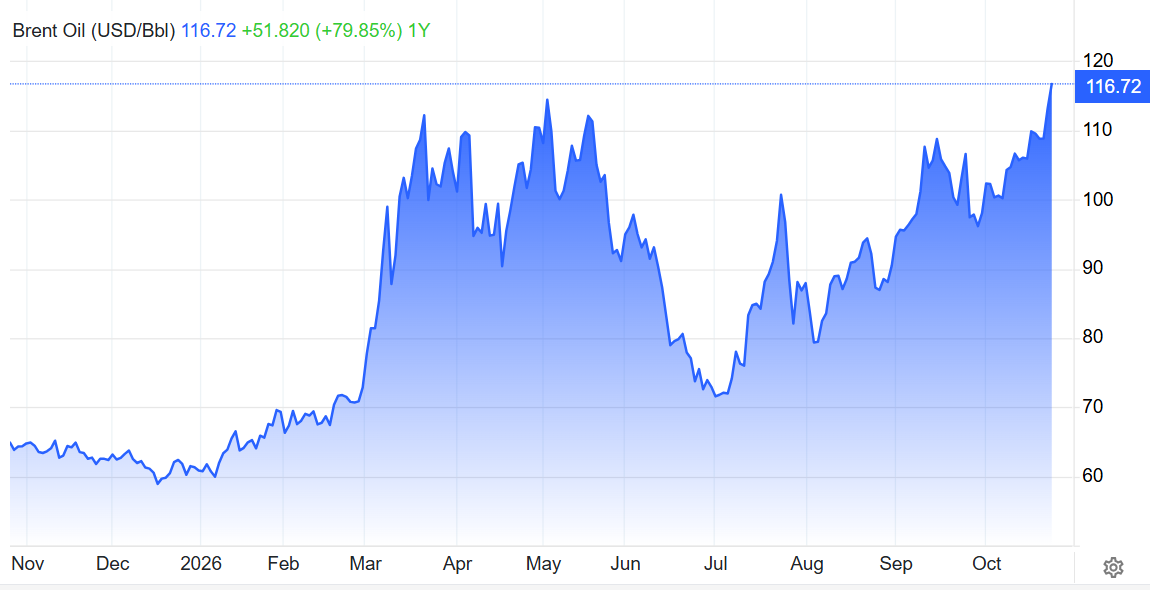
Attacks on Russian-Ukrainian energy facilities continued, and energy facilities and shipping safety risks in the Middle East intensified. The international crude oil benchmark, the Brent crude oil futures price, closed at an all-time high of around $116.72 per barrel on October 23, the highest closing level since April 29, based on the last trading day before the war broke out on February 28. Brent crude oil has surged 61% since the outbreak of the war in Iran. In particular, the energy shock has entered US prices: in September, the consumer price index (CPI) rose 0.6% month-on-month, 3.7% year-on-year, and gasoline rose 9.1% month-on-month, contributing more than half of the overall monthly increase.
However, concerns about the decline and growth of AI-related technology stocks, triggered by soaring oil prices and a surge in US bond yields, have also attracted capital to buy treasury assets, driving the 10-year US Treasury yield, which has the title of “the anchor of global asset pricing,” to drop significantly to around 5% from a high level at the beginning of the month. Energy is still creating inflationary pressure, but the financial market is beginning to trade the AI infrastructure process, which is critical to economic growth, has slowed sharply under the pressure of financing costs, and the two forces are driving the direction of changes in the benchmark interest rate/10-year US Treasury yield.
When Walsh removed the “forecast road map” for interest rates, AI computing power trading, which dominates the global stock market bull market, was tested by the Federal Reserve's policy and profit side at the same time
This also explains why rising treasury bonds (rising US bond prices mean lower yields) did not immediately resolve the AI financing dilemma. Corporate bond pricing generally consists of a risk-free benchmark yield for the same period, plus credit and liquidity premiums. Lower benchmark interest rates can be offset by widening credit spreads. The October 22 report showed that the yield on bonds due in 2031 of CoreWeave (CRWV.US), which is at the core of the “AI computing power sell-off storm” and the “AI bubble bursting argument”, reached 15.76%, and the five-year credit default swap (CDS) was about 1,115 basis points; previously reported by some media on October 15, the cumulative implied default probability of the five-year CoreWeave was about 63%. As a comparison, about 30% a year ago — however, this Probability values include recovery rate assumptions and market risk premiums. They reflect how expensive default protection is, and are not a direct prediction of actual default probability.
The sharp rise in AI financing costs has also affected Facebook's parent company Meta and the trillion-dollar AI infrastructure process and basic prospects of high-rated tech giants such as Microsoft and Google, but they have provided a stronger buffer for mature business cash flow over a long period of time; in contrast, new cloud vendors that rely on continuous external financing are more sensitive to tightening financing conditions. Meta's five-year CDS price was about 123 basis points on October 23, and Amazon-related indicators were close to the highest level since March 2020 on the 22nd. In terms of cash bonds, the October 5 quote shows that the yield to maturity (YTM) of Microsoft's 2060 maturing bonds, Amazon's 2076 maturing bonds, and Meta 2064 maturing bonds is about 6.36%, 6.95%, and 7.48%, respectively; these are secondary market quotes for specific ultra-long-term bonds, not the company's average interest rate.
However, in specific comparison, new cloud vendors such as CoreWeave need to invest in construction first and then gradually recover cash, and are more dependent on continuous external financing, so tightening financing is more likely to affect project construction and delivery; Microsoft, Amazon, and Meta have mature business cash flow and stronger cushioning capabilities. The pressure is more reflected in the fact that new financing is becoming more expensive, free cash flow is under pressure, and the return on investment threshold has increased.
For Walsh himself, reducing the Fed's policy statement and forward guidance (Forward Guidance) in other official Federal Reserve disclosure documents has clear policy-level logic. In his Jackson Hole speech, he pointed out that making an approximate commitment to future interest rates in advance will limit the ability to respond when making actual decisions; if the market follows the Federal Reserve's guidelines and the Fed also reads information from market prices, it is easy to form a “Hall-of-Mirrors Problem” (Hall-of-Mirrors Problem), making price feedback an echo of the central bank's original statement. Accelerated changes in geopolitics, supply chains, and technology are also making the fixed-interest rate path more likely to fail.
Therefore, since he became Chairman of the Federal Reserve, he has emphasized observing data trends rather than responding mechanically to individual data points. Reduced path promises can preserve policy flexibility, but they may also amplify repricing before and after data releases and interest rate meetings when the market does not understand its decision-making methods.
As a result, this week's major test for global financial markets is twofold. Wall Street analysts' latest market trading strategy guidelines generally indicate that Google's parent company Alphabet and Microsoft will announce their results on October 28, while e-commerce and AI cloud computing supergiant Amazon will announce after the US stock market on the 29th local time. Global financial market investors will pay close attention to whether AI capital expenditure can bring strong enough returns and whether these tech giants' AI capital expenditure expectations will expand further after 2028 or 2030; at the same time, futures pricing on October 23 still shows an 80% probability of interest rate hikes in December. The FOMC of the Federal Reserve will announce the resolution at 2 a.m. on October 29, Beijing time. Walsh will hold a press conference on the Federal Reserve's monetary policy at 2:30.
Wall Street financial giant Jefferies recently said that the S&P 500 index is expected to soar to 8,000 points by the end of 2026 and further hit 9,000 points in 2027, driven by the dual engine of AI investment frenzy and rising profits of AI-related companies exceeding expectations. Jefferies's core logic is clear and powerful: in a cycle where AI-driven profit growth exceeds the historical average by more than two times the historical average, fighting against profit trends is dangerous. Jefferies's 2026 8,000-point S&P 500 benchmark forecast is based on earnings per share (EPS) reaching $373 (up 35% year over year, well above 29% of market consensus) and a price-earnings ratio of 21.5 times.
Christopher Gannatti, a senior analyst from WisdomTree, pointed out that since the launch of ChatGPT in November 2022, one of the signals that the market is most concerned about is how much capital five or six large technology companies have invested to accelerate the construction of AI data centers around the world. According to the AI capital expenditure forecast and outlook of the J.P. Morgan strategist team, hyperscale cloud vendors will spend about 950 billion US dollars in 2026, 1.4 trillion US dollars in 2027, and 3 trillion US dollars in 2030.
The latest financial reports and basic future prospects of these tech giants will comprehensively test whether AI revenue generation and cash flow associated with future AI applications/AI smart tools can be realized faster than expected. Interest rate decisions and the chairman's speech will affect the discount rate and financing conditions of these cash flows. For the “AI computing power trading theme”, which affects global stock market bull market conditions and bull market beliefs, it can be described as AI-related profits continue to grow strongly, inflationary pressure continues to ease significantly, and the rapid settlement of corporate credit spreads along with the major trend of easing the Fed's monetary policy path, and also requires the Federal Reserve to provide support for the continuation of AI capital expenditure by tech giants and the repair of AI computing power theme valuations — although the probability of the latter two occurring simultaneously is very low, this also highlights the importance of tech giants' cautious positions; however, in some cases, a cautious stance is critical; Analysis of According to the teacher, even if the tech giants are generally positive, the Fed's suspension of interest rate hikes only once may not be enough to complete this transformation, unless the US Federal Reserve Chairman Walsh, who aims to refuse to reveal forward-looking guidelines, unexpectedly favors the dovish.
Walsh asked traders to pay attention to the data rather than the Fed's own developments, but they are still steadfastly following the Fed's footsteps
In the early morning of October 14, with only a few hours left until the release of a much-publicized US inflation report, Gennady Goldberg, a senior portfolio strategist from Wall Street financial giant TD Securities, advised clients to bet that the Federal Reserve would not raise interest rates later that month. He based his judgment on the fact that the inflation performance is likely to be moderate enough to support keeping interest rates unchanged. Equally important, several Federal Reserve officials have delivered speeches for several days in a row, refuting the market's expectations of an impending rate hike.
The data released later showed that inflation was too hot. Traders quickly increased their bets on the October rate hike, once pushing the probability to about 50%, compared to about 20% before the report was released. Goldberg and his team have also begun discussions about whether the deal that has just been established should be dropped. However, the market trend began to reverse almost as fast. By the end of the day, most of the original changes had been erased. “We haven't even had time to close our positions,” said Goldberg, who is in charge of US interest rate strategy.
On the same day, multiple market forces jointly drove this round of round-trip fluctuations, including a fall in the stock market, concerns about AI, and heightened tension in France. However, for many, the key remains a series of statements from US Federal Reserve officials implying that interest rate hikes will be suspended in October. At a time when Chairman Kevin Walsh expressed his desire to gradually rid the market of reliance on such “forward-looking guidance,” these seemingly clear statements are particularly remarkable.
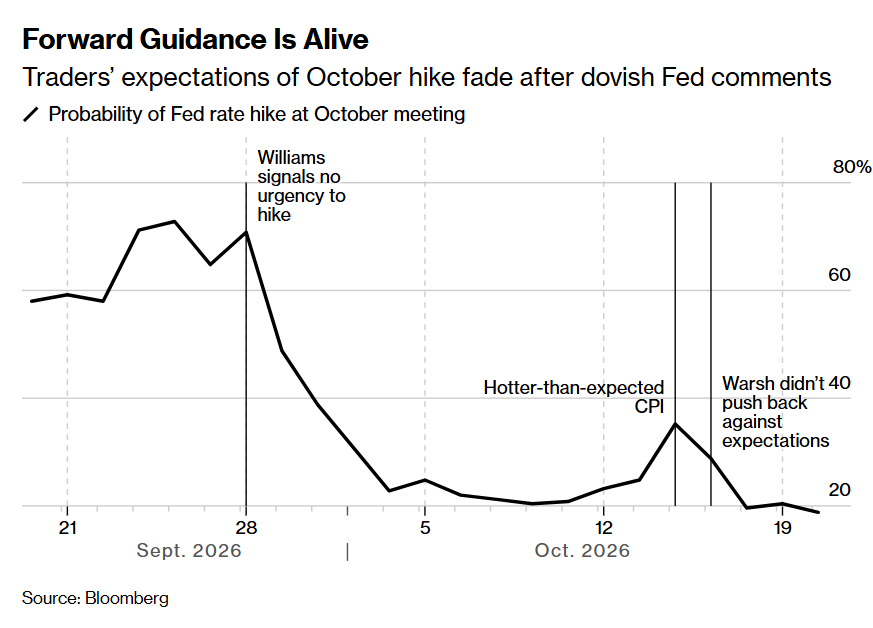
As shown in the chart above, Walsh declined to reveal any predictions, but the dynamics associated with the “forward-looking guidance” are still working — after some Federal Reserve officials made dovish remarks, traders' expectations for an October rate hike dropped sharply.
Caught between these intertwined signals, traders relied again on familiar methods of judgment to find direction in policymakers' speeches. But they also acknowledged that if they only looked at inflation data, they might have bet on an October rate hike. This leaves investors in an unstable position as they enter this week's policy session: they still rely on speculation to a certain extent, and are vulnerable to shocks if misjudged.
“There is a disconnect between what Walsh said and the signals sent by other officials,” said Neil Dutta, head of economic research at Fuxing Macro Research. “When this happens, the market faces intense and repeated risks at any meeting.”
Admittedly, recent market changes have reduced the possibility of such drastic repetition. As AI stocks continue to fall, the market is beginning to worry that once the AI boom wanes, the US economic growth prospects will be affected. Traders' confidence that the Federal Reserve will raise interest rates this week or even within the year has weakened further. Based on interest rate swap pricing, the probability of an October rate hike is currently less than 15%. But just a few weeks ago, at the beginning of this series of speeches, the market situation was quite different.
The background at the time was a round of intense bond sell-off, driving a sharp rise in US Treasury yields. The Federal Reserve raised interest rates for the first time in three years in September, and the market increasingly expects to raise interest rates again in October, and possibly again in December, all with the aim of reducing the inflation rate that continues to be higher than the central bank's target.
In this market climate, New York Federal Reserve Chairman John Williams said on September 29 that it might be appropriate to raise interest rates again “later this year.” Based on federal funds futures contract pricing, this speech prompted traders to cut the probability of an October rate hike from around 70% to about 50%.
Two days later, on October 1, Vice Chairman Philip Jefferson went on to say that policymakers should spend more time watching before deciding whether further rate hikes are needed. This statement further reduced the market bet to about 25%. Federal Reserve Governor Christopher Waller, who has permanent voting rights on FOMC monetary policy during his term, delivered a speech on October 8, saying that Fed officials do not have to tighten policy at two consecutive meetings, further consolidating market expectations for the suspension of interest rate hikes.
“I think they looked at the bond market and thought: 'Wait, the rate hike included in the market was much more aggressive than we expected, '” Cathy Bosjancic, chief economist at the US National Insurance Company, said of these Federal Reserve officials. “So, I think it made them uneasy, so they said, 'OK, let's slow down a bit. '”
By the time the inflation data was released, showing that the price increase was the fastest in five months, investors' judgments were actually already affected by previous statements, and most people expected interest rates to remain unchanged. Bosjancic believes that the probability of interest rate hikes should be closer to 50%, and some others have even more clear opinions.
“This data supports interest rate hikes,” said Ed Al Husseini, portfolio manager at Threadneedle Investments in Colombia. “The only obstacle to deciding whether to raise interest rates or stay the same is the Fed's statement.”
Walsh himself stressed at a public event in Bangkok on October 16 that he would not prejudge the outcome of any meeting. “I don't agree to say what actions I might take in the remaining few meetings of the year,” he said in an interview with the host of the International Monetary Fund's annual meeting. “The Federal Reserve has opened a new chapter, and we are no longer doing this.”
Even so, traders are concerned: even though the inflation data has been released, the Federal Reserve Chairman has taken no action to dispel market expectations that interest rates will remain the same this week, other than reaffirming the promise to achieve “price stability.”
Matthew Luzerti, chief economist at Deutsche Bank of the United States, said that the Federal Reserve official's speech before the inflation data was released is an example of traditional central bank communication methods: when officials think there is a disconnect between market pricing and policymakers' expectations, they will communicate. Without these speeches, the market is likely to be even more volatile.
“In fact, this can still be incorporated into the framework described by Chairman Walsh and other officials: 'We're not relying on individual data points, we're watching data trends, '” Luzzetti said. He expects further rate hikes in the coming months.
As for these trends — which policy makers are particularly concerned about — inflation expectations remain stable, indicating that households and businesses still believe that the central bank will control price increases in the coming months.
Walsh's proposition to reduce forward-looking guidance was not only supported by some central bank peers, but also endorsed by some private sector economists. They believe that forward-looking guidance may restrict the hands and feet of policy makers. Furthermore, there are reasons to update the way central banks communicate policy prospects to businesses and households.
This time, officials seem to think it is necessary to release a signal. But investors are puzzled by this inconsistent information: do forward-looking guidelines still exist, or are there none?
“The market needs to know the rules, and now we don't know,” said Jamie Parton, co-head of TCW Group's global interest rate business.
Goldman Sachs's latest warning: Interest rate risks in December are hidden in “why to act” and “what to do later”
Cosimo Codacci-Pisanelli, a senior financial market strategist at Goldman Sachs, recently released a research report that attributes the recent rise in US bond prices (rising bond prices to a decline in yield indicators) due to pressure on AI assets, rising risk at the end of the market under pressure on AI assets, rising risk in anticipation of declining growth, and long-term treasury bonds playing a role in stock risk hedging.
The team led by strategist Codacci-Pisanelli pointed out that the inflation performance provided a basis for interest rate hikes, but Federal Reserve Chairman Walsh previously refused to give clear guidance on subsequent interest rate decisions, and the market gradually favors that the Fed will suspend interest rate hikes in October and leave policy adjustments until December.
On October 22, the 10-year yield fell by about 17 basis points in a single day according to its quoted caliber, returning below 5%; at the same time, AI-related credit spreads widened to the widest level during the year. This means that investors' reasons for buying treasury bonds are partly shifting to protecting capital, while corporate financing conditions are not improving at the same time. Goldman Sachs expects AI capital expenditure to be about 1.6 trillion US dollars in 2027. Continued financing requirements will still increase the supply of corporate bonds and project financing, competitive investor capital, and affect credit spreads and term premiums; this does not mean that AI corporate bonds will directly increase the amount of US Treasury bonds issued by AI companies.
The Goldman Sachs strategist team still uses the suspension of interest rate hikes in October and the return to interest rate hikes in December as the benchmark scenario. The market price quoted on October 23 was about 90%, and the cumulative interest rate hike is expected to be about 2.7 times as of September 2027. Goldman Sachs strategists said that since an interest rate hike has been roughly calculated, the real surprise mainly comes from the intensity of subsequent austerity, the time interest rates remained high, and the reasons behind suspending or raising interest rates.
Goldman Sachs deduces that if the December rate hike simultaneously sends a signal of continued tightening, the discount rate and financing pressure on technology stocks may rise again; if the suspension stems from a marked weakening of AI investment and economic growth, the rise in US Treasury bonds with a term of 10 years or more will not necessarily lead to a rise in technology stocks, because profit expectations and credit quality may deteriorate at the same time. Walsh refused to promise a path ahead of time, making the market even more in need of judgment: whether inflationary pressure or changes in growth and financial conditions are dominating the Federal Reserve's next move.