


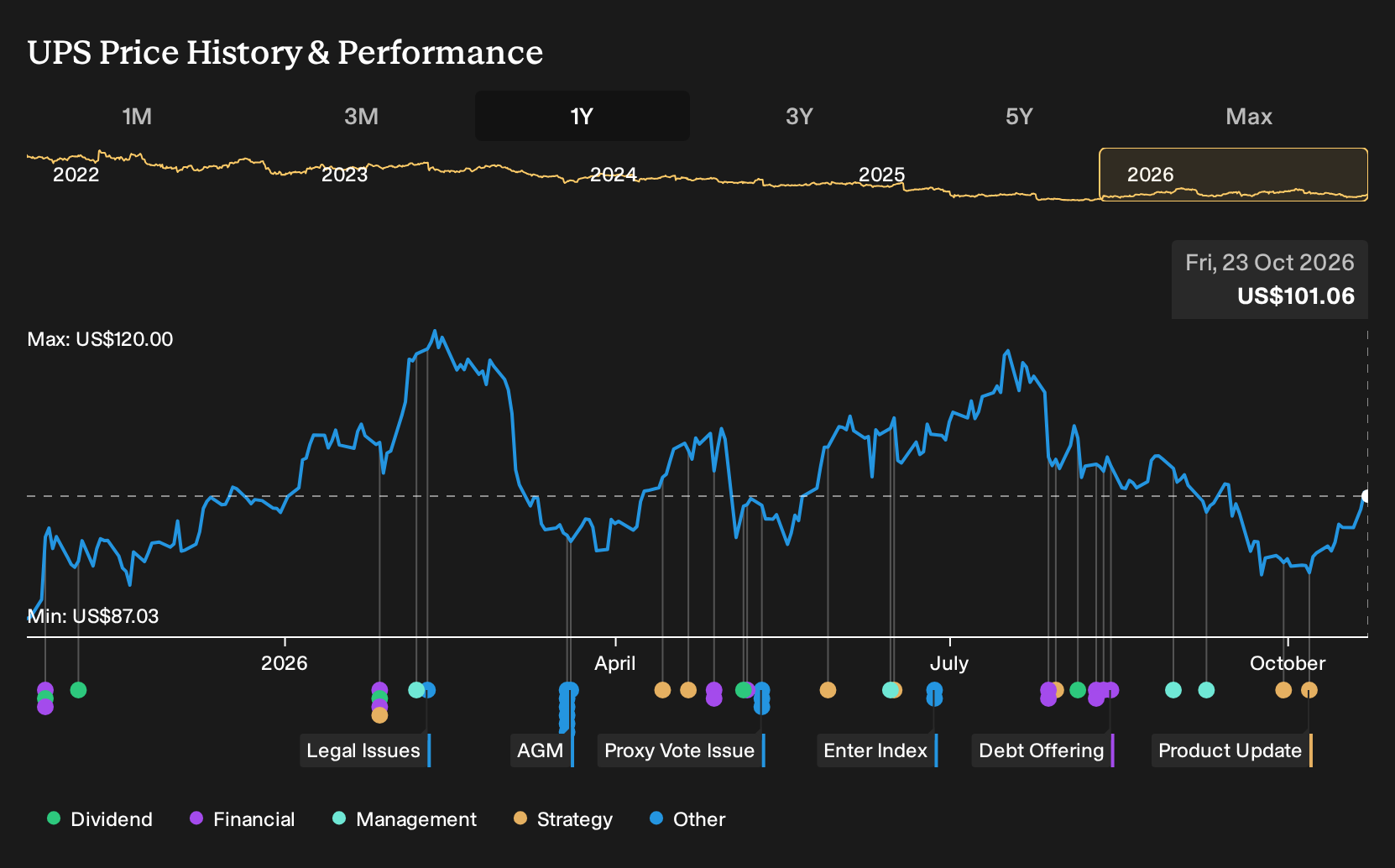
UPS spent the year cutting Amazon volume, closing facilities and wrestling with higher fuel and labor costs, while investors watched Amazon push harder into third party logistics. Holding United Parcel Service over the past year would have returned 23.5%, including dividends. If you had been weighing those trade and cost risks back in October 2025, what might you have reasonably expected from a leaner UPS and its reshaped delivery network?
Narratives are how investors here put a case on the record, with explicit assumptions about revenue, margins and the multiple. Those assumptions imply an estimated Fair Value.
The easy part of this move is behind United Parcel Service. Zero in on 29 high quality undervalued stocks for companies trading below our estimates.
The Two United Parcel Service Stories Investors Had In Mind
The shares cost US$87.03 at the start of the period. Anyone looking at United Parcel Service then had to decide which future seemed more convincing, not which one was guaranteed.
The bullish narrative set Fair Value at US$103. It assumed revenue would rise 1.5% a year with profit margins reaching 7.5%, helped by cutting low margin Amazon volume and leaning into automation.
The bearish view put Fair Value at US$75. That story focused on trade policy uncertainty and rising labor and automation expenses that could keep pressure on margins and limit flexibility.
What The Results Put To The UPS Argument
Amazon’s launch of a broad supply chain service directly targeted United Parcel Service’s small business customers and reinforced the cautious case about competition and pricing power. At the same time, UPS shifted its mix toward healthcare and higher yielding parcels, with revenue at US$21.2b in Q2 2026 and net margin at 2.6%, below the more optimistic 7.5% margin idea. The evidence cut both ways.
The key assumption was that pruning Amazon volume and adding automation would protect profitability. For any other logistics stock, it is important to track whether revenue quality claims show up in net margin and segment mix, not just headline sales.
What United Parcel Service's Recent Run Already Prices In
UPS shares trade at US$101 today after a 23.5% gain over the past year, while the selected Narrative’s Fair Value sits below the current price. That view leans on concerns about labor costs, customer concentration and how far automation really helps unit economics.
For UPS to justify today’s price, an investor needs to assume mix upgrades and technology keep offsetting cost pressure, even with limited room for further large network cuts.
"While United Parcel Service is leaning harder into higher yielding SMB, B2B and healthcare accounts, the concentration of healthcare revenue above US$3b per quarter and the focus on premium contract renewals could expose the company if large customers push back on pricing or shift volumes, which would pressure revenue growth and compress segment margins."
The price and this Narrative do not agree. → Uncover what this Narrative says United Parcel Service is actually worth
Where UPS Touches On-Demand Delivery
UPS is reshaping its network around higher value parcels to serve shifting demand.
That turn puts more attention on another player building on-demand delivery as a core business.
Rather than global hubs and brown trucks, this platform leans on software coordinating drivers and routes in real time.
The same merchants choosing parcel carriers also decide how to move meals, groceries and bulky items through that system.
As more spending flows through app-based logistics, one question lingers. How much everyday movement can a software marketplace quietly claim for itself?
The case is on the record, with the assumptions it rests on. → See the Narrative that values this company 74% above its price
Have feedback on this article? Concerned about the content? Get in touch with us directly. Alternatively, email editorial-team@simplywallst.com