


Starwood Property Trust stock performance and recent returns
Starwood Property Trust (STWD) has traded around $12.58 recently, with the share price flat over the past day but recording a modest gain across the past week.
Across longer windows, the stock has declined over the past month, the past 3 months, year to date, and over the past year, which puts recent trading in context for investors tracking the trust's income focused profile.
For Starwood Property Trust, the recent 7-day share price return of 0.96% sits against a much weaker 30-day share price return, which is down 12.40%, and a year-to-date share price return that has declined 31.70%. This combination suggests that short-term momentum is fading after a tough run for income oriented investors.
Total shareholder return tells a similar story, with the 1-year figure down 24.14% and the 5-year total shareholder return down 18.69%. This points to a market that has been repricing the trust's risk and income profile rather than reacting to a single short-term catalyst.
Compare Starwood Property Trust's recent pullback with hand-picked income-focused opportunities in the 5 dividend fortresses to see how other high-yield plays are holding up.
After a long slide and a small recent bounce, the real question for Starwood Property Trust is whether this reset already compensates you for the risks, or whether patience still offers a better entry.
Most Popular Narrative: 37% Undervalued
Against the last close at $12.58, the most followed narrative pegs Starwood Property Trust’s fair value at $19.88. This frames analysts’ focus on dividend coverage and portfolio cleanup as the key swing factors.
The main thing that has to go right is successful execution on selling or refinancing roughly 40% of the current nonaccrual and REO book, scaling infrastructure and net lease earnings, and keeping credit performance and funding costs in line with recent experience.
The current valuation implies the share price does not fully reflect the potential earnings contribution from resolving about $1.9b of nonaccrual and REO assets, the growth in the $3.1 to $3.2b infrastructure portfolio, and the ramp of the $2.7b net lease platform. This supports the view that Starwood Property Trust is undervalued and that the market is cautious about dividend sustainability.
See why 50 investors see Starwood Property Trust as 37% undervalued.
Result: Fair Value of $19.88 (UNDERVALUED)
Still, the narrative around Starwood Property Trust only holds if dividend coverage firms up and recoveries from the US$1.9b nonaccrual and REO pool are in line with expectations.
Find out about the key risks to this Starwood Property Trust narrative.
Another View: What Multiples Say About Starwood Property Trust
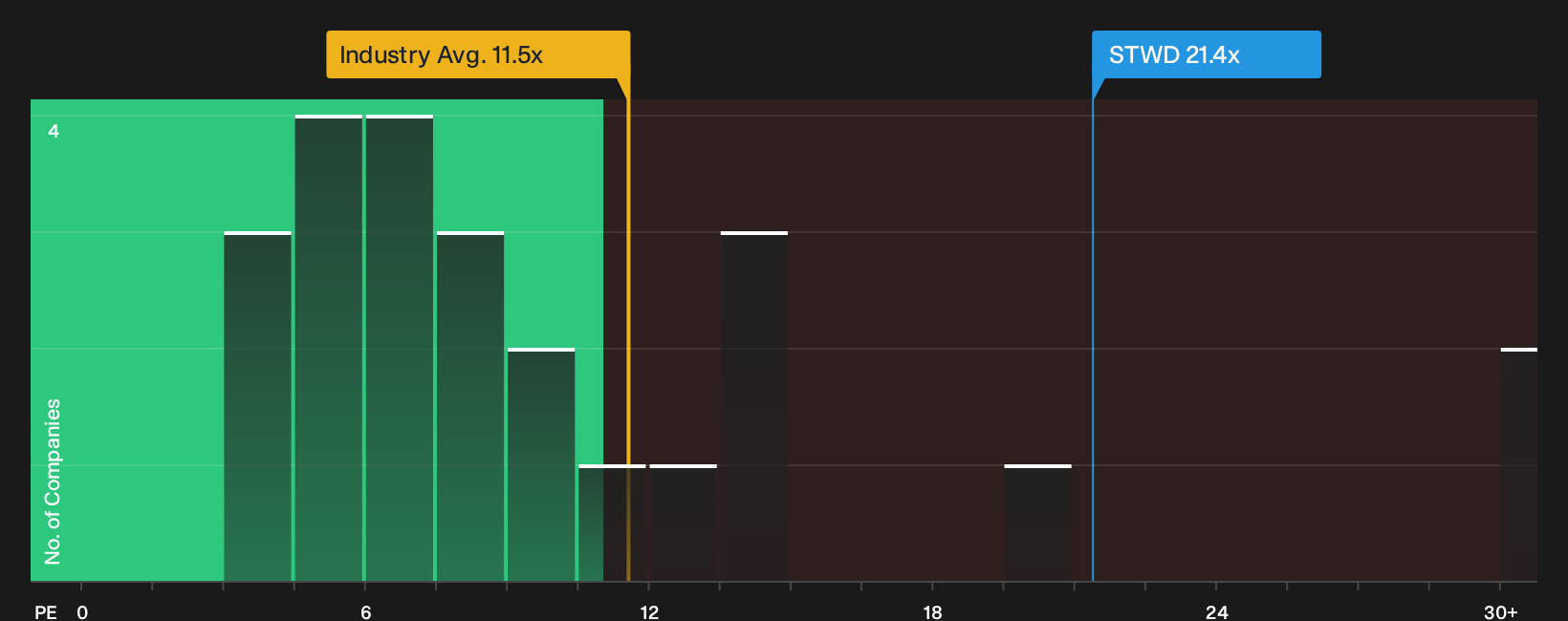
Analyst narratives frame Starwood Property Trust as 37% undervalued, yet the market’s own yardstick tells a different story. The current P/E of 21.4x is higher than the US Mortgage REITs industry at 11.5x and above a fair ratio of 16.7x, so the stock screens as expensive on earnings. That kind of gap can limit upside if sentiment cools or earnings delivery slips. Which signal should investors consider more closely, the story or the multiple?
See what the numbers say about this price, See what the numbers say about this price — find out in our valuation breakdown.
Next Steps
Mixed messages on value and risk can be useful, as long as you use them as a starting point rather than the final word. Act while the data is fresh, weigh both sides of the story, and ground your own view in the underlying 2 key rewards and 4 important warning signs
Looking for more Starwood Property Trust style investment ideas?
If you stop with Starwood Property Trust, you risk missing other setups that fit your income, value, and risk preferences just as well or better.
- Target reliable cash generators by scanning our list of solid balance sheet and fundamentals (24 results) that can handle stress without stretching their finances.
- Hunt for mispriced opportunities by reviewing our 21 high quality undiscovered gems before the broader market pays attention.
- Prioritise sleep-at-night holdings with the 30 resilient stocks with low risk scores that score well on stability and downside protection.
Have feedback on this article? Concerned about the content? Get in touch with us directly. Alternatively, email editorial-team@simplywallst.com