


The Zhitong Finance App learned that as the global pension system takes longer to pay, the size of the contributor population that supports these payments continues to decline relatively, forcing the pension system to redistribute responsibilities between governments, employers, and individuals, and adjust investment portfolios. In other words, as the aging of the global population deepens, the pension payment period is extended, and the ratio of workers to retirees continues to decline, the pressure on financing and continuous payment of the pension system increases, pushing pension funds to re-examine investment returns, risk taking, and liquidity arrangements. At the same time, the government is required to enhance the long-term sustainability of the pension system through measures such as improving the retirement system, immigration policies, and promoting productivity improvement.
According to the 2026 Marsh CFA Institute Global Pension Index released on October 20, 43 of the 55 systems covered have fertility rates below the generational replacement level of 2.1 and 23 below 1.5; the remaining life expectancy of 65-year-old people in developed regions increased by 50.9% compared to 1950, reaching about 20 years. For capital markets, this means that global pensions must simultaneously address two issues: whether long-term assets can cover a longer period of retirement, and whether current cash can pay benefits on time.
From retirement protection to investment risk: global pension funds face an aging crisis
As life expectancy increases and fertility rates decline, the global pension system is facing a demographic crisis. The pressure on retirement funds may continue to increase, and whether it can continue to pay pensions for future generations is also being questioned.
Pension plans are generally divided into two categories: defined benefit plans, which promise to provide pre-determined income to retirees; defined contribution plans, where the amount of benefits depends on accumulated savings and return on investment.
Aging poses different challenges to the two types of systems: as retirees live longer, defined benefit plans face increasing liabilities; insured participants in defined contribution plans may run out of savings during their lifetime, putting more pressure on fund investment performance.
Sebastian Bettmeer, executive director of the Center for International Pension Administration, said the problem “is very serious and has become more prominent over time.” He pointed out that some pension fund members have been retired for almost half a century and have reached the age of 107 or 108.
“The longer you live, the longer the pension fund will have to pay, which immediately adds an additional liability.” In an interview with the media, he said, “Think about the cost this actually brings to the next generation... this is a time bomb.”
The “2026 Marsh CFA Institute Global Pensions Index” (MCGPI) report released last Tuesday revealed the scale of this challenge. Of the 55 pension systems covered by the index, 43 have fertility rates below the generational replacement level of 2.1 children per woman, and 23 are below 1.5.
Meanwhile, life expectancy for 65-year-olds in developed regions has increased by 50.9% since 1950 to about 20 years, meaning that retirement benefits now take significantly longer to pay. The number of potential workers able to support the elderly population is also expected to drop significantly.
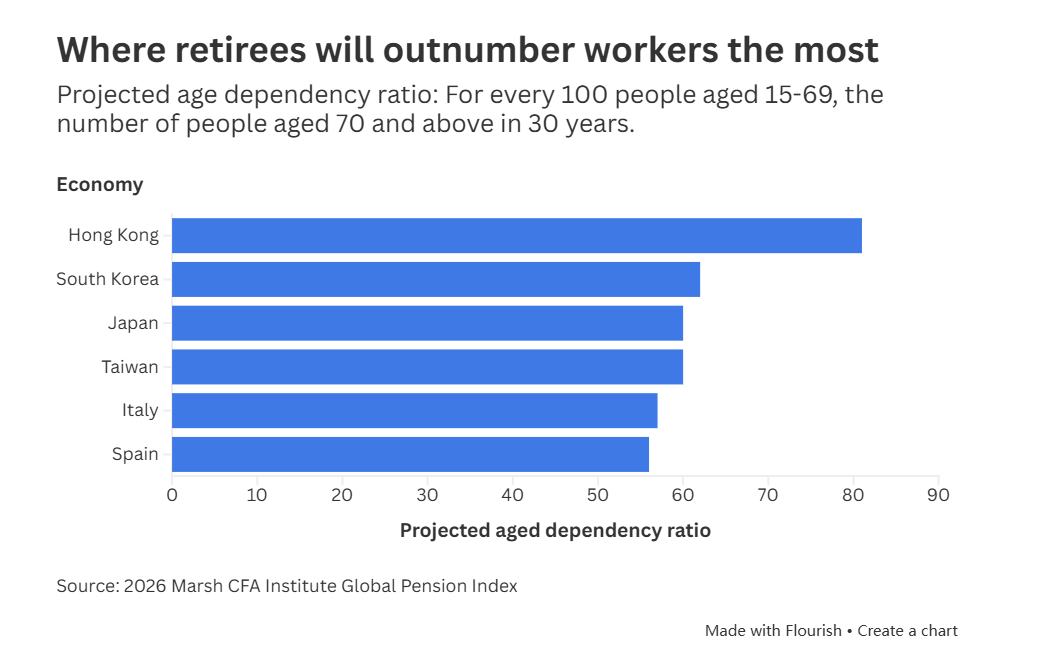
The MCGPI report states: “As the ratio of workers to retirees continues to decline, funding for future pensions and aged care becomes more critical. According to the way it currently operates, there are very few truly stable systems.”
For pay-as-you-go pension systems, this problem is particularly serious. This type of system mainly uses contributions from current workers to pay benefits to current retirees, so it is particularly vulnerable to the shrinking labor population.
The US is already showing these pressures. According to the latest trustee report, the Old-Age and Survivors Insurance Trust Fund, which provides retirement and survivor benefits to tens of millions of Americans, is expected to run out of reserves in the fourth quarter of 2032.
A full accrual pension plan is also no exception. Such plans invest contributions from workers and employers to pay for future retirement benefits.
MCGPI warns that as members retire and begin receiving benefits, some funds may find that their payments exceed additional contribution income, and must reconsider investment strategies and liquidity requirements.
The report emphasizes: “Future benefit expenses will exceed contributions or premium income... this financial pressure is bound to increase in the future.”
Demographic pressures are reshaping how pension funds are invested, with some funds taking greater risk to obtain the returns needed to meet growing retirement payment obligations.
Many mature funds already have welfare expenses that exceed contribution income, and are therefore increasingly dependent on investment returns and accumulated assets.
According to a 2025 report from the Australian Prudential Regulation Authority, about one-third of Australia's pension funds recorded negative natural cash flow over a three-year period, meaning that benefit payments exceeded contribution income.
Industry observers say the pressure to obtain higher returns has prompted some funds to switch to riskier and more complex investments, including private equity, infrastructure and private credit.
In an interview with the media, Bettmeer said, “You can try to get a higher return on investment, but this requires taking a higher level of risk.”
Jean-Pierre Aubrey, associate director of state and local research at the Boston College Retirement Research Center, said that pension funds are increasingly shifting to riskier investments, but there are big differences in the degree of transformation in different markets.
In an interview with the media, Aubrey said, “I think everyone is slightly increasing their risk taking within their means. As the demographic structure changes, costs are rising.”
Using US state and local government pension funds as an example, he pointed out that these funds only allocate about 20% of their assets to bonds, and most of the rest are invested in stocks and private equity assets.
He said that with this allocation, the investment risks borne by US public pension funds are significantly higher than similar funds in Europe and Canada.
Not all pension managers agree that aging means risk-taking should be increased.
David Elias, CEO of Australian pension fund Hostplus, said demographic changes are only one of many factors affecting investment decisions.
He emphasized that investment portfolios should be diversified across asset classes, regions and industries while ensuring that potential returns are sufficient to cover the risks taken.
Elias also said that the government can ease the pressure of population aging through immigration policies, technological progress, etc., and changes in the population structure itself may also create new investment opportunities.
He said, “I'm not underestimating the government's ability to show great creativity in dealing with such issues. However, there is no doubt that they must address these issues.”
To pursue high returns, it is even more important to get cash: will pension fund allocation inevitably become fragmented?
The dependency of pensions on market returns is already reflected in asset allocation. According to Public Plans Database data, in 2025, about 42.2% of US state and local pensions will be allocated to stocks, 21% to fixed income, 13.9% to private equity, and 9% to real estate.
Australian regulators, on the other hand, found that about one-third of pension funds had a negative three-year natural cash flow ratio, that is, the inflow of related contributions was insufficient to cover outflows such as welfare expenses. This indicator does not include investment income. A negative value itself does not equal loss or insolvency, but it will increase the fund's requirements for investment cash income and asset monetization capacity.
As a result, two investment orientations have been formed: some funds seek higher returns through private equity, infrastructure, and private credit; other funds with relatively high retirement members need to reduce risk and increase liquid assets that can be used for payments. The Global Pension Index Report also clearly suggests that the aging of members may push funds to gradually reduce the allocation of growth assets. The investment implication behind this is that the expected long-term return must match the actual cash payment time: if the withdrawal of private equity assets is delayed, credit asset repayment is blocked, and pensions must continue to be paid, the fund may sell liquid assets when the market is sluggish, weakening the income base in the future.
This adjustment will also affect the bond market. The Dutch central bank previously estimated that the transformation of the pension system may reduce local funds by about 100 billion to 150 billion euros, treasury bonds and interest rate swap positions with a term of at least 25 years: younger members increase their allocation of growth assets, and older members continue to focus on income stability, but the required asset period is relatively short. Therefore, transaction opportunities brought about by aging pensions need to be specifically implemented to match bond terms, credit quality, and cash flow; currently, it is not possible to simply deduce that all long-term bonds will benefit, or that all risky assets will receive incremental capital.