


The Zhitong Finance App learned that Goldman Sachs said that the yen is becoming a more effective tool to hedge against market shocks driven by artificial intelligence because changes in Japan's policy environment reduce the risk that the yen will weaken sharply when global yields rise.
“Although the global context supports a further weakening of the yen, the yen now looks more like a more attractive hedging tool in procyclical portfolios than in recent years,” strategists including Kamakkia Trivedi wrote in an October 23 report.
The judgment was made after the yen once again showed the characteristics of its traditional safe-haven currency during the sell-off of global technology stocks last week. On Thursday, the yen rose 0.9% against the US dollar. On Friday, it hit its strongest level in more than a month, as market concerns about the AI investment boom dragged down the stock market and triggered a sharp rise in US Treasury bonds. Subsequently, as US bond yields stabilized, the yen took back some of its gains.
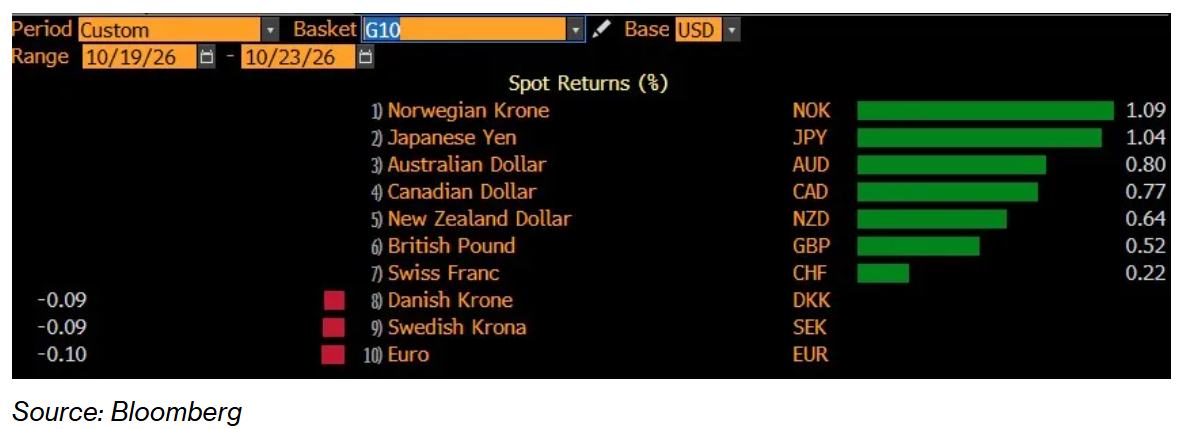
Goldman Sachs believes that the AI boom has made the US stock market and the US dollar particularly sensitive to deteriorating growth prospects. If an impact were to simultaneously depress the stock market and bond yields, it would create the most favorable market environment for the yen in history.
Goldman Sachs also said that there are initial signs that the vulnerability of the yen is decreasing when global yields rise. Recently, the yen's weakening response to rising yields has been more limited than in the past six to seven years. Strategists believe this probably reflects a reduction in depreciation pressure brought about by Japan's domestic policy environment.
This is in stark contrast to 2022 — when the Bank of Japan maintained yield curve control (YCC) while global borrowing costs soared. This change in relationship means that even if arbitrage trading still has negative returns, the yen “should be a hedging tool that is less painful to hold.”
A more constructive domestic policy environment, undervalued yen valuations, and rising risk of exchange rate intervention are also jointly limiting the potential upside of the dollar against the yen, thereby improving the asymmetry of holding yen as a hedging tool.
In the short term, Goldman Sachs continues to prefer shorting the euro against the yen. The reason is that there is almost no obvious domestic catalyst to push the yen to appreciate sharply, and the Bank of Japan released hawkish messages in its October 30 policy decision, which surprised the market.
However, looking at the longer term, these strategists believe that USD/JPY trading is a more effective protection against worsening risk sentiment. They wrote, “Shorting USD/JPY should be the most effective tool to hedge against overall growth fluctuations, particularly widespread AI shocks.”