


The Zhitong Finance App learned that the International Data Corporation (IDC) China Liquid Cooling Server Tracking shows that the revenue of Chinese liquid cooled server market manufacturers increased by 153.1% year-on-year in the first half of 2026, and the compound annual growth rate of shipments over the next five years is expected to be close to 49%. However, what is more noteworthy than the growth rate is the changes taking place on the purchasing side: more and more high-density computing power projects are no longer selecting models on a “platform” basis, but instead are configuring and delivering computing nodes, inter-node interconnection, power supply, and in-cabinet liquid cooling as a complete system.
The cabinet is changing from a physical container in a computer room to a delivery unit for purchasing computing power. The impact of this change extends beyond the procurement process. When the entire cabinet becomes a delivery unit, the server manufacturer delivers an integrated system, and the data center no longer undertakes several devices, but a set of loads with clear requirements for power supply, cooling, and interface conditions.
Changes in the form of equipment are pushing the issue of competitiveness from “whether it can be bought” to “whether it can be received”. In the context of the rapid spread of inference and agent (Agent) applications, the pace of change is likely to be faster than expected.
Demand side: behind the growth of liquid cooling, demand differentiation rather than full expansion
The growth of China's liquid-cooled server market is closely related to the computing demand brought about by artificial intelligence. IDC China's liquid-cooled server market research shows that Internet companies are currently the most important source of procurement, accounting for 65.6% of China's liquid-cooled server market; telecom operators and IT services are also the main application areas; some traditional industry customers have yet to use liquid cooling, mainly because their current business is mainly general computing, and air cooling solutions can meet cooling requirements, but these industries are actively exploring liquid cooling solutions suited to the business characteristics of the industry.
Therefore, it is now even more important to see where the anchors of growth are. IDC's quarterly tracking of the Chinese server market shows that in the next five years, the average compound annual growth rate of Chinese server market shipments will be about 6.8%, while the compound annual growth rate of market revenue will reach 24.6%. A moderate increase in shipment volume coexists with a high increase in revenue, indicating that incremental value is being concentrated on high-configuration, high-density computing power systems, and the growth of liquid cooling comes from these scenarios.
Looking at the technical route, cold plate liquid cooling is still mainstream, accounting for about 90.2%. The mature supply chain, cooling capacity, and cost advantages of large-scale deployment make it more suitable for implementation at this stage.
Another notable change is that the AI payload structure itself is changing.
The early construction phase mainly revolves around large-scale model training, with large clusters and concentrated deployment;
As the model enters the application stage, the proportion of inference load continues to rise - online inference is closer to the end user, placing higher demands on latency and continuous online;
In an application form represented by an agent (Agent), a single user request often triggers multiple rounds of model calls and tool calls, and the consumption of inference computing power is multiplied.
Recently, in large-scale computing power clusters newly built in China, existing projects are aimed at training and reasoning at the same time during the design phase, and reasoning is becoming a permanent load that requires long-term and large-scale carrying.
Here is an easily confused observation: the requirements for computing equipment and infrastructure are not the same whether to expand data centers, undertake daily business systems, storage and backup, or centrally deploy high-density computing clusters. One of the values of liquid cooling is to help identify the true high-density computing power requirements.
Therefore, the growth of the liquid cooling market in China does not mean that all types of data centers are simultaneously expanding liquid cooling deployments. Whether to adopt it depends on the business requirements for computing performance, equipment configuration and deployment density, and the overall trade-off between energy consumption and operation and maintenance costs.
Purchasing side: From “buying a server” to “buying a whole cabinet”, the purchasing unit is changing
After clearly calculating the requirements, it is also necessary to observe in what units the customer purchases the calculation system. The significance of a liquid-cooled cabinet is not only to install more servers in one cabinet, but to configure and deliver computing nodes and related interconnection, power supply, and in-cabinet liquid cooling equipment as a set of systems.
The difference between the two procurement methods is the object of purchase and evaluation:
Purchase according to independent servers: Customers use the configuration and performance of a single device as the basis for model selection, and then organize relevant support by themselves or the integrator;
Procurement by cabinet-level system: Customers evaluate the complete system, comprehensively considering computing power, node collaboration, expansion methods, and integrated delivery requirements.
This change is no exception to the Chinese market. According to IDC's global server tracking, in the first half of 2026, Rackscale (full cabinet level) servers already accounted for 34.5% of global server spending, an increase of about 250% over the previous year — large-scale GPU deployments are being concentrated on high-density cabinet systems; liquid-cooled cabinet solutions represented by NVIDIA GB300/Vera Rubin NVL72 are based on the whole cabinet unit from design, delivery to inspection.
According to IDC statistics, the proportion of full-container deliveries in North America reached 47.4% in the first half of 2026, compared to 5.0% in China. In the Chinese market, there is another practical reason for the advancement of the supernode model: the availability of high-end acceleration cards is getting tighter, and buyers tend to lock in computing power through supernodes and full-cabinet solutions. As a result, full-cabinet delivery has changed from an “efficiency choice” part to a “path choice under supply constraints.”
Judging from the load characteristics, the reasoning scenario is also strengthening the logic of purchasing the entire cabinet. Inference clusters usually require large-scale, batch deployment, and consistent configuration for unified operation and maintenance; concurrent requests for Agent-like applications have clear peaks and valleys, and capacity expansion is often carried out in batches. This requires consistent delivery pace and configuration, and is why cabinet-level solutions are more acceptable in inference scenarios.
Of course, whether to use a full cabinet procurement still depends on the scale of the business, expansion plans, and existing facility conditions, and it is impossible to assume that all customers will choose the same path. To observe the liquid-cooled cabinet market, in addition to focusing on the scale of shipments, it is also necessary to understand the actual usage of cabinet-level systems in different customers and application scenarios.
Deployment side: The equipment is ready, is the computer room ready?
The rapid increase in demand for liquid cooling equipment does not mean that data centers already have the corresponding deployment conditions. According to IDC data, the installed power of IT equipment in China's data centers in 2025 was 9403 MW, which is only 21.5% of North America; at the same time, the new installed power of liquid cooled servers in China is expected to increase from about 1.1 GW in 2025 to about 6.9 GW in 2030. It can be seen from this that there is a clear time difference between the growth curve on the equipment side and the carrying capacity on the facility side.
Density is another variable. According to IDC's global data center facility power forecast, the global power density per cabinet has increased about 25 times since the 2010s (starting at around 10kW). In terms of cabinet types, most general-purpose computer cabinets are in the 5-30kW range, while GPU cluster cabinets and supercomputing cabinets have entered the 50/100/250kW classification — in the same computer room, the cabinet power for different businesses may differ by an order of magnitude.
IDC research also shows that cabinet configurations of ≥50kW will become structural mainstream by 2027; demand for ≥80kW high-density cabinets is expected to increase from 5% to 34%; 76% of service providers have deployed AI/HPC dedicated cabinets.
The Asia Pacific region currently uses a low percentage of liquid cooling in large-scale environments, but is leading the way in deploying plans over the next 12-24 months — China is at such an inflection point.
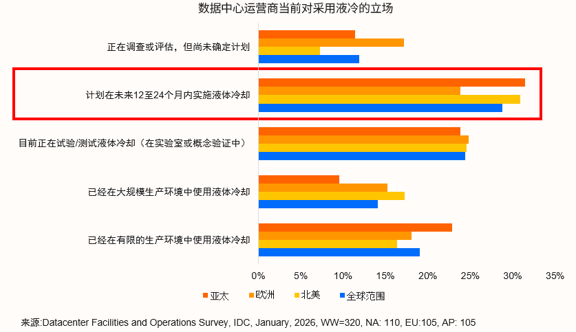
Taking cold plate liquid cooling as an example, the server cold plate needs to be connected to the computer room cooling system through distribution pipelines, coolant distribution units (CDU), etc. The cabinet integration only solves some supporting problems, and the computer room still needs to provide corresponding operating conditions.
This leads to a more specific observation: the data center's ability to deploy liquid cooling should specify the computing systems that can carry what configurations, rather than simply “supporting liquid cooling” in general terms. In preparation for the project:
New data center: it is necessary to determine the supporting plan in conjunction with the target equipment at the design stage;
Existing plant: it is necessary to assess the gap between the system to be deployed and the existing facility, and then determine the scope of necessary modifications.
Another reason why the connection costs remain high is that the construction standards for liquid cooling data centers are not uniform: there are no consistent specifications for mechanical installation, power supply, liquid cooling pipelines, etc. between the entire cabinet and the computer room, and projects often need to be adapted on a case-by-case basis, lengthening the cycle from equipment preparation to large-scale deployment. The industrial side is promoting convergence. For example, the Open AI Infra community under the Global Computing Consortium (GCC), in collaboration with Internet companies, operators, equipment manufacturers, data centers and research institutes, has issued a series of specifications such as the “GCC Liquid Cooled Cabinet Interface Specification” and “GCC Liquid Cooled Cabinet System Architecture Design Specification - Type A” to unify the requirements of the cabinet and computer room in terms of power supply, liquid cooling and mechanical docking, and provide a technical reference basis for large-scale deployment of complete cabinets from multiple manufacturers.
The deployment characteristics of inference loads further amplify this bridging problem. Unlike large-scale training clusters concentrated in a few parks, online inference for users is more likely to be deployed in stages in multiple regions and multiple existing plants. The scale of single-point expansion is not necessarily large, but there are clear requirements for latency and usability. The transformation window, power supply margin, and cooling conditions for such projects are all different — the closer they are to the user side, the more they test the specific ability of the computer room to “be able to handle”.
Taken together, there is still a gap between China and North America in terms of total cabinet delivery ratio, power base, and liquid cooling maturity, but it is not slow in terms of the speed of planned deployment, the advancement of supernode models, and the pace of large-scale project implementation — the gap is mainly not equipment, but the facilities and supporting capacity to undertake equipment.
Further understand data center requirements from changes in the way liquid-cooled servers are deployed
Currently, IDC is carrying out further research on the liquid cooling cabinet market in China. Based on existing liquid-cooled server market research, we will continue to analyze the overall cabinet market size, product structure, configuration characteristics and procurement and delivery methods, and combine communication between manufacturers and users to understand the usage of cabinet-level systems in different scenarios and the specific impact of different power and interface requirements on data center facilities.
Xin Yi, research manager at IDC China, said: To observe the significance of liquid cooling to the server market, we should see the linked changes in server application methods:
Load layer: training and inference place completely different configuration requirements on the hardware;
Morphological layer: the server is transferred from single delivery to the entire cabinet and supernode delivery, and the purchasing unit changes from “desk” to “cabinet”;
Delivery layer: The entire cabinet raises the server deployment threshold from the equipment itself to supporting power density and liquid cooling.
It is the intelligent computing power load that pushes the power of a single cabinet above the range where air cooling fails, causing the form to move towards liquid cooling, and the entire cabinet in turn changes the procurement and deployment decision chain.
Therefore, liquid cooling penetration rate is not only a heat dissipation index, but a preliminary indicator for observing changes in server application methods: the speed at which it rises is essentially the speed at which the load structure, delivery pattern, and deployment capacity are aligned.