


- Synchrony Financial reported third quarter 2026 results with net income of US$892 million, net charge offs of US$1,236 million, and continued capital return through a US$0.34 common dividend and ongoing preferred dividends.
- The business combined sizeable share repurchases of 25,403,525 shares for US$1.9 billion with a new CareCredit integration at Weave that embeds Synchrony financing directly into healthcare workflows.
- The next area of attention is how Synchrony Financial's earnings mix and significant capital returns may influence the investment narrative around credit resilience.
Scan how Synchrony Financial's credit and capital story compares with hand picked peers by jumping across to 30 resilient stocks with low risk scores focused on balance sheet strength and measured downside risk.
Synchrony Financial Investment Narrative Recap
To stay invested in Synchrony Financial, you need to be comfortable with a consumer credit cycle story. The thesis leans on resilient net interest income of US$4,809 million in the quarter, tight control of net charge offs at US$1,236 million, and management continuing to run a capital heavy model with dividends and buybacks while earnings per share from continuing operations sit at US$2.68 diluted.
The near term catalyst is execution on embedded finance and health focused lending, where integrations like CareCredit within partner platforms can support receivables and fee income. The biggest risk remains credit normalization alongside already high bad loan levels, as well as any renewed pressure on revenue or net interest margins that would challenge this capital return heavy playbook.
The most relevant update for this story is the completed repurchase of 25,403,525 shares for US$1.9b, including 14,437,611 shares bought in the latest quarter. That is a large reduction in the share count in a short period, and it directly shapes how you think about per share metrics against only modestly lower net income of US$892 million.
For you as a shareholder, this kind of capital deployment can amplify both upside and downside from the core credit and earnings profile of Synchrony Financial. If revenue pressure or net charge offs were to worsen, buybacks would not offset weaker fundamentals, while steady performance would mean each remaining share is tied to a larger slice of earnings and dividends.
Synchrony Financial Forward Assumptions and Valuation Set Up
Analysts anchor the Synchrony Financial narrative on a forecast revenue growth rate of 20.3% each year over the next three years, paired with a shift in profit margins from 33.8% today to 18.0% within that same window. Current earnings are quoted at US$3.2b, while the consensus view points to earnings of US$3.0b by 2029. That implies an earnings decline of US$0.2b into the 2029 forecast year. On these numbers, forecasts point to 2029 revenues of US$16.8b and earnings of US$3.0b. These figures provide a framework for comparing Synchrony Financial against other credit focused stocks using similar time horizons.
Uncover how Synchrony Financial's fair value indicates a 19% potential upside to its current price, which may not last much longer.
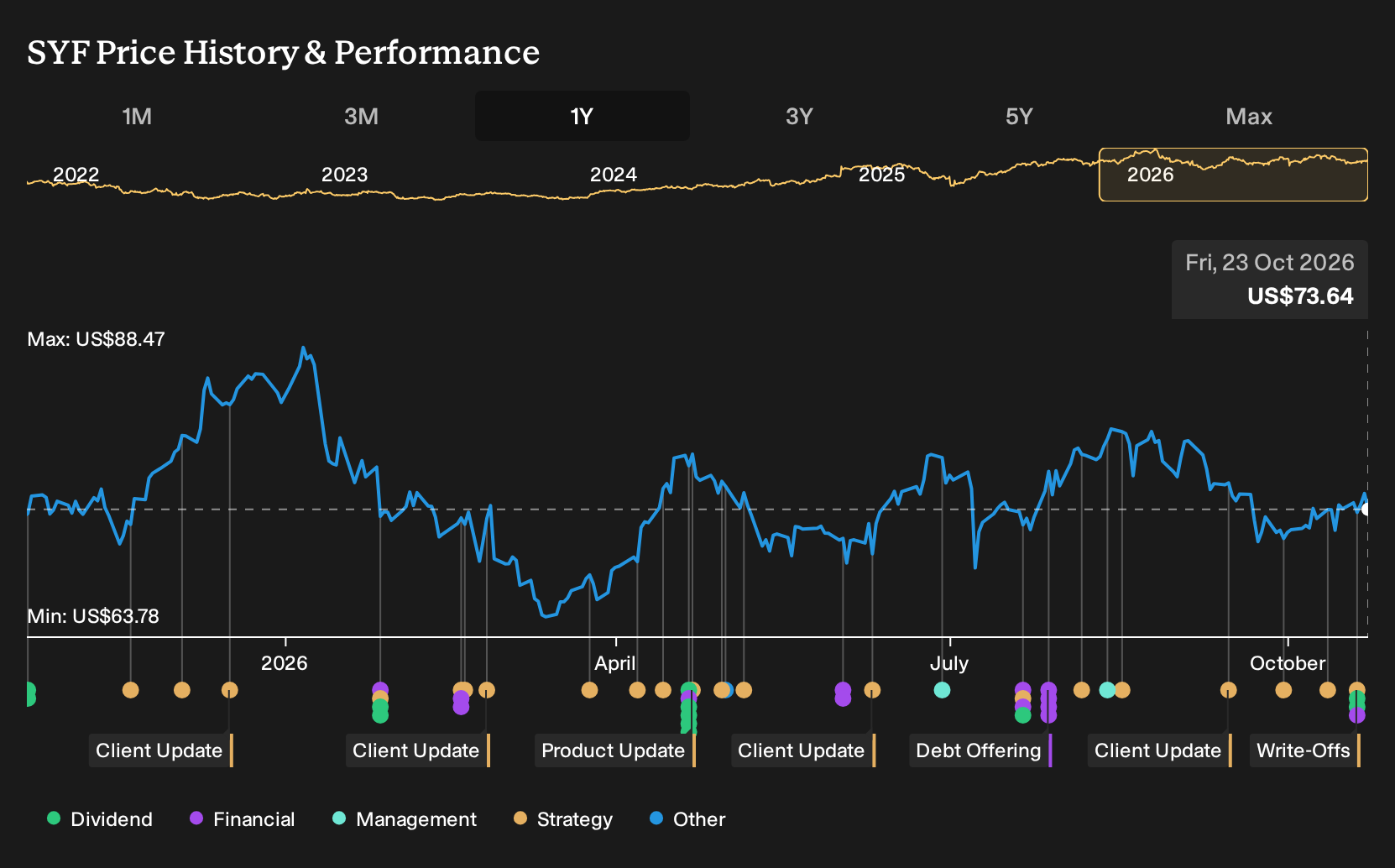
Exploring Other Perspectives
One point where the lowest analysts push back hard is on earnings resilience. They saw 2029 earnings closer to US$2.7b on revenue of about US$17.6b, compared with the consensus US$3.0b. That more cautious view came before this quarter’s US$892m profit and US$1,236m in net charge offs, so you should expect opinions to evolve.
Explore 4 other Synchrony Financial fair value estimates, including one that suggests it could be worth just $87.50.
Reach Your Own Conclusion
Don't just follow the ticker. Dig into the data and build a conviction that's truly your own.
- A great starting point for your Synchrony Financial research is our analysis highlighting 3 key rewards and 2 important warning signs that could impact your investment decision.
- See our latest analysis for Synchrony Financial. The report includes a comprehensive fundamental analysis summarized in a single visual, the Snowflake, making it easy to evaluate Synchrony Financial's overall financial health at a glance.
Looking For More Investment Ideas Beyond Synchrony Financial?
Once you have formed a view on Synchrony Financial, it can help to set it beside other opportunities that match your preferred mix of quality, risk and income potential.
- If you want a hunting ground for smaller high risk, high reward opportunities, scan through 8 elite penny stocks with strong financials that meet strict financial filters instead of relying on hype.
- For investors who care most about getting strong fundamentals at a sensible price, run your ruler over a carefully curated 29 high quality undervalued stocks that screens for quality balance sheets and robust cash flows.
- If income is your anchor and you care about durability as much as yield, focus on a 5 dividend fortresses built to surface businesses offering substantial payouts with an eye on sustainability.
Have feedback on this article? Concerned about the content? Get in touch with us directly. Alternatively, email editorial-team@simplywallst.com