


The Zhitong Finance App learned that BOESPEAK, a natural language processing model that tracks the statements of Bank of England's Monetary Policy Committee (MPC) members, shows that the central bank officials are releasing the most hawkish signal in more than three years, paving the way for interest rate hikes as early as next month.
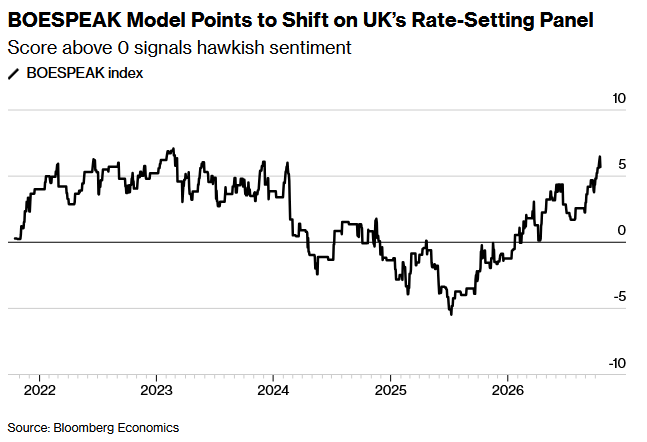
The BOESPEAK model shows a shift in the Bank of England's MPC stance
According to reports, after Bank of England officials recently delivered a series of speeches during the International Monetary Fund (IMF) and World Bank meetings, the BOESPEAK index rose to its highest level since the beginning of 2023. Since the end of August, the index has risen sharply. Despite a slight decline from the current peak, it is still near the highest level since March 2023. At that time, the UK inflation rate was as high as 10%, interest rates were 4%, and it was still rising.
In response, economist Dan Hanson said, “The rise in this index is very remarkable and coincides with the rise in energy costs in recent months.” He expects the Bank of England to raise interest rates in November and February next year. He added: “Of course, the MPC may just be sending a tough signal. However, we believe that the balance of risks surrounding economic growth and inflation prospects has changed sufficiently to convince most members of the Committee that higher interest rates are needed.”
Unlike the Federal Reserve and the European Central Bank, the Bank of England has yet to tighten monetary policy due to the worsening inflationary shock caused by the Middle East conflict. But a growing number of Bank of England officials are warning of the potential second-round effects of inflation, where companies pass on rising costs to consumers while employees demand higher wages.
Investors currently expect the probability that the Bank of England will raise interest rates next month close to 100%, and they expect to raise interest rates at least three times before July next year. According to a recent survey, economists generally expect the Bank of England to raise interest rates in November and February next year.
The market currently anticipates that the Bank of England MPC will support a 25 basis point increase in interest rates to 4% on November 5. This will be the first in a series of interest rate hikes until next summer. In September, the committee voted 6 to 3 to keep interest rates unchanged, so only two members needed to change their positions was enough to reverse the voting results.
Bank of England Governor Andrew Bailey is the key swing ticket in the MPC. Although Bailey said the effects of a second round of inflation have yet to be seen, he warned that as the energy shock and the Middle East conflict continue for longer, it is becoming more and more difficult to avoid interest rate hikes. His two deputies, Dave Lumsden and Claire Lombardley, used similar language, and the Middle East war still shows no sign of ending.
Earlier this month, Kathryn Mann said that the UK labor market is “static” rather than relaxed, while warning that inflationary pressure is becoming entrenched. Mann is one of the most hawkish officials on the Bank of England's monetary policy committee. She has always advocated that interest rate hikes are needed to stop the energy shock from spreading to the wider economy. At the same time, she is worried that upcoming wage negotiations will exacerbate higher inflation rates due to rising fuel and energy costs.
Another hawkish official, Megan Greene, said last week that the growth rate of the UK economy has exceeded expectations and the job market remains resilient, which is enough to show that the Bank of England is not doing enough to curb inflation. Recently, she once again stated that the current process of falling wage inflation in the UK seems to have stopped above a level consistent with the 2% CPI target, and bluntly stated that “the risk of the second round effect is greater than we anticipated.”
According to the latest data, the number of salaried employees in the UK unexpectedly increased by 13,000 in September, in stark contrast to the 8,000 reduction previously anticipated by the market, and is the biggest monthly increase since August 2025. The August data was also drastically revised, from a decrease of 26,000 people initially reported to an increase of 1,000 people. In the three months ending August, the unemployment rate unexpectedly fell to 4.7%, the lowest level since July 2025; the unemployment rate remained at 4.4% in September.
According to the UK Office for National Statistics, although total pay, including bonuses, has fallen to its lowest level in nearly six years, regular wage growth has remained relatively stable — this is mutually confirmed by Greene's judgment on wage stickiness.
Investec analyst Ellie Henderson pointed out that the Bank of England has always believed that labor market easing will help reduce the risk of secondary effects caused by energy shocks, but the latest data shows that the job market situation has improved, “which may make policy makers uneasy.”
Bank of England's chief economist Hugh Peel also warned that the upcoming wage agreement poses a threat. He said that in an economy where supply is limited, economic activity and the labor market are showing resilience.
However, according to Bank of England Deputy Governor Sarah Briden, British companies are seeking to absorb energy shocks and cut costs on their own rather than raise prices to consumers. This statement suggests that she is cautious about the need to raise interest rates. However, she also stressed that whether the impact of the energy shock has been weakened or simply postponed is still an unresolved question.
In addition to the hawkish signals released by Bank of England officials, recently released economic data also boosted market expectations for the central bank's interest rate hike. According to data released by the UK Office for National Statistics on Wednesday, the consumer price index (CPI) rose 3.5% year on year in September, higher than the 3.1% increase in August and the 3.4% market forecast; the core CPI rose 2.8% year on year, higher than the 2.6% increase in August and 2.7% of market expectations. Furthermore, as an indicator of inflationary pressure in the UK, the service sector inflation rate rose to 3.7%.
Driven by surging gasoline and diesel prices, the UK's inflation rate unexpectedly rose to its highest level in 11 months. According to the UK Office for National Statistics, motor vehicle fuel costs are driving up inflation — previously diesel prices hit a record high at the end of September as oil prices rose above $100 per barrel. Ordinary households in the UK will also face further financial pressure, and the price cap that determines the level of household energy bills will be raised in October. Furthermore, the Bank of England currently expects the inflation rate to double its 2% target at the beginning of next year and raise the third-quarter GDP growth forecast to 0.4%.