


A stronger yuan, a softer U.S. dollar and a pivotal political meeting in Beijing are pulling attention back to one of the market’s simplest stories. Chinese households either spend or they do not. When currency trends and policy signals line up, consumer-facing stocks exposed to these currents can move quickly, which risks leaving latecomers on the sidelines. This article unpacks the backdrop and then walks through 3 stocks from our Chinese Domestic-Focused Consumption Stocks screener that appear positively exposed to the latest news.
The three stocks below are only a sample, since the full screen surfaced 45 more companies with equally detailed stories that are not covered here. To go beyond this short list, head straight into the Chinese Domestic-Focused Consumption Stocks screener to identify, compare, and analyze your own highest conviction ideas.
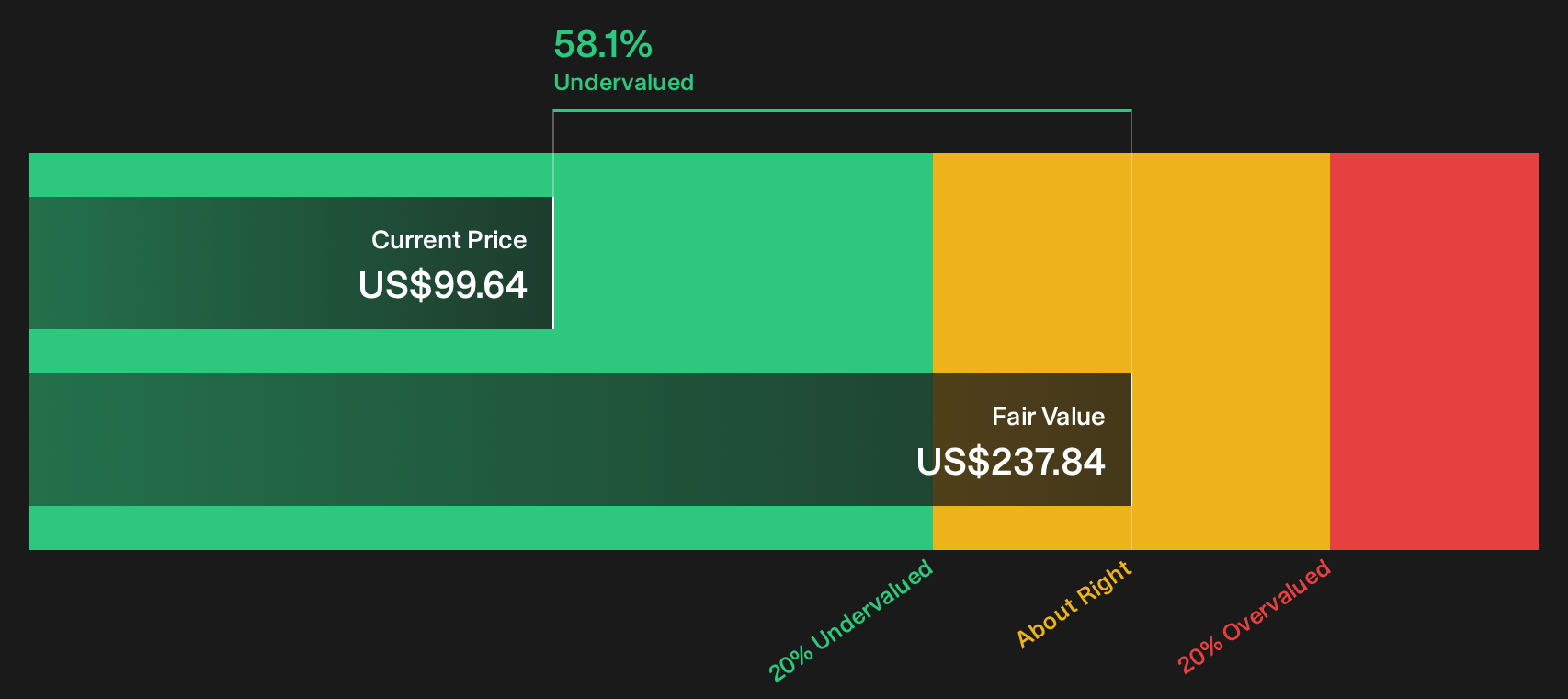
JD.com (JD)
Overview: JD.com runs a large supply chain based e commerce and retail platform in China, connecting consumers with everything from groceries and electronics to healthcare and household essentials.
Operations: JD.com generates about CN¥1.12t from JD Retail, CN¥243.3b from JD Logistics, and CN¥43.2b from New Businesses, almost entirely within China.
Market Cap: US$34.1b
For a screener built around Chinese domestic consumption, JD.com is one of the purest ways to track how everyday spending flows through online retail, logistics, and services when sentiment toward the yuan and local policy becomes more supportive.
"Ongoing investments in logistics, automation, and supply chain optimisation, now reinforced by plans to deploy RMB 10b into AI and robotics and to build over 80 RoboBase industrial bases, are expected to deepen procurement and fulfilment efficiencies and support further gross margin and operating margin gains in JD Retail and JD Logistics."
The real swing factor for JD.com is how a single, still evolving shift in its domestic consumer mix eventually shows up in margins.
That margin mix question is exactly what the full narrative for JD.com unpacks, laying out how JD.com’s logistics push and AI spend could reshape returns on each new yuan of demand.

Baozun (BZUN)
Overview: Baozun runs end to end e commerce and brand management services that help consumer brands sell directly to shoppers across China.
Operations: Baozun generates about CN¥8.6b from E Commerce and CN¥2.1b from Brand Management, almost entirely from the People’s Republic of China.
Market Cap: US$207 million
Baozun fits this domestic consumption screen as a behind the scenes operator, wiring together online demand, brand partners, and Chinese shoppers.
"Accelerating deployment of AI agents across Baozun’s e commerce operations, such as automation in Gap online stores and AI tools for digital asset management and customer service, is already improving productivity and is expected to lower the cost to serve, which could support higher BEC net margins and earnings."
What happens to Baozun’s equity story if that quiet shift in how it spends each yuan on growth slightly changes the margin math.
That small tweak to Baozun’s spending mix is exactly what the full narrative for Baozun unpacks, highlighting where AI driven efficiencies might quietly reshape future earnings power.

Alibaba Group Holding (BABA)
Overview: Alibaba Group Holding runs Taobao, Tmall and related online platforms that connect Chinese consumers with merchants, services, groceries and everyday goods.
Operations: Alibaba records roughly CN¥879b of adjusted segment revenue, largely from businesses grouped under All Others, almost entirely within mainland China.
Market Cap: US$247.7b
Alibaba Group Holding is a cornerstone of this domestic consumption screen because its e commerce and services platforms sit directly in the flow of Chinese household spending. The company also ties that consumer activity to cloud, payments and AI infrastructure that could respond quickly if a stronger yuan and policy tailwinds support demand.
"If sentiment toward China improves and Alibaba successfully monetizes its AI and cloud investments over the next several years, the gap between market value and intrinsic value could narrow substantially."
The real test for Alibaba now is how one pressure point in its profit engine ultimately filters through to earnings power and investor sentiment.
That pressure point is exactly what the full narrative for Alibaba Group Holding unpacks, showing how monetization, AI and cloud momentum could be quietly decoupling Alibaba Group Holding’s value from current sentiment.
Seeking Fresh Alternatives Before Others?
Fresh ideas move first. By the time the crowd spots a breakout, momentum is already flying and ideal entry points are dropping from reach. Scan these under the radar lists and look at them early.
- Target dependable cash generators that still feel overlooked by using the 21 high quality undiscovered gems while they remain under the radar for now and before attention catches up.
- Consider structural demand for metals that power electrification and technology by working through the curated 16 top copper producer stocks before the most compelling ideas are fully priced.
- Focus on resilient operators that score well on risk and quality by sorting through the 30 resilient stocks with low risk scores while it still highlights quieter opportunities others may miss.
Have feedback on this article? Concerned about the content? Get in touch with us directly. Alternatively, email editorial-team@simplywallst.com