


The Zhitong Finance App learned that in a context where Wall Street is generally cautious about media giant Skydance Corp (SKYD.US), Citi Research recently published a completely different opinion in a research report. After a period of rating suspension, the bank's team of analysts led by Jason Bazinet resumed coverage of Skydance and directly gave it a “buy” rating, with a target price of $10.
Citi believes that the market is currently too pessimistic about Skydance's profit prospects, and that the synergy effects unleashed by the company through the acquisition of Warner Bros (Warner Bros) will far exceed management guidance, thus driving EBITDA to significantly outperform market consensus.
Citi said in the report that although its 2027-2029 eBITDA forecast falls short of the internal target set by Skydance management, this forecast is about 12% higher than Wall Street's general expectations. According to Citi, this gap shows that investors still have doubts.
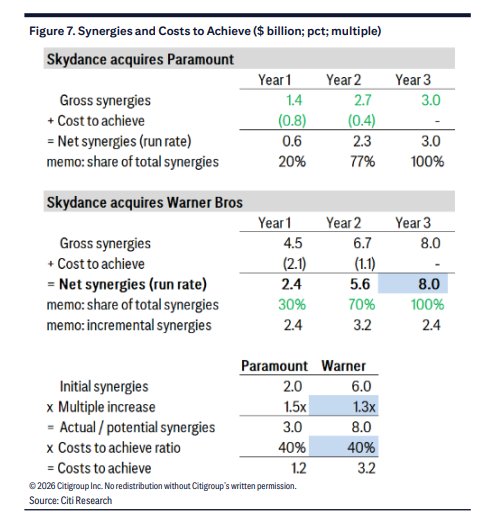
Citi's optimism is mainly based on the cost synergy of the acquisition deal. The report notes that when Skydance acquired Paramount (Paramount), management initially promised a net synergy of $2 billion, but ultimately actually delivered $3 billion. Based on this historical record of “overdelivery,” when management set a collaborative target of 6 billion US dollars for the Warner Bros. transaction, Citi believes that 8 billion US dollars is a figure closer to reality, which will be about 2 billion US dollars higher than the management target.
The birth of Skydance
Citi reviewed the birth process of Skydance in detail in the report. In the fourth quarter of 2026, Paramount bought Warner Brothers for $31 per share, totaling $81 billion. Taking into account about $15 billion in term loan repayments, $3 billion in NFLX.US (NFLX.US) break-up fees, and transaction-related expenses, Skydance would require approximately $104 billion in capital. This capital consists of 57 billion US dollars of new debt and 47 billion US dollars of equity financing. The share issue price is 12 US dollars per share, bringing the share capital for the exam preparation to 5.03 billion shares.
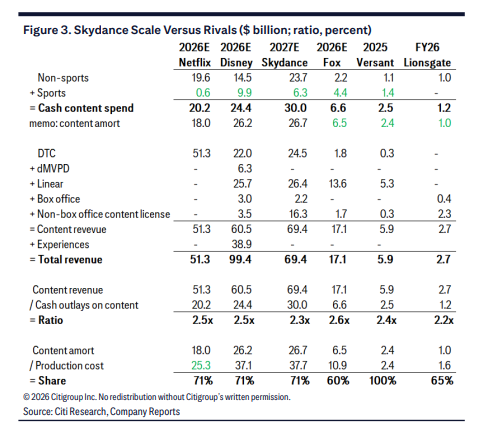
This merger and acquisition created a new entity of sufficient scale to target existing giants. Citi compared it to industry benchmarks in multiple dimensions: Skydance's annual content expenditure is about 30 billion US dollars, about 50% higher than Disney (DIS.US); its TV and film studio business is huge, with revenue about twice that of Sony (SONY.US), NBC Universal, or Disney; in terms of direct-to-consumer (DTC) business, although it is half of Netflix's size, it is comparable to Disney.
Synergies are the full engine of EBITDA growth
The EBITDA bridge built by Citi clearly reveals the company's future growth path. According to estimated consolidated caliber, Skydance's EBITDA in 2026 is US$12.5 billion. Citi expects the company to achieve a net synergy of $8 billion by 2029. However, its 2029 EBITDA forecast is $19.4 billion. This means that Skydance's eBITDA growth over the next few years will almost 100% depend on the delivery of synergy effects.
To quantify this synergy, Citi has broken down its components in detail: the net synergy of the Warner Bros. deal is expected to reach $8 billion after deducting about $3.2 billion in implementation costs. In terms of the pace of implementation, Citi assumes 30% in 2028, 70% in 2029, and 100% in 2030.
In addition to the synergy, Citi's EBITDA bridge also incorporates other key variables: including the negative impact of the $1.1 billion annual cord-cutting wave (CORD-cutting), the annual increase in cable TV subscription fees of $300 million, the $500 million sports copyright cost pressure due to MLB, NHL, etc. copyright renewals in 2028, and moderate growth in DTC business and studio business.
Risks and catalysts
Despite the positive outlook, Citi also clearly indicated the risks. Skydance's leverage ratio is high, and the net debt/EBITDA is expected to reach 6.3 times by the end of 2026. Companies may face the challenge of debt refinancing if they fail to deliver on cost synergies as scheduled. Furthermore, about 20% of the company's revenue comes from advertising, and if the economy falls into recession, its EBITDA and equity value will be significantly impacted. At the same time, the company's performance is highly dependent on the commercial success of iconic IPs such as “Top Gun,” “Mission Impossible,” and “Star Trek.”
In terms of potential catalysts, the report refers to market rumors on October 22 that Elon Musk invested around $1 billion in Skydance. Citi speculates that instead of subscribing for new shares, Musk may have bought shares from David Ellison. This move may give SpaceX priority access to Skydance TV spectrum after ATSC 3.0 is deployed. However, Citi estimates that the spectral transaction value is only about 800 million US dollars (0.16 US dollars per share), which has little impact on the company's overall equity value.