


The Zhitong Finance App learned that British government bond traders indicated that the UK will soon increase its use of short-term debt. This shift could depress British Treasury yields and ease the country's increasingly strained public finances. Meanwhile, although the upcoming fall budget has set a “no harm” tone, the impact that the budget may trigger on the UK treasury bond market is still worth wary of.
The UK plans to increase the issuance of short-term treasury notes or reduce the yield on British bonds
The UK government is expected to update investors on October 28 with plans to expand the treasury bill market. In May of this year, the British government announced that it would introduce a 12-month treasury note before the end of this fiscal year to supplement the current 1-, 3-, and 6-month term varieties.
The British government has traditionally relied mainly on long-term bonds for financing. The UK is a special case in terms of debt maturity. In 2025, around 20% of the UK's loans were issued in the form of treasury notes, compared to an average of about 47% in Organization for Economic Cooperation and Development (OECD) member countries.
Expanding the size of the treasury bill market will enable the UK to take advantage of the market's growing demand for short-term maturing debt, while also expected to reduce interest expenses. For the UK government, any savings would be welcome. Due to rising borrowing costs, the country's already limited fiscal buffer has been eroded.
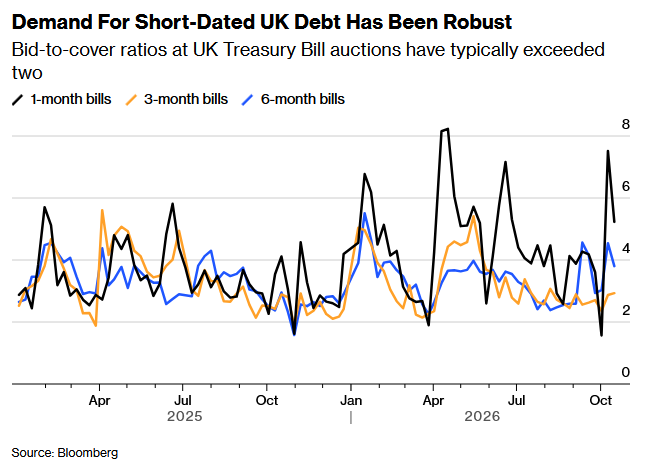
Demand for short-term debt in the UK has remained strong, and the bid multiplier for treasury bill auctions is usually more than 2 times
In the UK, market signs suggest that investors are in high demand for treasury bills. Bank of America said that demand for weekly treasury note auctions in the UK has always been strong, and the size of treasury notes held by banks has also increased in the past few years. The size of assets managed by UK money market funds is growing rapidly. This type of fund usually invests in short-term debt instruments issued by governments, banks, and businesses.
According to the median of 10 predictions from a media survey of Tier 1 traders, the net issuance of UK treasury notes will reach 11 billion pounds (about 14.7 billion US dollars) this fiscal year. This scale is roughly the same as the previous fiscal year, but far higher than the £5 billion forecast by the UK Debt Management Office in April. Traders also expect a significant increase in the issuance scale next year, with the Royal Bank of Canada Capital Market expecting the issuance scale to reach £25 billion.
Bank of America interest rate strategist Mark Capleton said, “Shortening the weighted average term of newly issued debt may reduce the yield on British Treasury bonds or reduce their upward pressure. By issuing debt with a shorter term, the average cost of interest can be reduced. Furthermore, by reducing the issuance volume of types such as 10-year treasury bonds, it is also possible to reduce the financing interest rate on these bonds.” He added: “Shortening debt maturities is a trend we are watching globally, but no country needs it more than the UK.”
The shift to short-term debt has shown some results. Since the Bank of England said it would stop selling long-term British Treasury bonds on September 17, the yield on UK 30-year Treasury bonds has fallen by 11 basis points. In contrast, French 30-year Treasury yields rose 39 basis points, while US 30-year Treasury yields fell by 5 basis points.
However, shortening borrowing terms also comes with risk—debt requires more frequent refinancing, leaving the government more open to risk when interest rates rise. This year, against the backdrop of a sell-off in global bonds, UK borrowing costs have risen sharply, and the yield on the benchmark 10-year treasury bond has risen to 5.36%, the highest level since 2007.
Be wary of the impact of the fall budget
It is worth mentioning that the British Burnham government will also announce the fall budget on October 28. After the former Chancellor of the Exchequer raised more than 60 billion pounds (about 80 billion US dollars) in the two budgets, the current Chancellor of the Exchequer John Healy has no intention of introducing another large-scale and impressive fiscal plan.
A few words that Healy and Treasury officials have used repeatedly recently — “do no harm,” “keep the current direction,” and “focus on the key points” — seem to have set the tone for the upcoming fall budget. Healy will seek to continue the good public opinion climate and rebound in approval ratings since the Burnham administration took office for three months, while delaying the most difficult and least popular issues in British politics until the future.
According to reports, Healy will fund a short-term spending plan aimed at catering to public opinion by raising bank taxes to help voters and businesses that are under pressure due to rising energy costs caused by the US-Iran war. The fall budget will also include a series of measures aimed at reducing the regulatory burden on enterprises, such as simplifying corporate reporting requirements; the government will also extend the suspension of import tariffs on products in various industries, covering fields such as chemicals, plastics, and hydrogen energy. Meanwhile, key issues such as welfare system reform and long-term investment in defense will be postponed.
James Nation, who served as special adviser to Sunak as UK Chancellor of the Exchequer and currently managing director of Forefront Advisers, said, “They have calculated this account and think that considering everything else that is happening around the world, this budget only needs to 'do no harm'. They don't want to do anything that could disrupt the current situation.”
When Healy submitted the budget this time, she was facing a tough market environment. Affected by rising inflation expectations driven by the Middle East war, global borrowing costs have risen sharply, and the UK has also been impacted as a result. When former Chancellor of the Exchequer Reeves made his last fiscal statement this spring, the UK Budget Responsibility Office made an economic forecast based on the market situation where the 10-year British Treasury yield was 4.5% at the time. However, in recent weeks, the 10-year British Treasury yield once rose to 5.5%, close to a decades-long high, further worsening the economic outlook facing Healy.
Therefore, one of the key decisions Healy must make is whether to rebuild the £23.6 billion fiscal buffer he inherited from Reeves. As borrowing costs soar and interest expenses on debt increase, this buffer has eroded. According to people familiar with the matter, Healy is willing to accept a smaller fiscal buffer. The median forecast from major government bond traders shows that the UK government's fiscal buffer will be reduced by about one-third to £15.2 billion. The decision to use part of the fiscal buffer reduced the pressure Healy faced between raising taxes and increasing spending.
In fact, the UK's fiscal buffer had shrunk drastically before the budget was announced. In March of this year, the British government still had a fiscal balance of 23.6 billion pounds, but due to global bond sales and rising borrowing costs, EY's estimate has dropped to about 11.3 billion pounds. UBS's estimate is about 10 billion pounds, and some fund managers even think it may only be around 14 billion pounds. According to the British National Institute of Economic and Social Research (NIESR), the 10-year British bond yield has risen by about 110 basis points to 5.4% since the Middle East conflict, and about two-thirds of this increase may be sustainable, which means that the structural rise in borrowing costs is systematically reducing the room for fiscal maneuver.
The budget itself faces a gap of about 7 billion pounds to be filled: including a funding gap of about 4.7 billion pounds in the defense plan, and about 2 billion pounds of living allowance expenses. Since income tax, value-added tax, and corporate tax have been excluded from tax increase options by political promises, there is quite limited room for doing so.
According to reports, Healy has abandoned the capital gains tax hike and instead used bank taxes as the main tool to increase revenue. UBS expects the government to adopt small-scale measures such as wealth tax, inheritance tax, and bank tax increases, while delaying difficult decisions on benefits and departmental expenses until 2027. This means that it is likely that the budget will only temporarily stabilize fiscal space, rather than actually fix it. EY warned that if the Strait of Hormuz is closed for a long time and inflation rises to 6%, fiscal space may evaporate further by £18 billion, turning into a deficit of about £7 billion, which directly violates fiscal rules.
Helen Miller, director of the British Institute of Finance, said in a statement: “To make plans to cut loans and comply with fiscal rules credible, the Chancellor of the Exchequer must clearly set out overall spending amounts, and these amounts must be something he is really willing to abide by. If only a few hidden cuts were arranged on paper that he had no intention of implementing, then this budget would be a piece of fiction.”
If Healy announces a “stabilizing” fall budget at that time, the yield on British treasury bonds is expected to decline slightly. Barclays strategists believe that for a new Chancellor of the Exchequer in an uncertain environment, a “lackluster” budget is the best outcome. UBS estimates that a budget that complies with fiscal rules is expected to eliminate the 15 to 20 basis point additional risk premium already included in 10-year British bonds, and the “value” of complying with the rules is about 20 basis points. Some large institutions have already bought British bonds before the budget is announced, betting that Healy will stick to fiscal discipline.
However, if this budget disappoints the market, the yield on British Treasury bonds may face an upward risk. UBS pointed out that if the budget violates fiscal rules, the 10-year British bond yield may rise by 25 to 50 basis points. The more fundamental problem is that the NIESR emphasizes that current interest rates are already higher than the economic growth rate, and that debt arithmetic is shifting from “smooth wind” to “headwind” — even just maintaining a stable debt/GDP ratio requires a larger basic surplus. If the budget responds to the impact by increasing borrowing, and the impact itself is continuous (energy prices, AI investment competition capital, global government borrowing requirements), then the Bank of England will be forced to take on more austerity tasks, further push up short-term interest rates and spread to the long term.
The market will focus on how much “margin” Healy has kept in the budget. If the fiscal buffer can be maintained at around £14 billion to £15 billion, it may be enough to calm the market; if it falls significantly below this level, or if major spending decisions are systematically postponed until the 2027 expenditure review, investors may interpret it as a “delay rather than a solution,” thus requiring a higher term premium. Simply put, this budget is difficult to reverse the general trend of shrinking fiscal space, but it can determine whether the market responds to this narrowing with “moderate acceptance” or “punitive sell-off.”