


The Zhitong Finance App learned that European gas prices have broken through 97 euros per megawatt-hour for the first time since 2022, and market concerns about Europe's weak supply and demand balance this winter and the prospects for the Middle East conflict continue to heat up. Benchmark Dutch TTF futures rose 3.5% in early Monday trading, continuing the weekly increase of about 7% last week. What triggered this jump was not a single supply incident, but a combination of low inventories, supply disruptions in the Middle East, and a rebound in seasonal demand — the market is being forced to reprice a “almost unbuffered” winter.
Traders expect heating demand to rise in the next few days, and temperatures in mainland Europe are expected to drop. This is compounded by tight global gas supply, or paving the way for competitive bidding wars between European and Asian buyers.
Market expectations for a short-term easing are fading. Hostilities and supply disruptions continue in the Gulf region. According to reports, Iran is preparing for a new round of US bombing around the November midterm elections, and plans to retaliate across the Middle East.
The Strait of Hormuz will also face a direct supply shock. Iranian Foreign Minister Alagach said that military action between the US and Israel has led to the closure of the strait, and global LNG supply has been disrupted. According to estimates by the International Energy Agency, more than 112 billion cubic meters of LNG will be transported through the Strait of Hormuz in 2025, accounting for about one-fifth of the global LNG trade, of which about 90% will go to the Asian market.
EU gas storage depots are currently about 75% full, the lowest level for the same period since records were recorded in 2009; German gas storage depots are only slightly above 61%, while the average for the same period of five years is as high as 89%. This gap is not something that can be summed up by a short delay in replenishing stocks in the short term.
After the 2022 energy crisis, Europe gradually replaced Russian pipeline gas with liquefied natural gas (LNG), and the marginal pricing role of LNG in its supply system increased significantly, which meant that Europe no longer only relied on long-term contract gas volumes, but must compete with Asian buyers for flexible shipping in the spot market. When inventories are at historically low levels, any supply disturbance is amplified into a price signal. As Europe enters a high demand season, it is particularly vulnerable to potential disruptions, and fuel stocks are abnormally low.
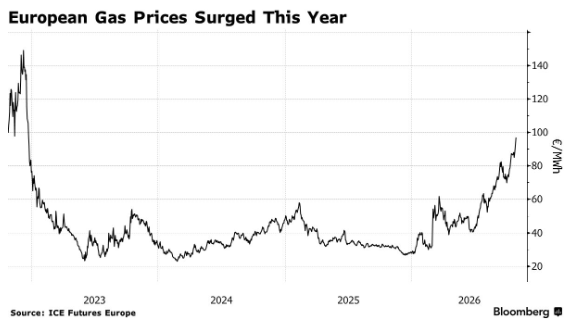
European gas prices are still far below the peak of the previous energy crisis, but the latest rise may boost inflation and drag down economic activity. Since October, European LNG imports have lagged behind the same period last year, although there was usually a jump in the same period in previous years.
As of press release, European benchmark Dutch futures rose 3.5% in recent months to 97.12 euros per megawatt hour. Affected by rising gas prices, France's electricity futures for the next month surpassed 200 euros per megawatt-hour for the first time since January 2023.