


The Zhitong Finance App learned that Bitcoin fell below the 80,000 US dollar mark on Monday and fell to a low of about 79,330 US dollars in the past 24 hours, approaching the lowest level since mid-September. As of press release, the price of Bitcoin has recovered above the $80,000 mark to $80,320. However, as the Federal Reserve's interest rate decision and the financial reports of Microsoft, Google, and Amazon came to fruition in the same week, crypto analysts clearly disagreed on Bitcoin's next step.
It fell below the 80,000 mark and fell to almost “the same as gold” during the year
Bitcoin traded around $79,930 after falling below $80,000. It fell 0.8% in the past 24 hours and fell more than 3% in the past week, with a total market value of about $1.61 trillion. What is really intriguing is the performance during the year: according to data given by MN Fund founder Michael Van de Poppe, Bitcoin fell 7.3% in 2026, while gold fell 7.5%. “Digital gold,” which has always been compared to gold, has declined almost the same as gold this year — this is exactly the reason for the bulls to shout at the bottom, and the basis for the bears to question its safe-haven nature.
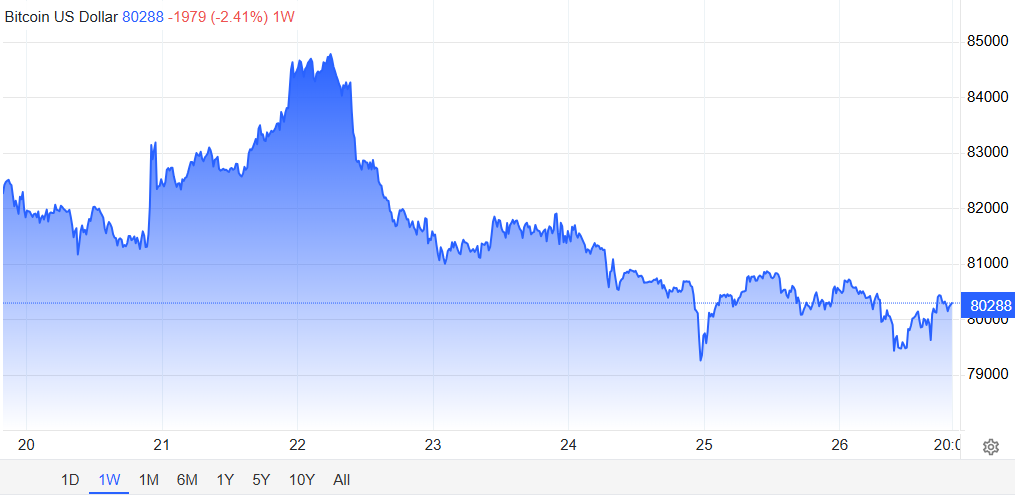
Judging from the trend, Bitcoin once approached 85,000 US dollars last Wednesday, then fell back. At one point, it fell to about 791,000 US dollars over the weekend; it hit 83,000 US dollars several times without success. Currently, the market's attention is quite concentrated: the price below is close to 79,000 US dollars as support; standing at 82,000 US dollars is enough to talk about short-term momentum improvement, while 83,000 US dollars is seen as a double threshold of technology and psychology. Also, according to data from Coinglass and several platforms, the Coinbase Bitcoin Premium Index has been negative for 33 consecutive days. The latest report was -0.15%, indicating that buying in the US market continues to weaken.
Two key macro variables for this week
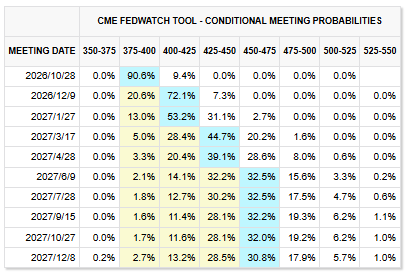
The first one is the Federal Reserve. The date for the interest rate meeting is October 27-28, and the resolution was announced in the early morning of October 29, Beijing time. According to CME FedWatch, there is a 91% chance that traders will keep their pricing interest rate at 3.75% — 4.00%, and the probability of raising interest rates by 25 basis points to 4.00% — 4.25% is 9%. It is important to note that the market's pricing is a small probability of “interest rate hikes” rather than interest rate cuts — investors will also look for signs from statements and press conferences whether to continue to raise interest rates in December, and the market expects the probability of interest rate hikes in December to soar to nearly 80%.
The second is Big Tech's financial report. Microsoft and Google are scheduled to launch on Wednesday, and Amazon on Thursday. Previously, Meta had raised its capital expenditure forecast for 2026 to $135 billion to $145 billion. The point is that the impact of huge AI spending on Bitcoin is bidirectional, and both directions are biased: on the one hand, if large investments allow investors to see growth opportunities, capital may be diverted from Bitcoin into technology stocks; on the other hand, if concerns about AI returns trigger wider sell-offs, investors enter a risk-removal model, and Bitcoin will also fall. Bitcoin will only benefit if technology stocks rebound and risk appetite picks up.
BTSE Chief Operating Officer Jeff Mei judged that all eyes are on the Federal Reserve meeting this week. Bitcoin's fall below 80,000 itself is a sign that investors are already reducing risk; it is likely to stay on hold this week. What really matters is how strong the chairman's signal for the December interest rate hike is. At the same time, he cautioned the risk: against the backdrop of record high oil prices, the escalation of the US-Iran conflict, and inflation, the Federal Reserve may well adopt a hawkish tone, which means higher interest rates and less liquidity — not good news for cryptocurrencies or stocks.
Funding trends
Prior to this decline, US spot Bitcoin ETFs experienced a total outflow of $773 million last week — the sum of the two trading days of October 22 (net outflow of 635.6 million) and October 23 (net outflow of 137.9 million). If you calculate the whole week, after this batch of funds recorded a net inflow of more than 1 billion US dollars from Monday to Wednesday, the final net inflow for the whole week was still about 301 million US dollars, ending the net outflow of the previous two consecutive weeks. However, looking at the full month of October, there was still a net outflow of about US$314 million.
In detail, the outflow of US$635.6 million in a single day on October 22 was the largest single-day redemption since June; BlackRock's IBIT and Fidelity's FBTC together accounted for US$471.6 million of the day's total outflow, close to three-quarters of the day's total outflow. As of recently, the cumulative net inflow of US spot Bitcoin ETFs is about 57.6 billion US dollars, and the total net asset value is about 10.2 billion US dollars. The net outflow of Ethereum spot ETFs was about US$221 million in the week, and about US$1.18 billion since October. In other words, funding did weaken, but the “net outflow of 773 million” was not as bad as it seemed.
Lever: The one being cleaned is the long one
Another pressure to lower prices comes from derivatives. According to CoinGlass data, the entire network contract liquidated $1542.3 million in a 24-hour statistical period, involving more than 62,000 traders, with the most losing orders of 117.99 million US dollars and short orders of only 36.23 million US dollars — the party betting on the rise bears the vast majority of losses; Ethereum took the lead with $43.17 million, followed by Bitcoin at $32.94 million.
Earlier, after Bitcoin was rejected around $85,000 on October 22, Material Indicators recorded an order book long trap and cleared multiple orders over $500 million. Bitfinex analysts warned on October 19 that futures exposure increased at the same time as prices fell, and a new wave of liquidations could be brewing.
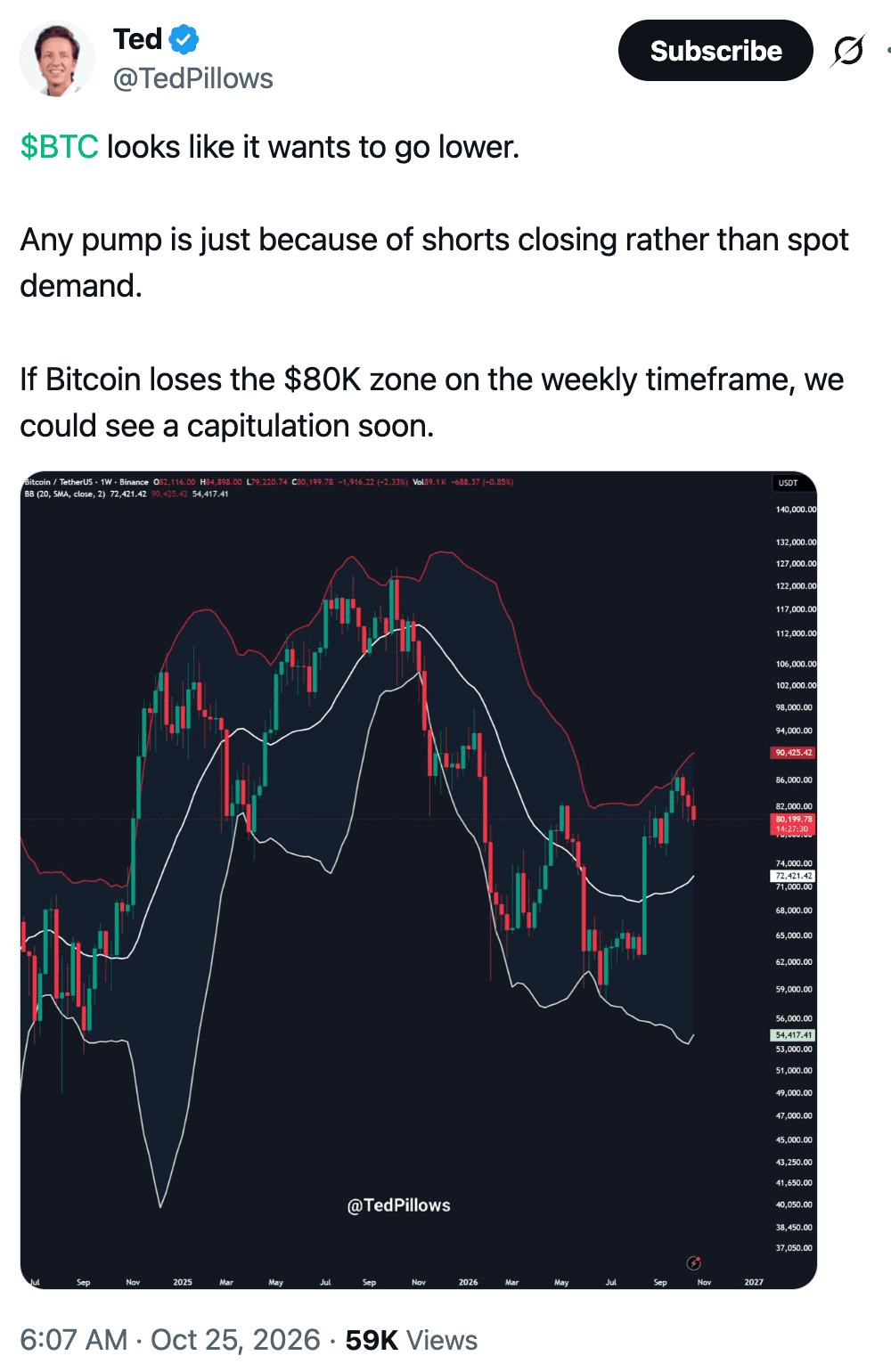
This background echoes the statement of the bears Ted Pillows — he believes that any rebound “is simply due to bears closing positions, not spot demand.”
“Surrender” or “scavenging”?
The core argument of Van de Poppe and the like is long-term returns: Bitcoin's annualized return since 2011 has been 120%, while gold is only 6%. Therefore, he believes that when Bitcoin is undervalued compared to gold, investors should “bet heavily” and “wait 1 to 2 years for the gold to complete its correction” before exchanging the money back to gold. He also wrote on October 25 that “Bitcoin's pullback will soon be over.” Earlier, from October 22 to 23, he gave two scenarios for going long: the price broke into the demand zone of $78,400 to $79,700, or the upward break of $82,900 made the bearish structure ineffective, and then looked at a new high during the year.
Meanwhile, the bearish side, Ted Pillows said on X that Bitcoin “looks like it still wants to go down” and warned that if the weekly level falls below the $80,000 area, “we may soon see a capitulation sell-off.”
The question raised by on-chain analysts James Check and Michael Sullivan in the Checkonchain newsletter is: is Bitcoin currently in a “rebound amid legendary doubts” or is it “another bear market rebound”?
The voice on the institutional side was similarly split. Orbit Markets co-founder Caroline Mauron believes that Bitcoin's performance is still resilient compared to AI debt concerns that are dragging down all risky assets. Apollo Crypto portfolio manager Pratik Kala pointed out that for many systemic funds and algorithmic traders, Bitcoin is a risk-averse asset category, so it is vulnerable to worsening sentiment; he added that advances in the AI field have also increased the potential security risks faced by crypto assets, making some investors more cautious. Gold bully Peter Schiff is targeting $75,000.
The technocratic framework provides a measure that can be falsified: analyst Benjamin Cowen's nine-step bearish roadmap has completed the first two steps (weekly closing below $83,000, upward breakout on October 25), and if Bitcoin recovers and stabilizes at $83,000, the situation will fail, so 83,000 has become a double technical and psychological threshold. Predicting market Myriad's sentiment has clearly turned sad: traders gave a 43% chance of “falling to $77,500 by the end of the month”, and only 32% the day before.
Market trends after setting the tone for this week
The disagreement between the two sides is actually not “whether it will fluctuate”, but “whether to wash the dishes or turn the bear this time.” The answer is likely to be given by the intensive implementation of events this week: the Federal Reserve's decision (US Eastern Wednesday), Microsoft and Google earnings (Wednesday), PCE inflation data for September (October 29), Amazon earnings report (Thursday), and the expiration of Bitcoin options with a nominal size of about 11 billion US dollars on October 30. Further ahead is the US midterm elections on November 3.
80,000 is the psychological threshold, and 83,000 is the technical threshold. In between, Bitcoin is being pulled by two forces at the same time: on the one hand, credit concerns about AI transactions and inflationary stickiness brought about by high oil prices, and on the other hand, the valuation of gold, which has been pushed to a historically low level. Van de Poppe's choice is to “take a heavy position” now, Ted Pillows' choice is to wait for “surrender” to appear — and the words of the Federal Reserve Chairman at Wednesday's press conference will determine which side the market's balance is tilted to.