


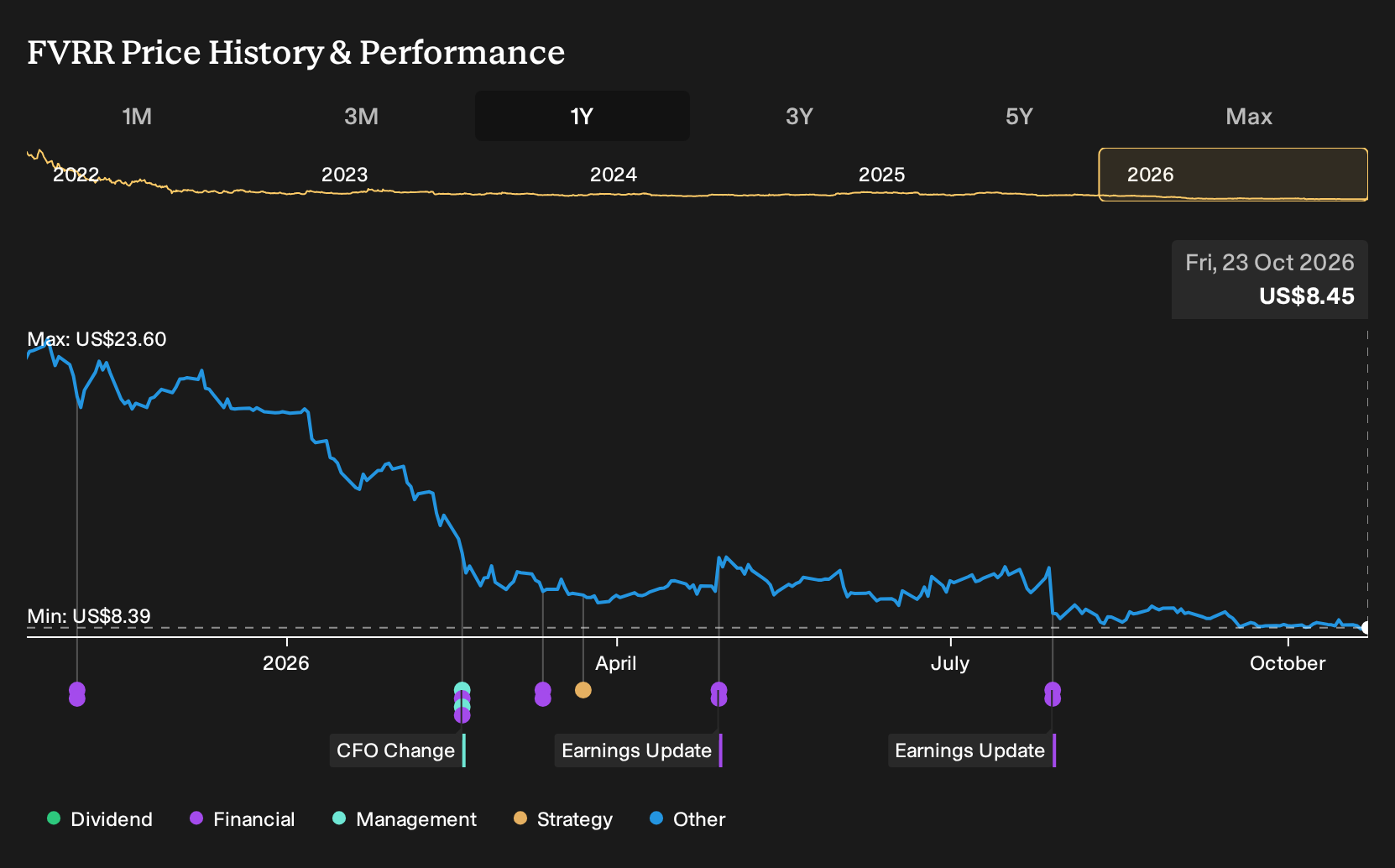
When Fiverr International disclosed an investor investigation tied to falling marketplace revenue, shrinking active buyers, and a weak 2026 outlook, it forced a hard question about how much risk shareholders had really signed up for. Holding Fiverr International over the past year would have meant a 63.6% loss, including dividends. If you had bought on 23 October 2025, how should that outcome reshape expectations about a platform that is leaning into AI and automation to revive growth?
If the move has made Fiverr International harder to judge, start where the gap is still open and scan 28 high quality undervalued stocks.
The Two Fiverr International Stories Investors Were Weighing
The shares cost US$22.91 at the start of the period, and buyers in Fiverr International had to decide which future they believed in.
One, more upbeat thesis argued that AI and automation could widen Fiverr International's reach. Its fair value was set at US$32.56, a price implied by assumptions such as 8.4% annual revenue growth over three years.
The more cautious view suggested freelancing growth might slow despite AI efforts. That narrative pointed to a fair value of US$21.45 and highlighted the risk that competition from platforms like Upwork could pressure Fiverr's expansion.
What The Results Put To The Test For Fiverr International
The clearest hard fact for Fiverr International was that Q2 2026 revenue of US$97.78m sat below Q2 2025’s US$108.65m, which leaned toward the cautious case that questioned sustained top-line expansion. Net income excluding extra items moved to US$4.47m from US$3.19m and net margin rose from 2.9% to 4.6%, so profitability progress kept the bullish efficiency argument alive. Overall, the evidence cut both ways.
The lesson is simple. When a growth story like Fiverr hinges on higher margins offsetting slower sales, track revenue and net margin together each quarter and test whether one is quietly paying for the other.
What You Would Be Paying For In Fiverr International Today
At a share price of US$8.45, Fiverr International is being valued below where this Narrative’s Fair Value sits, based on its own framework. The argument focuses on bigger-ticket work and AI tools rather than a rebound in smaller gigs.
Anyone buying today would need to believe that higher value, multi phase projects can grow fast enough to counter ongoing pressure on small gigs and active buyers.
"Ongoing mix shift toward projects at or above US$1,000, which now account for 15% of completed projects’ gross order amount and have seen double digit growth in clients completing such work, supports the idea that Fiverr International can replace shrinking low value gigs with larger contracts that have greater potential to support revenue and earnings over time."
Not everyone reads the same price the same way. → See the higher figure this Narrative lands on, and how it gets there
Where Fiverr’s AI Questions Point Next
If Fiverr leaves you wondering where AI spend really sticks, look nearby. Buyers of digital services still need trusted tools underneath their workflows.
Across risk scoring, legal research, and scientific publishing, those tools increasingly rely on embedded AI decisions. Clients pay for judgment and context, not just raw data.
One business quietly builds that judgment layer, weaving AI into software professionals already use. Its tools help insurers, lawyers, and researchers turn sprawling information into practical action.
As Fiverr pursues higher value projects, that deeper decision engine keeps working in the background. The open question is how much of future AI budgets land there instead.
That argument has a Narrative and a number behind it. → See the company one Narrative values 53% above its price
Have feedback on this article? Concerned about the content? Get in touch with us directly. Alternatively, email editorial-team@simplywallst.com