


Key Points
The stock has fallen more than 60% over the three months after weak results and a brutal roller coaster mishap.
Revenue will decline this year, and profitability is likely years away
The combination of Cedar Fair and Six Flags hasn't paid off, but the out-of-favor shares pose a high-risk contrarian investing play.
Like a poorly maintained wooden roller coaster, Six Flags Entertainment (NYSE: FUN) is looking pretty rickety these days. Shares of the country's largest operator of regional amusement parks have plummeted 45% over the past month -- down more than 60% over the last three months -- as a high-profile deadly roller coaster accident became the latest public relations nightmare for a business that was already struggling this year.
I want to make sure that I don't gloss over the passing of Hassan Jihad Ibn Kariem, the 42-year-old schoolteacher who died two weeks ago after falling out of the restraints of the Goliath hypercoaster at Six Flags Over Georgia. It's horrific. As a fellow coaster enthusiast who has been on that ride (and 275 other different roller coasters), I still can't get that accident out of my mind.
Missed AI’s "Act 1"? Act 2 Could Be 15x Bigger. Most investors think they missed the AI boat because they didn't buy Nvidia in 2005. But according to our analysts, we’re only at the end of "Act 1"—the R&D phase. "Act 2" is the global rollout. Continue »
I still became a Six Flags shareholder on Monday of last week. Let me spell out why I think Six Flags makes sense for risk-tolerant investors at this point.
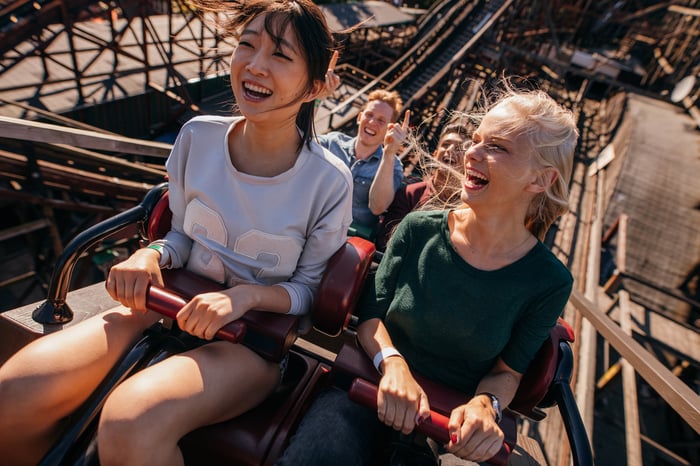
Image source: Getty Images.
1. Bargains aren't easy to find these days
Bottom fishing is a dangerous sport, and in the near term, I'm an inept angler. Six Flags would go on to tumble another 17% last week.
Pessimism continues to run high when it comes to Six Flags. This week kicked off with Goldman Sachs slashing its price target on the shares from $15 to $6 on Monday morning, and it's not even the Street low. Mizuho earned that honor last week, cutting its earlier target to $5 a share.
"Be fearful when others are greedy, and greedy when others are fearful," Warren Buffett says.
I should point out that I know the stock's 60% slide over the past three months doesn't mean Six Flags has shed three-fifths of its value. Six Flags' market cap has taken a 60% hit to $700 million, but this company's roughly $5 billion in long-term debt inflates the enterprise value to $6 billion. The actual enterprise value that a potential acquirer would take on has only fallen by just over 10% since this summer.
I'm not expecting a potential buyer or even a private equity firm to save the day here. I just think market sentiment can eventually stabilize and turn positive, offering a higher ceiling for public investors than the obvious floor of zero.
2. The seasonal timing of the stock slide is bullishly convenient
This week's Goldman Sachs update may seem rattling. The fresh analyst note highlights weak attendance trends, operational issues, and the debt-heavy balance sheet. Goldman Sachs says foot traffic data point to a 16% year-over-year decline so far this quarter, which is relevant because October accounts for the lion's share of the fourth quarter's results.
Seasonality is actually Six Flags' friend here. Outside of a couple of parks in the South, most of the chain's gated attractions close for the season shortly after the Halloween-themed events end. This time of the year, it's more about haunted houses and scare mazes than the actual scream machines that Six Flags had to temporarily close following the accident. It's already working on the modifications to make them safer.
In the meantime, Six Flags historically sees its fourth-quarter revenue cut in half from its peak third-quarter performance. The first quarter that follows sees its revenue decline by more than two-thirds from the fourth quarter.
Put another way, Six Flags has the next five months to fortify its safety procedures, reshape its 2027 season pass marketing approach, and move away from bearish headline fodder.
3. The spring is set for the next bullish catalyst
Remember when Six Flags spiked last October on news that an activist investor teamed up with NFL great Travis Kelce (and Mr. Taylor Swift) to make a play on the park operator? And investors warmed up to Six Flags after selling seven of its weaker-performing destinations to EPR Properties (NYSE: EPR) in a $331 million deal earlier this year?
Kelce was ultimately tapped as brand ambassador for Six Flags. Selling some of its lesser parks to the recreational and leisure real estate investment trust (REIT) came at an enterprise value discount to the overall attendance and adjusted earnings before interest, taxes, depreciation, and amortization (EBITDA) they contributed, but it provided an important cash windfall. The deal also helps Six Flags focus on its more financially successful attractions.
Six Flags will have a busy offseason. There will be more noise in the coming months, and all it takes is the next bullish spark to get the shares coasting in the right direction again.
Rick Munarriz has positions in EPR Properties and Six Flags Entertainment. The Motley Fool has positions in and recommends EPR Properties and Goldman Sachs Group. The Motley Fool recommends Six Flags Entertainment. The Motley Fool has a disclosure policy.