


Cybersecurity risk at banks is back in the political spotlight, and that puts a different kind of target on financial infrastructure. If regulation tightens again, spending on digital defenses may shift quickly, affecting some listed cybersecurity providers more than others. This article sets out three stocks from our Cybersecurity Providers Serving Regulated Financial Institutions screener that appear most exposed to the latest AI driven security debate.
The three stocks covered below are just a starting sample, and the full screen surfaced 20 more cybersecurity providers to regulated financial institutions with equally compelling narratives that are not covered here. To identify, compare, and analyze your own highest conviction ideas from that broader universe, head straight into the Cybersecurity Providers Serving Regulated Financial Institutions screener.
Everforth (EFOR)
Everforth aligns closely with the screener’s theme because its consulting, data, AI and cybersecurity work is positioned at the compliance-focused edge of both commercial finance clients and U.S. federal agencies that place a high priority on keeping regulated systems secure.
Everforth, Inc. provides IT consulting and cybersecurity-focused services across commercial and federal clients, generating about US$2.8b from Commercial work and US$1.2b from Federal Government contracts, and has a market value of roughly US$1.8b.
"Ongoing investments by Everforth clients in cloud, AI and cybersecurity solutions are now tied to larger, end to end modernization programs, with recent federal AI contracts such as SUNet 2.0 and Defense Health Agency work reinforcing a pipeline of high complexity projects that could lift consulting revenue and support higher net margins."
Consider what could occur if a single assumption about how tightly regulated clients increase that kind of spending shifts even slightly.
If that spending mix is starting to shift in your mind already, the full narrative for Everforth explains how Everforth’s AI heavy contract pipeline could either accelerate or stall.

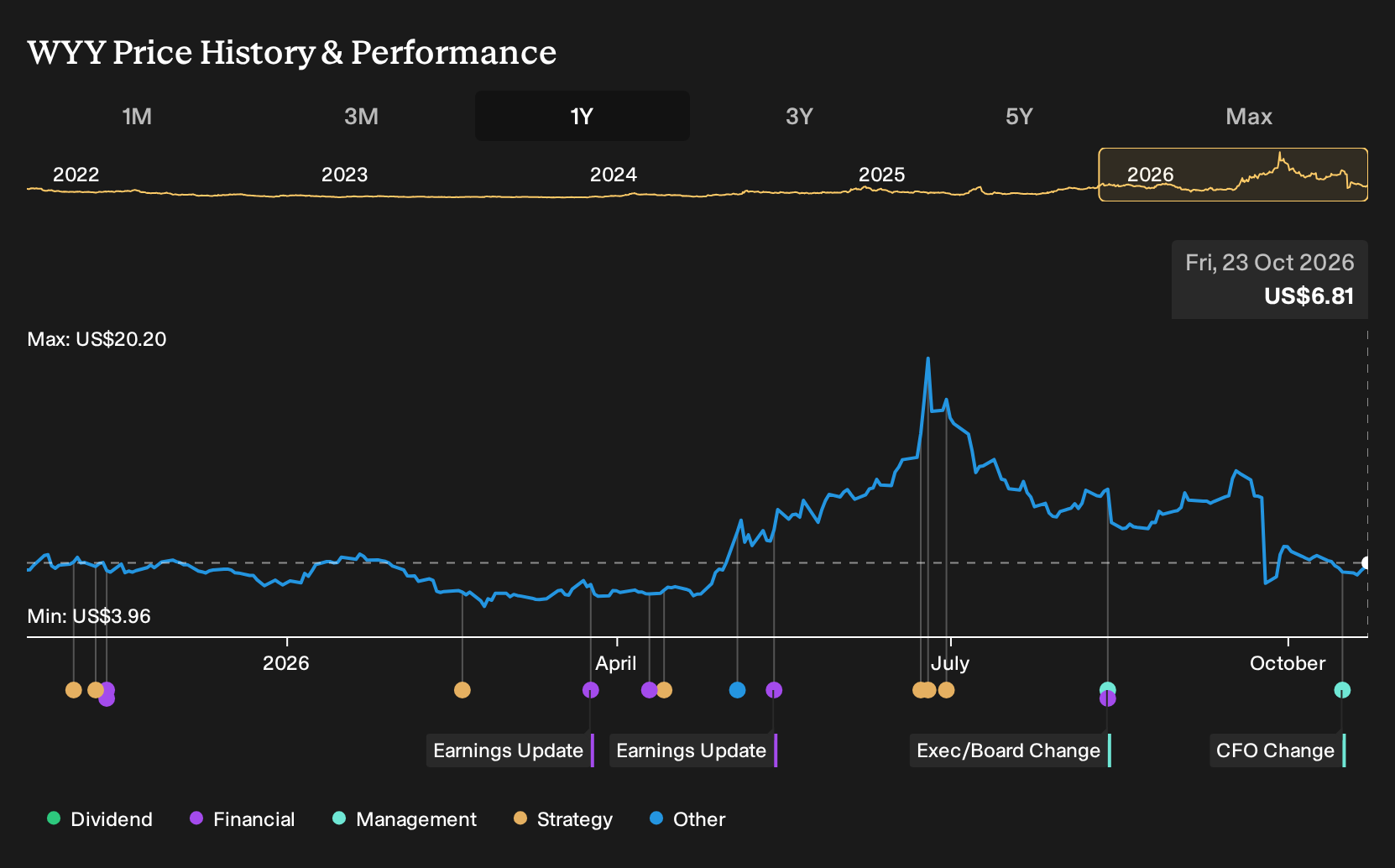
WidePoint (WYY)
WidePoint offers technology management as a service that blends telecom oversight, identity access controls, and cybersecurity. This naturally fits a screener focused on regulated security needs even though banks are not its primary audience.
WidePoint Corporation delivers TMaaS through secure government and enterprise portals, with about US$158 million in revenue from mobility services, telecom lifecycle, digital billing, analytics, and IT, and a market value near US$67 million.
For investors watching how AI driven cyber rules might ripple into regulated sectors, WidePoint brings telecom, device security, and identity management under one roof in a way that could matter if compliance expectations rise again.
"The upcoming $3 billion DHS CWMS 3.0 recompete contract, which WidePoint is described as being well-positioned to secure as a 2-time incumbent and one of the few firms with required FedRAMP authorization, is cited by some observers as having the potential to materially affect long-term recurring revenue and revenue visibility, especially with the contract term reportedly doubling from 5 to 10 years."
The real swing factor is what happens if a single large customer concentration assumption shifts at the same time that kind of contract renews.
That concentration risk cuts both ways, and the full narrative for WidePoint shows how WidePoint’s incumbency, AI driven contracts, and recurring revenue ambitions could be quietly re-rating the story.
Akamai Technologies (AKAM)
Akamai Technologies plugs into this screener as the kind of large scale security and cloud provider banks already lean on for application and API protection. Its role in keeping high traffic, regulated systems online makes it a useful bellwether for AI era cyber spending.
Akamai Technologies runs security, content delivery, and cloud computing services, generating about US$4.3b from providing cloud services, and carries a market value near US$13.4b.
Akamai matters here because it secures and delivers the same high value web and API traffic that regulators worry most about, giving you a way to watch how rising concern over AI driven attacks could translate into security demand across regulated financial systems.
"Rampant growth in data consumption, driven by AI powered applications, video, and real time use cases, is creating strong demand for Akamai Technologies cloud infrastructure and edge compute offerings."
What eventually happens to margins if a single assumption about how quickly that AI heavy infrastructure is built and filled starts to shift?
If that build out path is what you are weighing, the full narrative for Akamai Technologies explains how Akamai Technologies risk, pricing power, and AI infrastructure demand could be decoupling.

Seeking Fresh Alternatives Before They Fly?
Markets move fast, and the best breakout stories rarely stay under the radar for long. Scan fresh ideas before momentum is fully caught by the crowd and act now.
- Spot early-turnarounds with strong balance sheets and sturdy cash flows by scanning the curated list of solid balance sheet and fundamentals (24 results) while the valuations still look reasonable.
- Ride structural shifts in automation by tracking curated industrial and software players inside the 94 robotics and automation stocks before capital chases the next leg of momentum.
- Target resilient income payers with pricing power by sifting through the hand-picked 5 dividend fortresses while yields remain elevated and attention is still elsewhere.
Have feedback on this article? Concerned about the content? Get in touch with us directly. Alternatively, email editorial-team@simplywallst.com