


The Zhitong Finance App learned that Michael Wilson, chief stock market strategist from Morgan Stanley, highlighted in the latest research report that the agency's latest judgment is that the US stock market's internal adjustments starting in June have entered the final stage, but the index may still experience a final round of decline; after AI financing costs are under heavy pressure, the midterm elections, and the outlook for the Federal Reserve's monetary liquidity policy is gradually clear, the market is expected to see a major rebound at the end of the year.
According to top strategists at Wall Street financial giants such as Morgan Stanley, the global AI computing power theme, which has recently been hit hard by sell-offs, and the logic of increasing positions and buying on dips in a broad sense is being formed, but whether technology can achieve a bottoming rebound and a continuous upward trend thereafter will enter a double verification period of the performance disclosure season before the end of the year and AI financing conditions.
At a time when Damo continues to be bullish on the stock market, recent market conditions have shown the tension of a major rebound in semiconductor-led technology stocks and the fragmentation and division of capital shown by the corporate credit bond market.
The Philadelphia Semiconductor Index rose 0.44% on October 23 and rose further 2.82% on the 26th, but closed at 11083.5 points, about 24.27% from the closing high on June 22; the Nasdaq 100 Index, which has the title of “Technology Stock Weather Vane,” and the Nasdaq Composite Index, which includes more technology stocks, rose 1.09% and about 0.83% respectively on October 26, and are still about 6.25% and 5.18% lower than the closing highs on October 6. There has already been a strong short-term rebound in technology stocks in the US stock market, but the deep adjustments previously accumulated by the semiconductor sector, which accounts for a major share of technology stocks in market capitalization, are far from being repaired.
The credit market, on the other hand, revealed another side of the negative restraint faced by the AI computing power trading theme. The yield of CoreWeave's 2031 bonds due in the secondary market reached 15.76% on October 22, indicating that investors require higher risk premiums and compensation values for financing dependency and debt repayment risks associated with AI computing power infrastructure.
On October 26, the five-year credit default swap (CDS) interest rate spread for CoreWeave (CRWV.US), which is at the core of the “AI computing power sell-off storm” and the “AI bubble bursting argument,” was about 1,148 basis points; under the assumption of a 40% recovery rate, the model estimate corresponds to a 5-year cumulative implied default probability of about 62% — this indicator also focuses on the credit risk premium, which is not directly equivalent to the company's actual default probability over the next five years. In the same period, Meta, Alphabet, and Microsoft's five-year CDS were about 121, 83, and 55 basis points, respectively, up from 98, 73, and 52 basis points on September 25 — highlighting the general rise in corporate credit bond risk compensation values required by the credit market, but there is a significant gap in the pressure experienced by different companies.
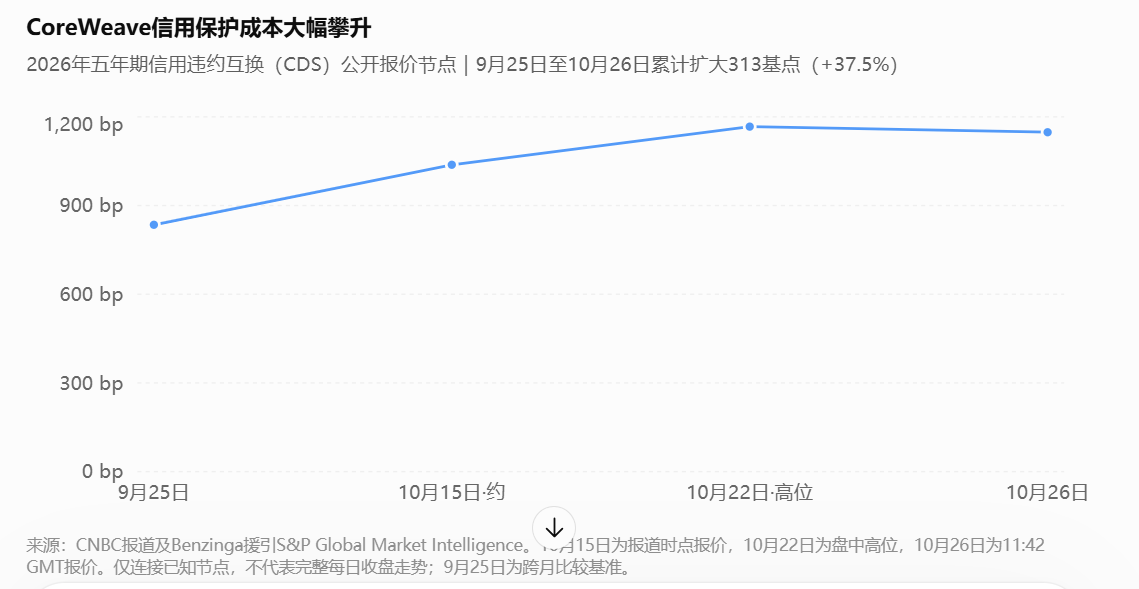
In recent years, Japanese investment giant SoftBank's five-year CDS, which is betting almost entirely on AI, rose to 432 basis points on October 20, the highest in nearly four years; the three-tier dollar bond issued in September reached 8.625%, 9.25%, and 9.75%, respectively. Together, these data show that whether the blowout expansion demand related to AI computing power resources can be realized as industry chain revenue depends increasingly on whether customers can continue to obtain capital and whether project cash returns can cover financing costs. High-rated tech giants are mainly under pressure from new financing becoming more expensive and valuations discounted, while new cloud vendors that rely on external capital are also directly constrained by the narrowing of financing channels.
Damo Wilson outlines the three core catalysts for the stock market rebound at the end of the year
Morgan Stanley's Michael Wilson said that the correction of bias and bearish sentiment in the US stock market, which began in June, is entering the final stage. Digesting three key uncertainties — capital issues related to artificial intelligence (AIQ, AIEQ), midterm election uncertainty, and changes in the Federal Reserve's liquidity — is expected to drive the market bottom and lay a major foundation for the S&P 500 index to rebound to a record point around 8,000 points at the end of the year.
This shift in the economic cycle to the middle stage occurred at the same time as the rate of change in the breadth of profit forecast revisions peaked; previously, the “rolling recession” experienced by various industries bottomed out around “Liberation Day” last year. The cycle shift has had a significant impact on individual stocks below the surface of the index. As investors turned to larger market stocks with higher fundamental quality, early cycle sectors such as new cloud forces, finance, cyclical consumer themes, and automobiles clearly failed.
Wilson wrote in a report released on Monday that since the start of this round of conversion, about 60% of the Russell 3000 Index (IWV.US), which focuses on small and medium cap stocks in the US stock market, has declined by more than 20%. Semiconductors have been hit the hardest, with 96% of the sector's stocks experiencing a retracement of more than 20%.
Quality Factor (QUAL) continues to lead the way in this transformation and is currently breaking through. Wilson pointed out that despite the resilience of the S&P 500 index, the breadth of the market has begun to improve, indicating that as investors gradually digest the mid-cycle transition, the index's performance and internal market conditions are “moving closer to the middle.”
Wilson said that the tactical downside target is still 7100-7,200 points, which means that the index may fall slightly below the 200-day moving average. At the time of writing the original article, the S&P 500 index was about 7,688 points, less than 2% of the all-time high set in early October.
The strategist proposed three catalytic factors that could mark the end of the adjustment. First, investors are generally active in the next three to four weeks focusing on AI's return on capital, capital costs and availability, security issues, and neighborhood avoidance — the local community's opposition to building data centers nearby — and is expected to be concentrated in the next three to four weeks.
Second, midterm elections usually present initial resistance to the market, but there are often strong returns six to twelve months after the election is over. Judging from historical performance, the average increase of the S&P 500 index in the 12 months after the midterm elections was about 17%.
Third, and most critical, Wilson believes that liquidity constitutes the biggest risk and catalyst for the market to form an ultimate low. Federal Reserve Chairman Walsh has slowed the balance sheet expansion rate by about half, but with inflation still above target, interest rate policy is still lagging behind the situation. Financial conditions have clearly been tightened to the same extent as in 2018, and close to the level of the 2022 active policy tightening period.
Morgan Stanley's composite sentiment index is currently at a neutral level, and third-quarter earnings are expected to increase 27% year over year. Based on this, Wilson maintains his judgment: as these key uncertainties gradually become clear in the coming weeks, the market should present attractive buying opportunities.
The S&P 500 index passed three hurdles before breaking 8,000 points: whether funding can continue, whether elections can be clarified, and whether liquidity changes
Based on the calculation of the S&P 500 index closing at 7676.77 points on October 26, 7100-7,200 points means about 6.2% to 7.5% of potential downside, and 8,000 points correspond to about 4.2% of upward space; if the index falls back to this support area and then recovers to 8,000 points, the increase will reach about 11.1% to 12.7%. This difference means that the investment opportunities in Wilson's judgment are highly dependent on the entry position and whether the profit base remains stable after the risk is released.
The first hurdle is whether the AI financing supply can be smoothly absorbed by the market. The team of Dama analysts led by Wilson has long focused on return on capital, cost and availability of capital, as well as security disputes and community opposition to data center construction. In the October 26 media podcast, he further pointed out that additional financing will still need to be accepted by the market in the next few weeks. Companies with weak qualifications may continue to face widening interest spreads and falling stock prices, and the semiconductor index is expected to drop another 10% to 15% by mid-November. This indicates that its year-end bullish judgment still involves a difficult risk digestion process.
Looking at the industrial chain mechanism, the implementation of financing can increase the probability of payment of GPU/TPU/ASIC, storage, network infrastructure, data center optical interconnection, and procurement of high-performance CPU equipment and power chain facilities, but the issuance of additional equity bonds also requires absorption of market capital. Expanding the scale of financing can support construction, and the financing price and subsequent cash flow determine how long this expansion will last. Therefore, the AI computing power theme in the global stock market and the key verification of the semiconductor sector's continued counterattack is that orders, deliveries, and repayments can be continuously fulfilled after the customer's budget is funded.
The second hurdle is the elimination of election uncertainty. Wilson believes that there are usually strong returns for 6 to 12 months after the midterm elections, but adjustments may continue for days or even weeks after voting ends. The logic is that settling the election results will help investors re-evaluate the regulatory, financial, and project construction environment; what really affects pricing is how policy risks change, not the election date itself.
The third hurdle, and the most important one, is whether liquidity pressure has prompted policy responses. Long-term interest rates in the US have risen by more than 100 basis points since February. The Federal Reserve raised interest rates only once after Walsh took office, yet the market has already tightened quite a bit through long-term interest rates and financing costs. Should such austerity further impact growth or credit markets, policy adjustments may support asset prices, even if it takes longer for inflation to return to 2%. Wilson's latest investment strategy in the research report is that investors are prioritizing cash flow, balance sheets, and profit quality at this stage to find a window to increase exposure after risk concentration is released; Wilson himself is particularly concerned about high-quality capital goods companies that have been significantly adjusted.