


Air Canada (TSX:AC) just put network growth back in focus. Fresh route announcements with United Airlines and new Montréal to Seville service give investors concrete capacity moves to weigh against recent share price swings.
For context, Air Canada’s share price is CA$21.55 after a 1-day share price return of 2.08% and a 7-day share price return of 1.27%, even though the 30-day share price return declined 21.18% and the 90-day share price return fell 16.34%. The year-to-date share price return is 9% and the 1-year total shareholder return is 16.3%, which suggests that investors have been reassessing both growth potential and route expansion risk over different time frames.
Scan beyond Air Canada and see how other carriers with growing route networks stack up on fundamentals using our curated screener of list of solid balance sheet and fundamentals (7 results).
Air Canada now trades well below both analyst targets and an intrinsic value estimate, yet the share price has just bounced on route news. How wide is the gap between today’s price and a reasonable fair-value range?
Most Popular Narrative: 7% Undervalued
Air Canada’s most followed narrative pegs fair value at CA$23.09, slightly above the last close of CA$21.55. This frames the recent route news against a modest implied discount that depends heavily on cost control and capital discipline.
Even though Air Canada expects nearly 100 basis points of margin benefit from fleet modernization as A321XLRs, A220s and 787 10s arrive over the next 36 months, the combination of a 5% to 6% full year 2026 adjusted CASM increase and elevated gross CapEx of $3.6b for 2026 creates a risk that fuel efficiency gains are overwhelmed by higher unit costs and capital intensity. This could restrain any improvement in operating margins and free cash flow.
See why 4 investors see Air Canada as 7% undervalued.
Result: Fair Value of CA$23.09 (UNDERVALUED)
Still, Air Canada’s record Q2 2026 revenue and EBITDA, along with liquidity of CA$8.9b and lower net leverage, could pressure a simple “modest discount” view.
Find out about the key risks to this Air Canada narrative.
Another View: How Multiples Frame Air Canada
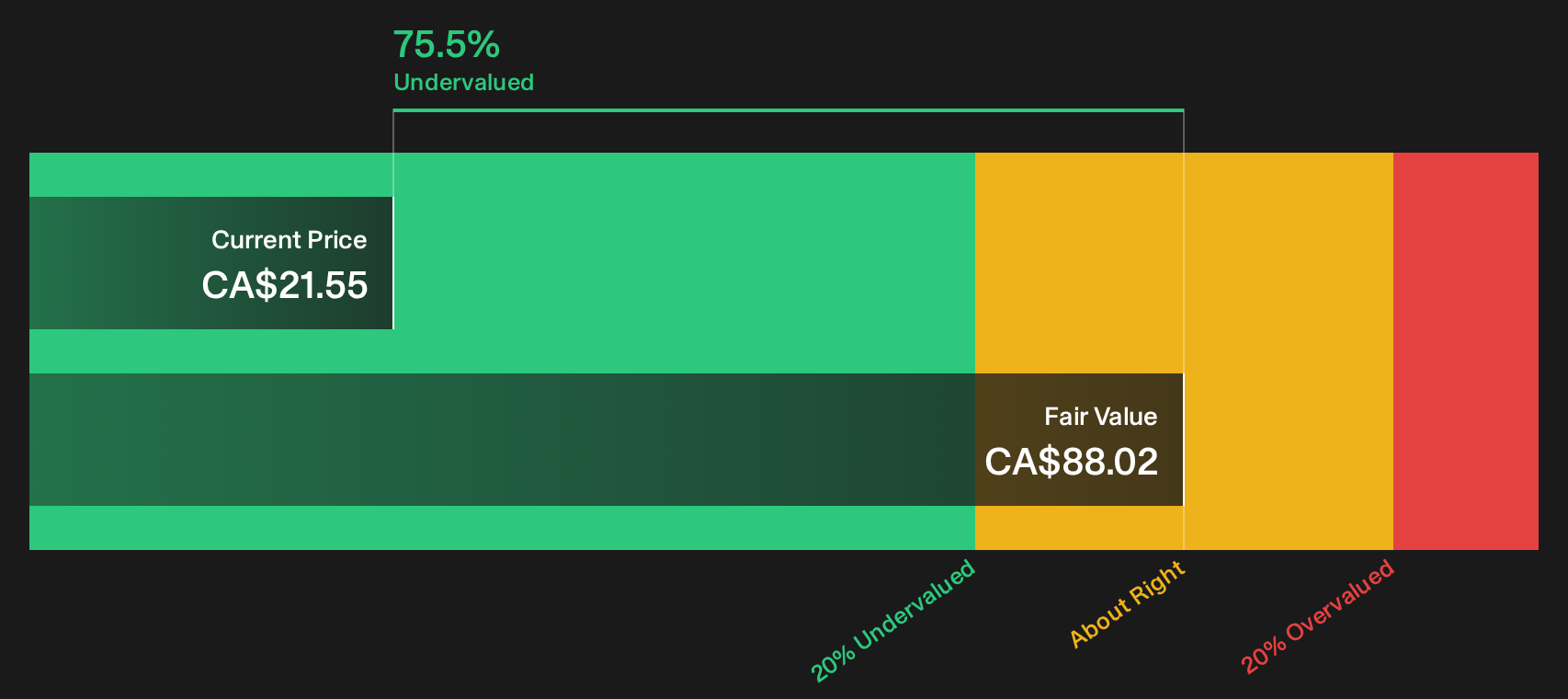
Our DCF work points to Air Canada trading well below an estimated future cash flow value of CA$88.02, which sits in sharp contrast to the CA$23.09 narrative fair value and the current CA$21.55 share price. If both are using the same earnings path, which signal deserves more weight?
Look into how the SWS DCF model arrives at its fair value.
Next Steps
Mixed signals around Air Canada’s value and risk profile do not need to leave you on the sidelines. Check the numbers, pressure test the narratives and weigh the 2 key rewards and 2 important warning signs.
Looking for more investment ideas beyond Air Canada?
If Air Canada has your attention, do not stop there. Use fresh data driven stock lists to cross check your thinking and spark new portfolio ideas.
- Target steadier potential returns by scanning companies that show resilient earnings and balance sheet strength with the 8 resilient stocks with low risk scores.
- Hunt for quality at a possible discount by running through companies that screen as attractively priced with the 3 high quality undervalued stocks.
- Spot opportunities the crowd may be overlooking by reviewing financially sound smaller players through the 9 high quality undiscovered gems.
Have feedback on this article? Concerned about the content? Get in touch with us directly. Alternatively, email editorial-team@simplywallst.com