


- Barclays reported nine month 2026 results showing net interest income of £11,568 million, net income of £6,578 million and basic EPS from continuing operations of £0.43.
- The latest figures indicate higher net interest income and net income year on year. This provides additional information on how Barclays is managing its core banking earnings engine.
- We will examine how Barclays' investment narrative aligns with this higher net income and what that may indicate for future expectations.
Barclays Investment Narrative Recap
To own Barclays, you need to be comfortable with a large, diversified bank that leans heavily on net interest income and is trying to sharpen returns through mix shifts and technology. The £11,568 million of net interest income and £6,578 million of net income for the first nine months show the earning engine in action. The near term swing factor is still execution on cost control, credit quality in securitised and consumer books, and delivery on digital and AI driven efficiency gains.
The biggest live risk remains credit and conduct issues that drag impairments and legal costs higher, especially given past fraud related losses and ongoing litigation. The latest earnings do not materially change that risk profile. What they do is give you fresher data to judge whether earnings can absorb potential hits while Barclays continues to reweight towards higher return UK, US consumer and financing activities.
Among recent updates, the nine month 2026 earnings release is the key one to focus on. Net interest income of £11,568 million, net income of £6,578 million and basic EPS from continuing operations of £0.43 provide a clearer read on how well the bank is monetising its structural hedge, deposit base and US Consumer and UK franchises. Those figures also help you gauge how much room management has to keep funding digital projects and business mix changes.
That operational snapshot matters for the core catalysts. It shows whether income is keeping pace with the ambitions to grow capital light US Consumer activities, keep the Investment Bank more skewed to financing and corporate clients, and support a shift towards higher return UK and wealth segments. For an investor, the question is how comfortably those earnings can fund both risk management upgrades in complex credit exposures and the technology and AI roll out Barclays is leaning on for margin improvement.
Analyst Expectations Around Barclays
Forecasts around Barclays give you a sense of how much change is already baked into consensus models. Analysts are working off the idea that revenue can grow by 7.1% a year over the next three years while profit margins move from 24.3% today to 26.4% by year three. On earnings, the group of forecasts points to profit of £9.2b and earnings per share of £0.75 by about 2029, compared with earnings today of £6.8b. This implies an earnings increase of roughly £2.4b over that period. Those same estimates anchor on a 2029 P/E of 9.8x versus about 8.3x now, and they assume the share count declines by around 3.42% annually over the next three years as buybacks retire stock.
Barclays' narrative projects £34.6b revenue and £9.2b earnings by 2029. This assumes 7.1% yearly revenue growth and an earnings increase of around £2.4b from £6.8b today.
Price targets in the consensus fold these inputs into a single number. The central target sits at £5.75 a share, with the most optimistic view at £6.80 and the lowest at £5.00. Against a recent share price of £4.26, that midpoint target is 25.9% higher. This indicates how much of the projected earnings and margin uplift analysts think is not yet reflected in the quotation. To line up with that view, you would need to be comfortable with the idea of £34.6b of revenue and £9.2b of earnings in 2029 and a higher future P/E multiple than the current GB banks industry average of 8.2x.
Discover how Barclays' fair value indicates a 37% potential upside to its current price that may not last much longer.
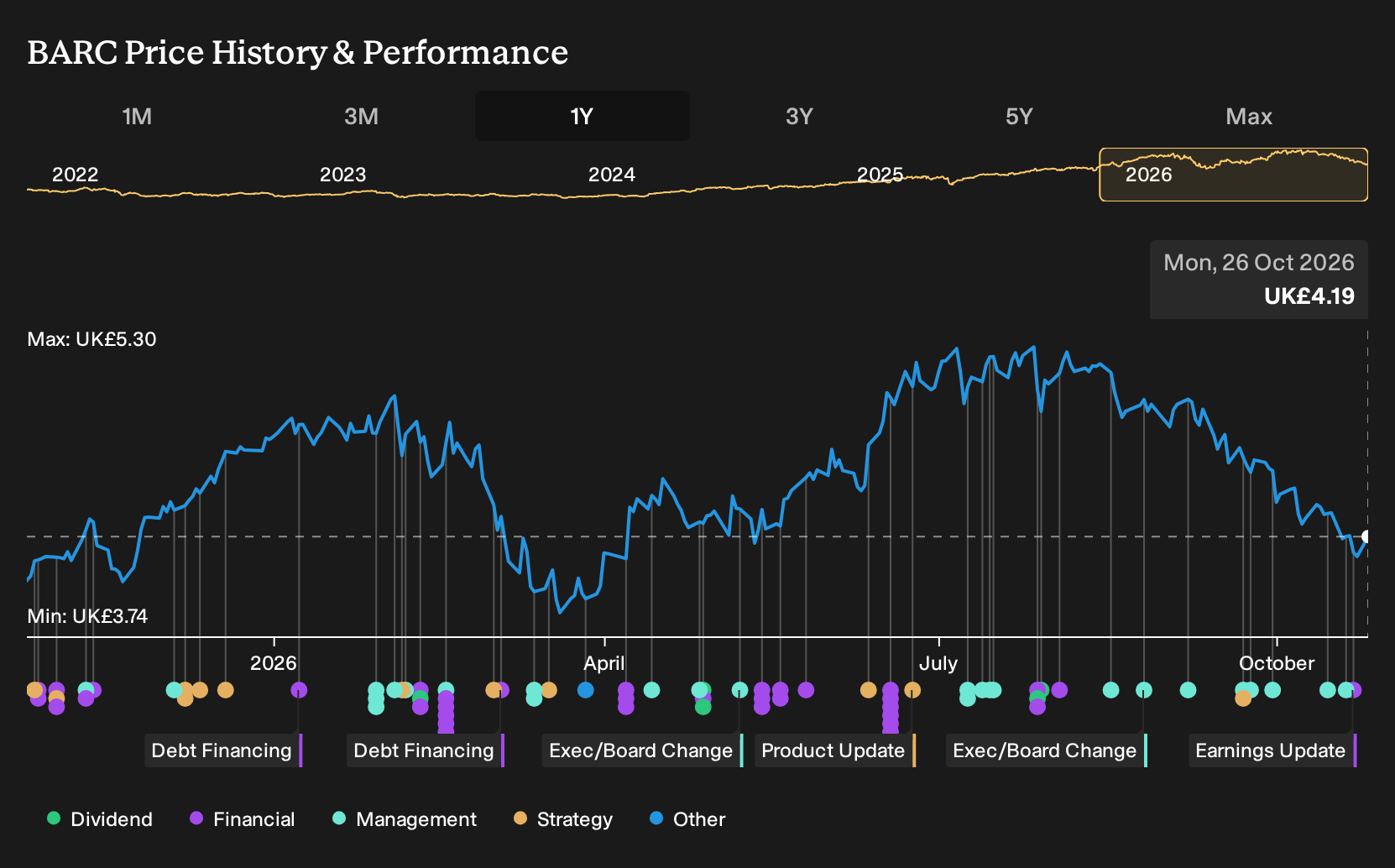
Exploring Other Perspectives
One alternate view puts Barclays cost cuts front and centre. The most optimistic analysts were already working with roughly £36.5b of revenue and £10.8b of earnings by 2029, assuming a lower group cost income ratio. Those forecasts came before these nine month 2026 results, so you should expect that story could shift as fresh numbers and leadership changes bed in.
Explore 6 other Barclays fair value estimates, including one that suggests potential upside of up to 129% from the current price.
Reach Your Own Conclusion
Disagree with existing narratives? Extraordinary investment returns rarely come from following the herd, so go with your instincts.
- A great starting point for your Barclays research is our analysis highlighting 5 key rewards and 4 important warning signs that could impact your investment decision.
- See our latest analysis for Barclays. The report includes a comprehensive fundamental analysis summarized in a single visual, the Snowflake, making it easy to evaluate Barclays' overall financial health at a glance.
Looking for more investment ideas beyond Barclays?
If Barclays has sharpened your sense of what you want from a bank or financial stock, the next step is to widen your universe. The Simply Wall St Screener lets you quickly sort through hundreds of companies so you can match your own risk tolerance, income needs, and balance sheet preferences.
- If you are hunting for quality at a sensible entry point, start with a broader opportunity set using the 5 high quality undiscovered gems that may not yet be widely followed.
- If capital resilience matters most to you, focus on businesses with stronger finances by checking the list of solid balance sheet and fundamentals (10 results) as a practical way to stress test your watchlist.
- If you care more about income reliability than price swings, use the yield focused 5 dividend fortresses to spot companies with higher payout levels that might suit a more cash flow oriented approach.
Have feedback on this article? Concerned about the content? Get in touch with us directly. Alternatively, email editorial-team@simplywallst.com